[In-depth] A shut-down reactor still needs power — the record of Zaporizhzhia's off-site power losses
Zaporizhzhia's six reactors are shut down, and for 18 days from August 20, 2026 they ran on diesel alone. Why a stopped plant still needs power, and the 26 losses so far.
Data as of September 13, 2026 — statistics, prices, schedules and regulatory status in this article were checked on this date. Where a different date is given in the text, that date takes precedence.
On August 20, 2026, the last power line still feeding the Zaporizhzhia nuclear plant, on the left bank of the Dnipro River in southern Ukraine, was cut after military activity across the river. It was the 330 kV Ferosplavna-1 line. The plant’s emergency diesel generators, on-site units that start automatically when grid power fails, kicked in, and for the next 18 days the pumps cooling six reactors and their spent fuel pools ran on diesel, not on the grid.
Nine days later, on August 29, IAEA Director General Rafael Grossi warned that without restored off-site power or fresh diesel the plant could lose all power in roughly ten days. A local ceasefire brokered by the IAEA took effect on September 5 and Ukrainian crews began repairs after demining, and on September 7 at 19:02 local time the line was reconnected, ending an 18-day outage; the diesel generators went back to standby (Energoatom statement; IAEA confirmed the reconnection). This record keeps three things apart: what the IAEA has confirmed directly, what Ukraine says, and what Russia says.
Key takeaways
- All six Zaporizhzhia reactors have been in cold shutdown since April 2024, but decay heat removal, spent fuel pool cooling and instrumentation still need off-site electricity.
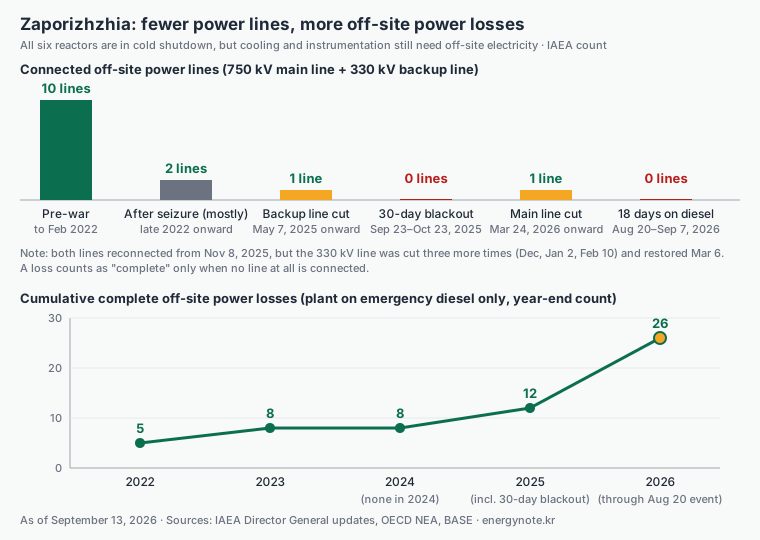
- The plant had 10 off-site lines before the war (four 750 kV, six 330 kV). From March 24, 2026 it had one; on August 20 that one was cut, and the 26th complete loss of off-site power by the IAEA’s count lasted 18 days until the line was repaired on September 7 (as of September 13, 2026).
- The last line of defense is about 20 emergency diesel generators with a required minimum of ten days of fuel, 11 groundwater wells drilled after the Kakhovka dam collapse, and staff who commute to work under drone attack.
1. Why a stopped reactor needs electricity
Shutting down a reactor ends the chain reaction within seconds, but the fission products built up in the fuel keep decaying and giving off heat, called decay heat. According to the World Nuclear Association’s account of the Fukushima accident, a reactor still produces about 1.5 percent of its rated thermal power an hour after shutdown; at Fukushima Daiichi unit 1 that was about 22 MW.
Decay heat falls with time, to a few tenths of a percent of the initial level after several years, but never to zero. The fuel must keep being cooled with water, and the pumps that move the water need electricity. A reactor that has spent years in cold shutdown like Zaporizhzhia’s (shut down, with the coolant held below boiling so the system is not pressurized) carries a much smaller heat load, so a few diesel generators keep it cool and the fuel stock lasts longer, but the need for power does not go away.
Cooling pumps are not the only load.
- Spent fuel pools — Fuel removed from the reactor sits underwater in pools whose circulation and cooling systems run on electricity. At Fukushima, unit 4’s pool held the entire core of 548 fuel assemblies, offloaded for maintenance, and was the accident’s biggest worry. Where that fuel eventually goes is in our piece on the world’s deep repositories.
- Instrumentation, control and communications — Temperature, pressure, water-level and radiation gauges, control-room displays and links to the outside world all need power. With the instruments dark, operators work blind.
- Ventilation and radiation monitoring — The ventilation systems that keep building pressures where they should be, and the radiation monitoring networks on and off site, also need power.
The lesson of Fukushima in 2011 sits exactly here. The March 11, 2011 earthquake cut all six off-site lines, and 41 minutes later a tsunami of about 15 meters (49 feet) flooded 12 of the 13 emergency diesel generators; the one survivor was an air-cooled unit high up at unit 6.
Units 1 to 3, which had been operating, lost all AC power, a condition called station blackout, and their cores melted. The reactors had shut down normally right after the quake; what was missing was the electricity to keep cooling them afterward. The story that followed, through to the treated-water discharge, is in our Fukushima discharge, three years on piece.
2. How Zaporizhzhia gets its power
Zaporizhzhia is Europe’s largest nuclear plant, six reactors of about 1,000 MW each. Russian forces seized it on March 4, 2022, and it has not generated electricity since September 2022. Two names recur below: Energoatom, Ukraine’s state nuclear operator, which ran the plant before the occupation, and Rosatom, the Russian state nuclear corporation, which runs it now.
Before the war, according to the IAEA, the plant had 10 off-site lines: four at 750 kV (kilovolts, an extra-high-voltage transmission level) and six at 330 kV. The table shows the status as of September 13, 2026.
| Line | Voltage | Status | IAEA update |
|---|---|---|---|
| Dniprovska | 750 kV (main) | Cut March 24. Plant-side repairs completed in June under an IAEA-brokered ceasefire, but a substation about 100 km (62 miles) away, damaged in May, cannot carry power to it | July 2, 2026 |
| Ferosplavna-1 | 330 kV (backup, via the switchyard of a nearby thermal power plant) | Cut Aug 20 after military activity north of the river; repaired under the 7th local ceasefire and reconnected Sep 7 at 19:02 | Sep 8, 2026 (IAEA/Energoatom) |
| Other 8 lines | Three 750 kV, five 330 kV | Damaged or cut one by one from the early months of the 2022 occupation, never restored | — |
The 750 kV Dniprovska line is the main tie to Ukraine’s national grid; the 330 kV Ferosplavna-1 line is a backup routed through the nearby Zaporizhzhia thermal power plant. The stretches on a single line have grown longer: the 750 kV line alone from May 7, 2025 (until it too was cut on September 23, starting a 30-day blackout), then the 330 kV line alone from March 24, 2026, for more than five months. In that state a thunderstorm or damage to a switchyard (the equipment that connects and disconnects lines) is enough to take the whole plant off the grid.
3. Timeline of the losses
A “complete loss” here follows the IAEA’s counting rule: no off-site line connected at all, with the plant running on emergency diesel generators alone. One line down while another stays live does not count.
The Ukrainian side (Energoatom) keeps its own tally and announced the August 20 event as the 27th blackout. Its count matched the IAEA’s through the 24th on August 4; on August 8 the line dropped twice in one day, and Energoatom appears to have counted that as two events, one more than the IAEA. That explanation is the author’s inference from comparing the two sides’ announcements, not something either side has stated; the tables below follow the IAEA count, from IAEA updates through September 6, 2026.
2022–2023: five in the first year of occupation, three the next
| Date | Duration | What happened |
|---|---|---|
| Aug 25, 2022 | Restored same day | Fire at the ash dump of the nearby thermal plant cut the last 750 kV line. Energoatom said it was the first time the plant had ever been disconnected from the grid |
| Oct 8, 2022 | About a day | Shelling cut the last 750 kV line; diesels started. Reconnected the evening of October 9 |
| Oct 12, 2022 | — | A substation in Dnipropetrovsk region was hit; second complete loss that October |
| Nov 3, 2022 | About 2 days | 750 kV and 330 kV lines lost together (substation damage off site); restored November 5 |
| Nov 23, 2022 | — | Lost in the wake of attacks on Ukraine’s grid as a whole |
| Mar 9, 2023 | About 11 hours | 750 kV line cut. IAEA counted this as the 6th complete loss |
| May 22, 2023 | — | 7th complete loss |
| Dec 2, 2023 | About 5 hours | A grid fault far from the plant cut the 330 kV, then the 750 kV line. 20 diesels started, then scaled back to 8 |
For 19 months, from December 2023 to July 2025, there was no complete loss, though single lines kept dropping; after the 330 kV line was cut on May 7, 2025 the plant depended on the 750 kV line alone.
2025: a 30-day blackout and the first local ceasefire
| Date | Duration | What happened |
|---|---|---|
| Jul 4, 2025 | About 3.5 hours | 750 kV line cut at 17:37, restored 21:11; 18 diesels started. 9th |
| Sep 23–Oct 23, 2025 | 30 days | 750 kV line cut with the 330 kV backup already down since May. Longest ever. IAEA brokered the first local ceasefire between the two sides for repairs. 10th |
| Nov 8, 2025 | — | 330 kV line reconnected after six months; two-line supply restored (not a complete loss). It was cut three more times, in December, on January 2 and on February 10, repaired each time under a local ceasefire, and reconnected March 6 |
| Dec 6, 2025 | About 30 minutes | Both lines lost at 03:21. 11th |
| Dec 13, 2025 | Over 2 hours | Both lines lost in the wake of military activity across Ukraine’s grid. 12th |
2026: fourteen in eight months
| Date | Duration | What happened |
|---|---|---|
| Mar 24 | — | 750 kV Dniprovska line cut; single 330 kV line from here on (not a complete loss) |
| Apr 14 / 16 / 26 | 90 min / over 2 h / about 60 min | Repeated cuts of the 330 kV line. 13th, 14th, 15th |
| May 28–29 | About 1 hour | Overnight cut, cause not established. 16th |
| Jun 3 / Jun 5–6 | — / about 15 hours | 17th, 18th. Around the time of a May 30 drone strike on a turbine building |
| Jun 10–13 | About 3 days | Damage near the thermal plant’s switchyard. 19th |
| Jun 20 / Jul 3 / Jul 14 | — | 20th, 21st, 22nd. The July 14 cut was caused by a thunderstorm |
| Aug 1 / 4 / 8 | Around an hour each (Energoatom figures) | Three in eight days. 23rd, 24th, 25th |
| Aug 20–Sep 7 | 18 days | 330 kV line cut after military activity north of the river. 26th. Repaired under the 7th local ceasefire (from Sep 5) and reconnected Sep 7 |
In its August 14 update the IAEA noted that 13 of the 25 losses had come in the four months since April. In 2022 lines were physically cut by shelling; in 2026 a single remaining line is exposed to many causes at once, from the thermal plant’s switchyard and substations to thunderstorms, and drops again and again. Energoatom stresses the wear on diesel generators from frequent starts; the IAEA stresses the fragility of depending on one line at all.
4. The last line of defense: diesels, water, people
Emergency diesel generators and fuel
Zaporizhzhia has 20 fixed emergency diesel generators and three mobile ones (OECD Nuclear Energy Agency status page; the IAEA reported 20 started in December 2023 and 18 in July 2025). When off-site power fails, all of them start and the plant then keeps only as many running as cooling requires. According to IAEA figures cited by BASE, Germany’s federal office for the safety of nuclear waste management, 7 of the 19 available units were running as of August 25, 2026.
The problem is fuel. The IAEA puts the required minimum stock at ten days’ worth and, in its August 29 update, the actual stock at about that level. The last delivery to the plant’s main storage was in March 2026, a May delivery was postponed because of military activity, and IAEA staff have been denied access to the fuel storage on security grounds since March 2025.
The time to fuel damage after a total loss of power is far longer for a cold-shutdown reactor than for an operating one, but the IAEA has not published a figure and this article does not estimate one.
On August 27–28 IAEA staff confirmed several tens of metric tons of diesel being moved to the plant from two nearby locations. Plant management (Rosatom) said Ukrainian attacks on the access roads made fuel transport dangerous and resupply difficult; the Ukrainian side had claimed since July that Russia was using the plant for nuclear blackmail. The IAEA attributed the situation to neither side, saying only on September 5 that reserves were running down and the plant could lose all power within days.
Cooling water after the dam
The collapse of the Kakhovka dam on June 6, 2023 drained the Kakhovka reservoir on the Dnipro that had been the plant’s original cooling water source. The plant fell back on its large on-site cooling pond and on groundwater wells drilled that year: 11 wells, by IAEA figures, supplying about 250 cubic meters (66,000 gallons) an hour to the 12 spray ponds that cool the safety systems.
By an IAEA update of February 19, 2026 the cooling pond had fallen more than 3.2 meters (10.5 feet) since the dam collapse, about 60 centimeters (2 feet) of it in the preceding three months. Isolation dikes in the pond’s channels and mobile pumps hold the channel level at about 14.1 meters (46 feet), just over 2 meters (7 feet) above the roughly 12-meter (39-foot) floor below which the pumps cannot draw. The IAEA has consistently said the wells supply enough water for safety functions, but the pond keeps falling year by year.
In July 2026 water failed in a different way. Military activity damaged electrical equipment in Enerhodar, the town where most plant staff live, and on the plant site, cutting the town’s water supply from July 18; even the resident IAEA team had only limited tap water. Well water for reactor cooling did not run short; the drinking water of the town where staff and their families live did.
People: staff whose commute is a front line
What keeps Zaporizhzhia safe, in the end, is staff who keep turning up for their shifts. IAEA updates from the summer of 2026 alone give this picture.
- June 30: a drone hit the fire station in Enerhodar, the backup to the plant’s own fire brigade, damaging the building and several fire engines.
- July 12–14: drone attacks in the town caused casualties including plant staff and contractors; a hospital, the fire station and homes were hit on the 13th and a staff commuter vehicle on the 14th. Rosatom announced around this time that the plant’s chief engineer had been killed by a Ukrainian drone.
- August 18: a drone exploded at a bus stop used by commuting staff, killing one person and injuring 19. On August 25 two staff were injured in a drone incident near the cooling pond, and on the 26th there were two more drone incidents, one near the dry spent fuel storage.
On these events the IAEA repeats its principle that plant staff must be protected at all times, and names no attacker. For each incident Ukraine points to Russian attacks and Russia to Ukrainian drones, and each side usually denies the other’s version.
5. What the IAEA can and cannot do
Seven pillars, five principles
On March 2, 2022, days into the invasion, Grossi gave the IAEA board seven indispensable pillars as the yardstick for nuclear safety in armed conflict: physical integrity of facilities; working safety and security systems; staff able to work and decide free of pressure; secure off-site power; an unbroken supply chain; radiation monitoring and emergency arrangements; and reliable communication with the regulator and operator. An IAEA report in September 2022 judged all seven effectively compromised at Zaporizhzhia.
The same report proposed a nuclear safety and security protection zone around the plant, which the two sides never agreed to. Instead, at the UN Security Council on May 30, 2023, Grossi presented five principles, among them no attacks on reactors or fuel storage, no heavy weapons based at the plant, and off-site power kept available at all times; these remain the minimum the IAEA asks of both sides.
The resident team and local ceasefires
The IAEA Support and Assistance Mission to Zaporizhzhya (ISAMZ), which Grossi led into the plant in person on September 1, 2022, continues as a small team of experts permanently on site. Rotations must cross the front line: in February 2025 a rotation was delayed a month and the team walked part of the way, and Turkey’s Anadolu Agency, citing the Russian-run plant’s press office, reported four new experts arriving at the December 2025 rotation. The team walks the site daily and confirms that radiation levels are normal, but some places, like the diesel fuel storage, are closed to it.
Since October 2025 the IAEA has added local ceasefire brokering: both sides stop firing along the stretch of line under repair while IAEA staff watch from both banks of the river. From the first agreement, which ended the 30-day blackout, to September 5, 2026 there have been seven. A ceasefire makes repairs possible but does not protect the grid: the June ceasefire fixed the plant-side section of the 750 kV line, yet a wrecked substation far away still means no power flows.
In short, the IAEA can record, verify and mediate; it cannot stop attacks or assign blame. Grossi said on September 5 that both sides were cooperating constructively on nuclear safety. The same week Rosatom chief Alexey Likhachev said that repairing the 330 kV line did not guarantee off-site power would resume, and no official Ukrainian response had been confirmed by this article’s as-of date.
6. How Korea’s reactors are prepared
Zaporizhzhia is the extreme case of a war, but the question underneath it, what happens when off-site power is lost, has been put to every reactor since Fukushima. Korea’s government set 50 improvement measures right after the 2011 accident (later expanded to 56), and their implementation is recorded in decisions of the Nuclear Safety and Security Commission (NSSC, Korea’s regulator). How the regulator, the operator and the manufacturers divide the work is in our map of Korea’s nuclear industry.
Power comes in four layers. In May 2014 Korea Hydro & Nuclear Power (KHNP, the state utility that operates all of Korea’s reactors) announced 3,200 kW mobile generator trucks stationed at all four of its sites, Kori, Hanbit, Wolsong and Hanul, completing a four-layer emergency supply: grid lines from KEPCO (Korea Electric Power Corporation, the national grid utility), emergency diesel generators, alternate AC generators and the trucks. The trucks carry air-cooled gas turbines that need no external cooling water; 1 MW trucks were added later, so each site holds both 1 MW and 3.2 MW units (Korean daily Asia Economy, report from Kori unit 2, March 19, 2026).
New reactors are held to a higher bar. The agenda document for the Saeul unit 3 operating license, which the NSSC voted on at its 228th meeting on December 30, 2025 (public on the NSSC site as of September 2026), confirms the following.
- All 33 of the 50 post-Fukushima measures that apply to Saeul 3 are complete, including mobile generator trucks and batteries (item 3-1) and an improved design basis for the alternate emergency diesel generator (item 3-2).
- Beyond the two 7,500 kW emergency diesel generators serving the safety-grade loads (about 7,000 kW per train), the unit has a 7,200 kW alternate AC diesel generator for station blackout, one per unit; the preceding units, Shin-Hanul 1 and 2, shared one between them.
- That generator carries fuel for 72 hours of continuous operation (24 hours at Shin-Hanul 1 and 2), is built to the highest seismic category, and sits 3.45 meters (11 feet) above site grade against flooding.
- The accident management plan lists low- and high-pressure mobile pumps and 1 MW and 3.2 MW mobile generator trucks as in place on site.
That is as far as public documents go. Unit-by-unit figures for operating reactors, such as the number of off-site lines or days of diesel on hand, could not be confirmed from public sources and are not given here. Whether “measure completed” also means “verified in practice” is a separate question, and it is left open.
What Zaporizhzhia shows is less a list of equipment than what a layer means. Ten lines became one; when the last was cut, the diesels, the fuel routes, the wells and the people became the final layers in turn. Korea’s four layers and 72 hours of fuel answer the same question, what comes next, and whether the answers work is something only drills and inspections can show.
Where this goes next
The 330 kV Ferosplavna-1 line came back on September 7 after three days of repairs under the seventh local ceasefire, so the plant is again on a single backup line. Next comes the 750 kV Dniprovska line, which needs the distant substation repaired before it can carry power, and winter, when Ukraine’s grid comes under more strain. The IAEA’s numbered updates remain the reference count, and this timeline will be extended as they arrive.
Sources: IAEA Director General updates on the situation in Ukraine, Update 354 (June 19, 2026), 356 (July 2), 358 (July 15), 359 (July 23), 361 (August 6), 362 (August 14), 363 (August 20), 364 (August 29) the September 5, 2026 local-ceasefire statement and the September 8, 2026 reconnection statement; Energoatom statement on the September 7 reconnection; World Nuclear News, “Zaporizhzhia reconnected to external power after 18 days” (September 8, 2026); IAEA topic page on nuclear safety, security and safeguards in Ukraine (seven pillars, March 2, 2022); IAEA September 2022 report (protection-zone proposal); UN Security Council meeting record SC/15300 (five principles, May 30, 2023); IAEA updates of July 4, 2025 (9th loss), December 6, 2025 (11th), December 13, 2025 (12th), February 19, 2026 (cooling pond level) and April 2026 (13th–15th); OECD/NEA status page on Ukraine’s nuclear facilities (April 24, 2026); BASE (Germany) Ukraine status page (August 25, 2026); World Nuclear Association information pages on the Russia–Ukraine war and on the Fukushima Daiichi accident; World Nuclear News, December 4, 2023, July 7, 2025, October 23, 2025, November 10, 2025, September 1, 2026; Xinhua, May 29, 2026; Kyiv Independent, June 2026; Energoatom statements and Ukrainska Pravda, August 4 and 20, 2026; UNN, August 20 and September 5, 2026; Reuters, July 24, August 29 and September 5, 2026 (carried by Daily Maverick, Al Jazeera, Global Banking and Finance); Arms Control Today, September 2026; Anadolu Agency, December 3, 2025 (IAEA rotation); AP and PBS, October 8, 2022; The Hill, October 12, 2022; Al Jazeera, August 25, 2022; NSSC 228th meeting, Saeul unit 3 operating license agenda document (December 30, 2025); KHNP press release on mobile generator trucks at all sites (May 7, 2014); Asia Economy report from Kori unit 2 (March 19, 2026)