Designing for 100,000 years: the world's deep repositories, from Onkalo to Korea's Gyeongju
Finland's Onkalo cleared its safety review in Aug 2026; the first spent-fuel repository may open soon. Where Sweden, France, the US, Germany and Korea stand.
Data as of October 2, 2026 — statistics, prices, schedules and regulatory status in this article were checked on this date. Where a different date is given in the text, that date takes precedence.
The Great Pyramid of Giza has stood for about 4,600 years, which makes it one of the oldest large structures humans have built. A handful of countries are now building facilities that must stay safe for more than 100,000 years: deep geological repositories for high-level radioactive waste, mostly spent nuclear fuel. Engineering a guarantee longer than recorded history is hard enough.
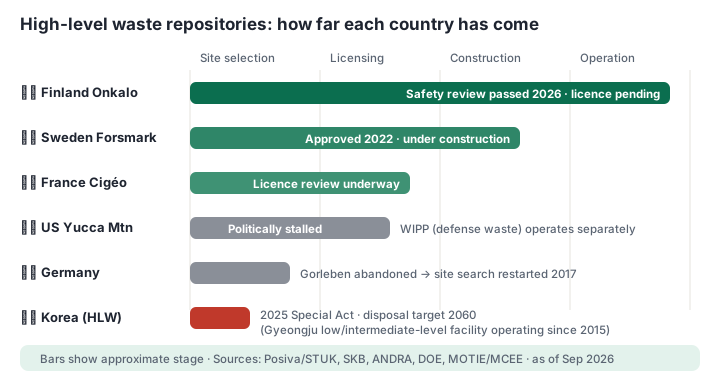
What the scorecard below shows is that the outcomes differ far more by country than by technology.
Key takeaways
- Finland’s Onkalo passed the regulator’s safety review in August 2026 and is one decision away from becoming the world’s first operating spent-fuel repository, with Sweden and France following.
- The United States’ Yucca Mountain and Germany’s Gorleben did not stop on the geology. They stopped on public acceptance and politics, which is where the real difficulty of this business sits.
- Korea has operated a low- and intermediate-level repository at Gyeongju since 2015, but has no site for spent fuel. A 2025 special act finally created the legal process, with targets of 2050 for interim storage and 2060 for disposal.
1. What a deep repository actually is
Every program on this list uses the same basic idea: a multi-barrier system. The waste is sealed in an engineered container, the container is packed in a buffer material such as bentonite clay, and the whole package is placed several hundred meters down in a rock formation chosen because water moves through it very slowly. No single barrier is expected to last forever; each one buys time for the next.
The best-known version is the Finnish-Swedish KBS-3 concept, in which spent fuel goes into a copper canister with a cast-iron insert, surrounded by bentonite, in crystalline granite. France and Switzerland chose clay rock instead of granite.
The United States’ one operating deep repository sits in salt. The rock differs; the principle does not.
2. Finland’s Onkalo: first to the finish line
Finland is the clear leader. The Onkalo repository, built by the waste company Posiva into bedrock about 400 meters below Olkiluoto island on the west coast, is a KBS-3 facility: spent fuel in copper canisters, wrapped in bentonite, placed in granite.
Parliament approved the site in 2001. On August 10, 2026, STUK, Finland’s nuclear regulator, said it saw no obstacle to granting Onkalo an operating licence. The government’s decision is expected in autumn 2026 and is the remaining step before Onkalo can claim the title of the world’s first operating spent-fuel repository.
Finnish experts tend to credit the result less to technology than to trust in the process: decades of transparent site investigation, a host municipality that consented, and political consistency that did not keep postponing the decision.
The technical debate is not closed, though. Independent researchers, notably in Sweden, have argued for years that copper canisters may corrode faster in repository conditions than the safety case assumes. That dispute was one reason Sweden’s approval was delayed, and it is still running.
3. Sweden and France: the second group
- Sweden, Forsmark. The same KBS-3 method as Finland, developed by the waste company SKB. The government approved the repository in 2022 and the project is in the construction stage.
- France, Cigéo at Bure. France reprocesses its spent fuel, so the high-level waste it needs to bury is vitrified waste, a glass form of the fission products left after reprocessing. The plan by ANDRA, the French waste agency, is to place it in a deep clay layer in eastern France, and the licence application is under review. The choice of clay rather than granite is the interesting technical difference from the Nordic programs. Why France reprocesses and Korea does not is covered in our comparison of reprocessing and direct disposal.
4. Two programs a step behind: Switzerland and Japan
These two are not in the chart below, but they are useful reference points for an international reader.
- Switzerland. Nagra, the Swiss waste cooperative, submitted the general licence application for a repository at Nördlich Lägern, north of Zurich, on November 19, 2024. After a completeness check, Nagra filed a revised version in June 2025. The host rock is Opalinus Clay at 800 to 900 meters. Nagra’s own timeline puts a Federal Council decision in 2029, a parliamentary decision in 2030 and a probable national referendum in 2031, with high-level waste emplacement from 2060 (as of September 2026, per Nagra).
- Japan. NUMO, Japan’s waste organization, has run first-stage literature surveys in the town of Suttsu and the village of Kamoenai in Hokkaido since November 2020, in Genkai, Saga Prefecture, since June 2024, and on the remote Tokyo island of Minamitorishima since May 2026. In November 2024 NUMO concluded that Suttsu and part of Kamoenai could move to the second stage, a preliminary investigation with drilling, but that step needs the prefectural governor’s consent and the governors of Hokkaido and Saga have both said they oppose it. As of September 2026 no preliminary investigation had begun anywhere; on August 31, 2026 the industry ministry asked a fifth municipality, the city of Hitachiomiya in Ibaraki Prefecture, to accept a literature survey, and the mayor said he viewed it positively but would consult the city assembly first (Japan Times/Jiji, August 31, 2026).
5. United States: one repository running, one stopped
- WIPP, New Mexico. The Waste Isolation Pilot Plant is a deep repository for defense transuranic waste, not commercial spent fuel. It sits in a salt bed about 650 meters underground and has been in real operation for more than 20 years, with one long interruption: a 2014 radiation release underground halted waste emplacement for about three years before the plant restarted. Salt is attractive as a host rock because it creeps and closes gaps by itself.
- Yucca Mountain, Nevada. Chosen for commercial spent fuel, investigated for decades at a cost of billions of dollars, and now effectively stalled by state opposition and national politics. It is the standard example that the binding constraint on a repository is acceptance, not engineering.
6. Germany: the cost of starting over
Germany investigated the Gorleben salt dome for decades and then, after years of social conflict, abandoned it and restarted the site selection process from zero under a 2017 law.
The country carries an expensive lesson as well. Low- and intermediate-level waste was placed in the former Asse salt mine, groundwater began entering the mine, and Germany is now pursuing retrieval of all of the waste. Asse is the case usually cited for why record-keeping, verification and retrievability matter, as opposed to a policy of bury and forget.
7. Where Korea stands
Korea has to be read in two halves, and several institutions appear in the story.
- KORAD (Korea Radioactive Waste Agency) is the state agency that builds and operates Korea’s disposal facilities and runs the Gyeongju site.
- NSSC (Nuclear Safety and Security Commission) is Korea’s nuclear regulator, the counterpart of the US NRC or Finland’s STUK; it licenses any repository.
- MOTIE (Ministry of Trade, Industry and Energy) drafted waste policy and the special act. Under a government reorganization passed in September 2025, all energy functions except resources and overseas nuclear projects moved on October 1, 2025 to the new Ministry of Climate, Energy and Environment, which now oversees the disposal program and the committee that runs site selection; the trade ministry was renamed the Ministry of Trade, Industry and Resources.
- KHNP (Korea Hydro & Nuclear Power) is the state utility that operates all Korean reactors and stores the spent fuel on its plant sites in the meantime.
Low- and intermediate-level waste: Gyeongju, operating since 2015
The Gyeongju repository on the southeast coast has been operating since 2015. It disposes of low- and intermediate-level waste in engineered caverns excavated in bedrock 80 to 130 meters below ground, the same family of facility as Sweden’s SFR. In that sense Korea is already a repository-operating country, but for the lower categories of waste only.
High-level waste: a law, targets, and no site
For spent fuel Korea has no repository and no chosen site. The High-Level Radioactive Waste Special Act, passed in February 2025 and in force since September 26, 2025, created the legal framework for site selection for the first time, including the procedure for finding a volunteer community. The act’s targets are an interim storage facility by 2050 and a disposal facility by 2060.
That leaves a gap of roughly 30 to 40 years behind Onkalo, and through that period spent fuel stays in pools and dry casks inside the reactor sites. The at-reactor storage problem, and the argument over whether Korea should reprocess instead, is the subject of our reprocessing-versus-disposal piece; what happens to a Korean reactor at the other end of its life is in our Kori-1 decommissioning tracker.
8. The scorecard in one table
Stage of each national program for high-level waste, as of September 2026.
| Country | Site / rock | Stage |
|---|---|---|
| Finland | Onkalo, granite (KBS-3) | STUK saw no obstacle to a licence (Aug 10, 2026); government decision expected autumn 2026 |
| Sweden | Forsmark, granite (KBS-3) | Government approval 2022; construction |
| France | Cigéo, Bure, clay | Licence application under review |
| Switzerland | Nördlich Lägern, Opalinus Clay | General licence application filed November 2024; referendum expected 2031 |
| US | Yucca Mountain, tuff | Stalled; WIPP (salt) operates separately for defense waste |
| Japan | Suttsu, Kamoenai, Genkai, Minamitorishima | Literature surveys only; Hitachiomiya asked August 2026 |
| Germany | Gorleben abandoned | Site selection restarted 2017 |
| Korea | No site | Special Act 2025; targets 2050 interim storage, 2060 disposal |
Where this goes next. The next dated marker is the Finnish government’s operating licence decision for Onkalo, expected in autumn 2026, which would turn a 25-year program into the first working example the rest of the world can point to. In Korea, the things to watch are the High-Level Radioactive Waste Management Committee, launched in October 2025 when the act took effect and now drafting the criteria for excluding unsuitable areas, the first call for volunteer communities, and whether the 2050 interim storage date holds as at-reactor pools fill up.
The copper corrosion argument is worth following too; if it gains ground, it affects Finland and Sweden alike.
Industry note. A repository is a decades-long civil engineering and nuclear project. If Korea’s high-level program moves from law to site, the domestic companies with the relevant roles are KEPCO E&C (KRX: 052690) in design, Doosan Enerbility (KRX: 034020) in canisters and equipment, and radiation management specialists such as Orbitech (KOSDAQ: 046120); the wider decommissioning and back-end value chain is mapped in our Korean guide to decommissioning stocks (in Korean). The timeline for any revenue from this program is measured in decades.
This section is provided to help understand the industry and is not a recommendation to buy or sell any security. Investment decisions and their consequences are the reader’s own.
Sources: STUK and Posiva, Onkalo safety assessment and operating licence process (2026); ANS Nuclear Newswire, “Onkalo SNF repository passes safety assessment” (August 10, 2026); IAEA, status of geological disposal programs; SKB, Forsmark repository approval (2022); ANDRA, Cigéo licence application; Nagra, general licence application for Nördlich Lägern (November 2024) and project timeline; NUMO and World Nuclear News, literature surveys in Suttsu, Kamoenai and Genkai (2020–2024); Nippon.com, Japan’s repository site search (January 2025); The Japan Times, Hitachiomiya survey request (August 31, 2026); The Japan Times, Minamitorishima literature survey (May 21, 2026); Ministry of Climate, Energy and Environment, press release on the High-Level Radioactive Waste Management Committee (May 15, 2026); Nagra, “Facts about the general licence application” (2025); US Department of Energy, WIPP operating history; Germany’s Site Selection Act (2017) and BGE, Asse retrieval; KORAD, Gyeongju repository; Korea, High-Level Radioactive Waste Special Act (2025); Shin & Kim / Lexology, establishment of the Ministry of Climate, Energy and Environment (September 2025).