Will a Korean reactor be built in America? What the US-Korea nuclear package says, and what it does not
Up to $120 billion for eight US reactors, two of them Korean APR1400s: what Washington and Seoul agreed, what is still unsigned, and what to watch by year-end.
Data as of October 2, 2026 — statistics, prices, schedules and regulatory status in this article were checked on this date. Where a different date is given in the text, that date takes precedence.
Eight reactors and up to $120 billion make the headline. The number that matters more is zero: as of October 2, 2026, no specific site, owner, construction contract or power buyer has been confirmed for any of them. What exists is a framework, and Korea’s own industry minister has said it does not mean the projects proceed immediately.
The framework was announced on September 30 in Washington, which was October 1 in Seoul. It covers six Westinghouse AP1000 reactors and up to two Korean APR1400s. This article separates what the two governments and the companies have put in writing from what is still being negotiated.
Commerce and Korea’s Ministry of Trade, Industry and Resources issued a joint statement on September 30. Sources disagree on whether the participants have signed the framework itself (ANS calls them signatories; the Korea Herald said they were expected to sign), and both Brookfield and Cameco call its terms non-binding.
Key takeaways
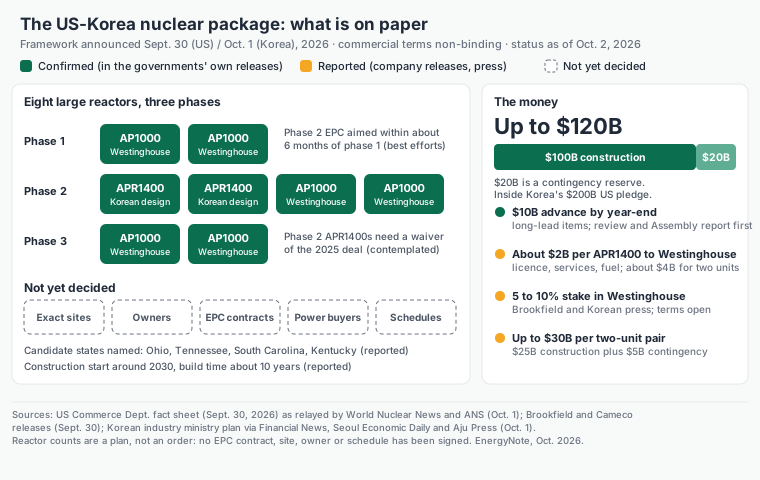
- The framework earmarks up to $120 billion ($100 billion for construction, $20 billion for contingency) from Korea’s $200 billion US investment pledge to eight large reactors, in three phases. Brookfield and Cameco, Westinghouse’s owners, both say the transaction terms are non-binding and subject to final negotiations.
- The two APR1400s depend on a waiver of the January 2025 Westinghouse settlement that Cameco says the framework “contemplates,” with compensation to Westinghouse of about $2 billion per unit, according to Cameco. A US owner would still need NRC licensing for a specific site, and I found no application that references the design.
- Not yet decided: exact sites, owners, who buys the power, construction contracts and schedules. The first hard tests are a $10 billion advance planned by year-end and Poland’s AP1000 contract, also targeted for year-end.
1. What was announced
The US Commerce Department described the package as “Project Power,” one of three Korean investment projects released together, according to World Nuclear News and ANS. The others are a $22.3 billion gas plant in Encinal, Texas, and an Alaska LNG pipeline that Seoul says is still under review. Nuclear is by far the largest piece, roughly 60 percent of Korea’s $200 billion ceiling.
The plan runs in three phases, per Cameco and Korean outlets: two AP1000s first, then two APR1400s with two more AP1000s, then two final AP1000s. The US side says the eight units serve President Trump’s goal of 10 large reactors under construction by 2030.
Money comes from a joint investment fund. Under the fund’s general terms, as reported by Aju Press, the Korea Herald and the Korea Times, project cash flows split 50:50 until Korea recovers its principal plus interest, after which the US side receives 90 percent. Korea’s investments across the whole fund are capped at $20 billion a year.
Two details are worded differently by source. Brookfield and Cameco say the reactors would sit on federal sites designated by the US government, and Brookfield describes a “cornerstone” Korean equity investment of between 5 and 10 percent in Westinghouse. The joint US-Korean statement is vaguer: Korean companies will pursue a “significant minority interest,” with terms left to commercial negotiation. Korean press, citing the ministry, also reports a combined stake of at least 5 but below 10 percent.
2. What is still unsigned
Trade and Industry Minister Kim Jung-kwan said on September 27, as reported by Asia Today and translated by UPI, that the framework does not mean the projects will proceed immediately, and he repeated the point at the ministry’s October 1 briefing. Each project must first pass a commercial-reasonableness review and National Assembly procedures.
- Construction contracts. No engineering, procurement and construction (EPC) contract exists. The two sides agreed to make “reasonable efforts” to sign the phase 2 EPC within six months of phase 1, which is not a deadline.
- Sites. Commerce Secretary Howard Lutnick named Ohio, Tennessee, South Carolina and Kentucky, without saying how many units go where or where the APR1400s would sit. JoongAng Daily listed only the first three, so treat the list as candidates.
- Owners and power buyers. Seoul Shinmun reported that who will buy the electricity is undecided, and the ministry acknowledged investment risk from that gap.
- Schedule. Korea’s Financial News reported a target of construction starting around 2030 and taking about ten years.
- The Westinghouse stake. Buyers, percentage and price are open. Korea originally sought 15 to 20 percent with a board seat, according to The Korea Herald (September 17), and the JoongAng Daily reported Washington remained cautious.
One more caveat: sources disagree on whether the waiver is finished. Cameco’s release says the framework “contemplates” it, while Seoul Economic Daily reported on September 22 that Korea and the US had agreed to amend the settlement to allow up to two APR1400s in strategic-investment projects; its English summary says the government “plans to revise” it. The text of any amendment is not public.
3. Why the APR1400 needed an exception
The settlement
The APR1400 descends from Combustion Engineering’s System 80+, a design Westinghouse absorbed in 2000, a lineage covered in the APR1400 design history. Westinghouse sued KEPCO and KHNP in October 2022, arguing the design contained its technology. A US district court dismissed the case in September 2023 on narrow grounds, finding Westinghouse had no private right to enforce US export-control rules, and Westinghouse said it would appeal while an arbitration continued.
On January 16, 2025, the parties announced a confidential global settlement. KEPCO is Korea’s state utility and KHNP its state nuclear operator.
The terms reported since, by The Korea Herald and others citing unnamed sources, have never been confirmed by the companies. They bar Korean bids in North America and several other markets, and require about $650 million in Westinghouse goods and services plus $175 million in fees per exported reactor, over 50 years. That market list lines up with KHNP’s withdrawals from four European bids in 2024 and 2025, which the export record tracks.
What the waiver changes
Under the framework, up to two APR1400s may be built in the US, reportedly only in projects financed through Korea’s investment fund. Cameco puts the compensation at about $2 billion of value per unit, a figure World Nuclear News’s account of the Commerce announcement also carries, delivered through licensing, engineering and procurement services, subcontracting and long-term fuel fabrication. Korean press reports it as roughly $4 billion for the pair.
That is more than double the reported standard terms of about $825 million per unit, but the packages differ in what they include, so the comparison is mine and not an official one.
What a US owner would still need
The NRC certified the APR1400 design in a rule effective September 19, 2019, codified in 10 CFR Part 52, Appendix F, and its 2025 rule extended every certification to 40 years. A certification lets an applicant reference the design instead of re-arguing it. It authorizes no plant.
An owner would still need a combined license under Part 52, or a construction permit and then an operating license under Part 50, plus site-specific safety and environmental reviews. NRC’s APR1400 page lists no application that references the design, and I found no report of one. How the “federal sites” language interacts with NRC licensing is not explained in the documents I could open.
4. Who does what
- Westinghouse. Owned about 51 percent by Brookfield and 49 percent by Cameco, per SBS reporting of the owners’ statements. It supplies the AP1000 design, and Brookfield says it receives an upfront payment, guaranteed scope on the APR1400 units and a fuel-fabrication contract.
- KEPCO and KHNP. Named as participants in the framework; reports differ on whether they have signed. KEPCO said it would manage “economic viability and business risks” with government and domestic companies, according to Herald Business.
- Korean builders. Korean press expects a “Team Korea” turnkey EPC with Hyundai E&C, Samsung C&T and others. Nothing has been awarded.
- Doosan Enerbility. Korea’s reactor-vessel maker has supplied AP1000 vessels and steam generators for Vogtle, V.C. Summer and Chinese units, plus APR1400 components, according to Econovill. The ministry cited lead times of 54 months for reactor vessels, 57 for steam generators and 65 for coolant pumps, which is why long-lead orders come first.
- US government. The Department of Energy offered $17.5 billion in conditional loan support in June 2026 for long-lead equipment for up to 10 AP1000s, per UPI and Brookfield’s release.
5. The money and the Vogtle yardstick
The ministry plan, as reported by Aju Press, caps each two-unit pair at $30 billion: $25 billion of construction plus $5 billion of contingency. Up to $10 billion is to be advanced by year-end for long-lead items, but only after a commercial-reasonableness review and a report to the National Assembly.
The benchmark critics cite is Vogtle in Georgia. Its two AP1000s were first estimated at about $14 billion, entered service on July 31, 2023 and April 29, 2024, and cost about $35 billion by the Associated Press’s tally (POWER magazine puts it nearer $36 billion), seven years late. Westinghouse itself filed for bankruptcy in 2017 after the project’s costs ballooned, Canary Media noted.
My arithmetic: six AP1000s at about 1,110 MWe and two APR1400s at 1,400 MWe total about 9,460 MWe, so $100 billion is roughly $10,600 per kilowatt before contingency. Vogtle’s total is about $15,700 per kilowatt, though it includes financing and an overnight budget does not.
Korea’s own reported APR1400 budgets sit near $2,300 to $3,100 per kilowatt. The US budget assumes a very different cost environment.
The financing risk is allocation, not only size. The Korea Herald reported before the announcement that Seoul wanted profits and losses netted across the whole portfolio while Washington preferred project-by-project settlement, and the published fund terms do not say how that was resolved. President Lee Jae-myung has stressed that commercial feasibility must be confirmed project by project.
6. What critics and supporters say
Korean concerns. In August 2025, after the settlement terms leaked, Democratic Party lawmakers and critics called the deal a “slave contract” that surrendered nuclear sovereignty, according to Korean press coverage of the time. Korean reports of the roughly $4 billion compensation, as summarized by BigGo Finance, raise the worry that little business is left for Korean firms. On the Westinghouse stake, Professor Chung Bum-jin told Aju Press that investing “won’t give us a level where we can secure management control.”
Korean supporters. KHNP called the entry recognition of Korean capability and an asset for third-country bids. Choi Sung-min, president of the Korean Nuclear Society, called it a possible bridgehead for more units, per Seoul Economic Daily.
US concerns. Cost comes first. Canary Media reported in March that an industry source called overruns the bigger problem and that utilities want federal overrun insurance. The Korea Herald also reported that Westinghouse and some US officials resisted including the Korean design, and an industry official quoted by the paper said it would mean fewer contracts for American companies.
Enrichment and proliferation. A separate track exists. A November 2025 White House fact sheet said Washington supports a process toward Korean civil enrichment and reprocessing, which arms-control analysts say raises proliferation risk. None of the framework documents I opened mentions enrichment, so I treat the two as unlinked.
7. Status at a glance
Status as of October 2, 2026.
| Item | What is reported | Source | Status |
|---|---|---|---|
| Size | Up to $120B: $100B build, $20B reserve | Commerce, via WNN | Announced |
| Reactor mix | 6 AP1000, up to 2 APR1400 | Commerce, Cameco | Announced |
| IP waiver | One-time, up to 2 APR1400 | Cameco, Seoul Econ. Daily | Reported |
| Westinghouse pay | About $2B per APR1400 | Cameco, WNN | Reported |
| Stake | “Significant minority” (joint statement); 5% to 10% (Brookfield, Korean press) | Brookfield, Korea Herald | Reported |
| Advance | Up to $10B by year-end | Korean ministry | Announced |
| Sites | Four states named | Lutnick, ANS | Reported |
| Contracts, owners | None signed or named | Korean ministry | Not decided |
8. What to watch in the next 90 days
- By December 31: the $10 billion advance. Watch whether the Assembly report and the commercial review happen, and which long-lead items are ordered.
- Q4: Korea’s validation work. Korean reports say the government will review specific US project proposals, with validation work in the fourth quarter. Korea’s go or no-go decisions follow those proposals. The first named site and owner would be the real news.
- The Westinghouse stake. A percentage, price and named Korean buyers would settle the largest open question.
- November: Dukovany supplier tender. KHNP and project owner Elektrárna Dukovany II plan to launch the first Czech tender, for auxiliary equipment and materials, with more than 60 Czech firms qualified, according to oEnergetice.cz. It is not a reactor tender, but it is an early test of the same Korean team’s supply-chain plan for the fixed-price Dukovany contract, where construction has not yet started.
- By end-2026: Poland’s AP1000 EPC. Westinghouse-Bechtel and PEJ agreed main commercial terms on September 23, with the rest to be finalized by year-end. It tests Westinghouse’s capacity and price at the same moment as the US plan.
Where this goes next
The contractual bar on Korean reactors in the US is on its way to being lifted for two units, but the larger question is open: will any utility sign for the power at Vogtle-era costs? The Barakah record suggests the Korean team’s edge is repeat building, and a first US unit would be a first build again. I would not call this an order until a named owner signs an EPC contract.
Industry note
Korean companies named in the framework coverage include KEPCO (KRX: 015760), Doosan Enerbility (KRX: 034020), Hyundai E&C (KRX: 000720) and Samsung C&T (KRX: 028260). Westinghouse is owned by Brookfield Renewable (NYSE: BEP) with institutional partners (51%) and Cameco (NYSE: CCJ, 49%). KHNP and Westinghouse are unlisted.
This section is provided to help understand the industry and is not a recommendation to buy or sell any security. Investment decisions and their consequences are the reader’s own.
Sources: US Department of Commerce fact sheet on Korea-US strategic investment projects (Sept. 30, 2026) as relayed by World Nuclear News (Oct. 1, 2026) and ANS Nuclear Newswire (Oct. 1 and Sept. 22, 2026); Brookfield Asset Management release (8-K exhibit, Sept. 30, 2026); Cameco release (Sept. 30, 2026); Westinghouse release on the Polish EPC terms (Sept. 23, 2026); World Nuclear News on the Westinghouse court dismissal (Sept. 2023) and the settlement (Jan. 2025); US NRC, APR1400 design certification page; Federal Register, APR1400 rule (May 22, 2019) and design-certification duration rule (effective Sept. 15, 2025); Seoul Economic Daily (Sept. 22, 23 and Oct. 1, 2026); UPI, translating Asia Today (Sept. 27 and Oct. 1, 2026); The Korea Herald (Sept. 17, 2026); Korea JoongAng Daily (Oct. 1, 2026); The Korea Times (Oct. 1, 2026); Aju Press (Oct. 1, 2026); SBS and SBS Biz (Sept. 30 and Oct. 1, 2026); Financial News, Herald Business, Econovill, Seoul Shinmun and other Korean-language coverage (Oct. 1 and 2, 2026); BigGo Finance (Sept. 2026); NucNet (Oct. 1, 2026); Canary Media (Mar. 13, 2026); oEnergetice.cz (Sept. 16, 2026); WRDW on Vogtle Unit 4 (Apr. 29, 2024); Arms Control Association (Dec. 2025); US-Korea joint statement of Sept. 30, 2026 as relayed by JoongAng Daily and the Korea Herald (Oct. 1, 2026); Associated Press tally of Vogtle costs via WRDW (Apr. 29, 2024); POWER magazine on the Polish EPC terms and Vogtle cost.