Superhero radiation scorecard — Hulk, Fantastic Four, Daredevil and friends graded by a radiation-protection yardstick
Hulk's gamma bomb, the Fantastic Four's cosmic rays, Daredevil's eyes, Doctor Manhattan's glow: six superhero radiation origins scored against real science.
Data as of September 3, 2026 — statistics, prices, schedules and regulatory status in this article were checked on this date. Where a different date is given in the text, that date takes precedence.
Superheroes are everywhere this season. In May, Netflix released The WONDERfools, a comedy about ordinary neighborhood misfits in 1999 who stumble into superpowers, and Spider-Man: Brand New Day, in theaters since late July, has passed 8 million admissions in South Korea. In our previous post we took apart Spider-Man’s “radioactive spider,” and that raised an obvious question about everyone else.
More heroes owe their powers to radiation than you might think. Below, six of them are graded one by one from a radiation-protection point of view. The short version: every one of them fails as a superpower origin, but two origin stories hide a piece of real science.
Key takeaways
- Hulk’s gamma-bomb exposure would in reality be an acute dose of tens of grays — acute radiation syndrome, not a transformation. Score: 0 out of 10.
- The Fantastic Four’s cosmic rays and Daredevil’s eye injury are the two premises that hold up: astronaut exposure in space and protection of the eye lens are real radiation-protection topics.
- The common thread across all six is that radiation is something to be managed, not a source of powers.
1. The scorecard at a glance
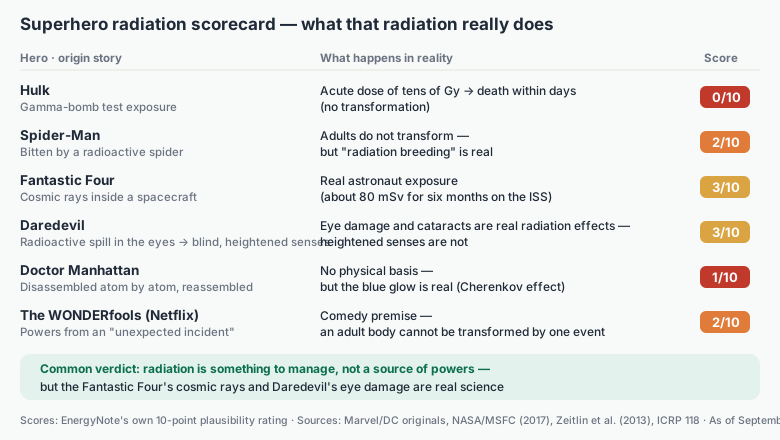
Scores are this blog’s own, on a 10-point scale for how much real radiation science survives in each origin story. A star marks the two premises that contain genuine science.
| Hero | Origin radiation | What that dose really does | Score |
|---|---|---|---|
| Hulk | Gamma rays at a gamma-bomb test | Acute dose of tens of Gy: vomiting within hours, death within days; no transformation | 0/10 |
| Spider-Man | Bite from a radioactive spider | Adults do not transform; but “radiation breeding” of better organisms is real | 2/10 |
| Fantastic Four | Cosmic rays inside a spacecraft | Astronaut exposure is real: about 80 mSv for six months on the ISS | 3/10 ★ |
| Daredevil | Radioactive material splashed in the eyes | Eye damage and cataracts are genuine radiation effects; no heightened senses | 3/10 ★ |
| Doctor Manhattan | Disassembled atom by atom, then reassembled | No physical basis; but the blue glow is real (Cherenkov effect) | 1/10 |
| The WONDERfools | An “unexpected incident” | Comedy premise; an adult body cannot be restructured by one event | 2/10 |
Two units appear in the table. The gray (Gy) measures energy absorbed per kilogram of tissue and is used for the large, acute doses that cause direct injury; the sievert (Sv, and its thousandth, the millisievert) is the weighted dose used for everyday and occupational exposure.
2. Hulk — gamma-bomb test exposure (0/10)
In the 1962 original, Dr. Bruce Banner is caught in the blast at a gamma-bomb test site, absorbs a massive dose of gamma rays and becomes the Hulk. In reality, gamma exposure near a nuclear detonation sits in the top row of a threshold-dose table (20 Gy and above): an acute dose of tens of grays. That is the territory of acute radiation syndrome — vomiting within hours, death within days — not transformation.
Gamma rays do not turn skin green and do not build muscle. The most famous hero on the list has to get the harshest score.
3. Spider-Man — radioactive spider (2/10)
As our previous post explained, an adult organism is not transformed by radiation, and the mutations radiation does cause are random. The two points are for the idea underneath: using radiation to produce a better organism does exist, as radiation breeding — except that it works by selecting from thousands of individuals in the next generation.
4. Fantastic Four — cosmic rays inside a spacecraft (3/10) ★ real science
In the 1961 original, four people fly a spacecraft into space, are exposed to cosmic rays and come back with powers. The powers are fiction, but cosmic radiation itself is one of the largest real obstacles to human spaceflight.
Outside the protection of Earth’s magnetic field and atmosphere, radiation levels climb steeply. An astronaut spending six months on the International Space Station (ISS) receives roughly 50–160 mSv depending on solar activity, typically around 80 mSv — 25 to 30 years’ worth of the annual natural background dose in Korea (about 3 mSv). A Mars round trip is about 660 mSv for the transit legs alone (measured by the Curiosity rover’s detector) and is expected to exceed 1 Sv once time on the surface is included, which is why space agencies manage it through shielding design and mission-length limits.
The cosmic radiation we pick up on an airline flight is a very shallow taste of the same thing. The Fantastic Four got radiation wrong, but their premise — go to space and you receive a lot more radiation — was right. Our post on what Artemis crews face in space radiation goes through the numbers in detail.
5. Daredevil — radioactive material in the eyes (3/10) ★ real science
Young Matt Murdock is blinded when radioactive material spilling from a truck splashes into his eyes, and gains heightened senses instead. The senses are fiction, but the premise that the eye is vulnerable to radiation is correct. The lens of the eye is a highly radiosensitive tissue — so much so that the ICRP (International Commission on Radiological Protection, whose recommendations underlie most national radiation rules) lowered its cataract threshold to 0.5 Gy — and radioactive material in direct contact with the eye also damages the cornea and conjunctiva.
The reason radiation workers wear protective eyewear is, in effect, written into Daredevil’s accident scene.
6. Doctor Manhattan — disassembled atom by atom (1/10)
In Watchmen, Jon Osterman is trapped inside an “intrinsic field” test chamber, taken apart at the atomic level, and reassembles himself into a blue-glowing, godlike being. There is no physical basis for any of that. The single point has an entertaining reason: the blue light that radiation produces in water is real.
It is called the Cherenkov effect, and it is the same phenomenon that makes a reactor’s spent-fuel pool glow blue. Doctor Manhattan’s blue body may well have borrowed that image.
7. The WONDERfools — powers from an “unexpected incident” (2/10)
Netflix’s action comedy The WONDERfools (released May 2026) is built on ordinary neighborhood residents who gain powers through an “unexpected incident.” Whether the cause is radiation or not, a fully grown adult whose body is restructured by a single event is biologically impossible, as a look at how cells repair DNA shows. It is a comedy, so the premise gets a pass; the two points are for the message that even a bunch of misfits can become heroes.
8. Final grades
The six share a single conclusion: radiation is something to be managed, not a source of superpowers. This imagination, born of Cold War nuclear fear, has dominated popular culture for 60 years. In the meantime, radiation science became the everyday technology that sets exposure limits for astronauts, protects workers’ eyes and develops new plant varieties with radiation.
If you can watch a movie and laugh at “how many points does that origin get?”, that is radiation literacy. For the other end of the dose ladder — how small everyday doses are — see our post on the banana equivalent dose.
Sources: NASA/MSFC, “Space Faring: The Radiation Challenge” (2017); Curiosity RAD measurements (Zeitlin et al., Science, 2013); ICRP Publication 118 (lens-of-the-eye threshold); Marvel Comics, Incredible Hulk #1 (1962), Fantastic Four #1 (1961), Daredevil #1 (1964); DC Comics, Watchmen (1986); Netflix, The WONDERfools (released May 15, 2026)