Would a radioactive spider bite give you powers? A radiation-protection scorecard for Spider-Man
A radioactive spider bite made Spider-Man in 1962. What radiation really does to DNA, why a mutation cannot hand out powers, and the crops it actually built.
Data as of September 2, 2026 — statistics, prices, schedules and regulatory status in this article were checked on this date. Where a different date is given in the text, that date takes precedence.
Spider-Man: Brand New Day swept Korean theaters in the summer of 2026, passing 8 million admissions and becoming the biggest hit of the Tom Holland series. Its origin story is older than most of its audience. In the 1962 comic, Amazing Fantasy #15, high-schooler Peter Parker is bitten at a science exhibit by a spider that had been exposed to radioactivity, and walks out with superpowers.
The 2002 film swapped in a “genetically engineered” spider, but the formula — radiation, then mutation, then powers — has been fixed in popular culture for more than sixty years. This post takes the premise seriously from a radiation-protection viewpoint and grades it claim by claim. The verdict does not end at “impossible”; there is a twist.
Key takeaways
- A finished body does not transform under radiation. DNA damage is repaired, or the cell dies, or in the worst case a surviving mutated cell becomes the seed of a cancer.
- Radiation mutation is a random dice roll. It does not select useful traits, let alone a matched set of strength, senses, wall-climbing and webbing.
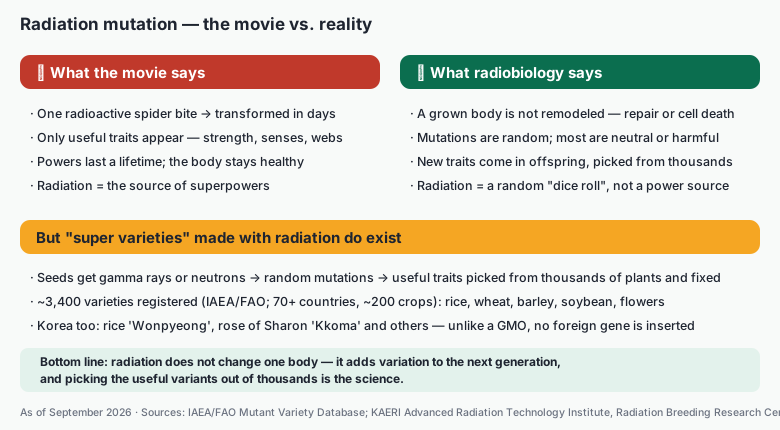
- Radiation has produced “super” organisms for real — about 3,400 registered crop varieties, Korean rice and rose of Sharon cultivars among them — by rolling the dice in seeds and picking winners in the next generation, not by remodeling one individual.
1. The scorecard
Four claims sit underneath the radioactive-spider premise. Here is each one next to what radiobiology says happens (details in the sections that follow).
| Claim | What the movie says | What radiation actually does |
|---|---|---|
| Transformation | One bite, one person changes within days | A grown body is not remodeled; damaged cells are repaired or die |
| Selection | Only useful abilities appear | Mutations land at random; most are neutral or harmful |
| Health | Powers last a lifetime, body stays well | A surviving mutated cell is a cancer risk, not a power |
| Role of radiation | The source of superpowers | A dice roller; new traits are selected in the next generation |
Four fails on the movie’s own terms, though, as section 4 shows, one of them is half right in a way the movie never intended.
2. A grown organism does not transform under radiation
That radiation damages DNA is true. What that damage does inside an adult body, however, is the opposite of a superpower.
- Most damage is repaired. Our cells experience tens of thousands to a million DNA damage events a day without any radiation, and fix them. Damage caused by radiation goes to the same repair machinery.
- Cells that cannot be repaired die. What an acute, high-dose exposure produces is not transformation but the collapse of rapidly dividing tissues such as bone marrow and the gut lining — the deterministic effects of radiation, which appear only above a threshold dose.
- A mutated cell that survives is the seed of a cancer, not a power. This is why cancer is a stochastic effect of radiation — an effect whose probability, rather than its severity, rises with dose.
The decisive problem comes before any of that. Peter Parker’s body is already complete, built from tens of trillions of cells. If a bite mutates a few cells on the back of his hand, there is no pathway for that change to spread through the body and rewrite the structure of his muscles, eyes and palms all at once.
An organism’s traits are laid down during development, following the blueprint in its genome. A finished body is not remodeled in real time.
3. Mutation is a dice roll
Grant the movie every concession and suppose the spider’s genes somehow moved into a human (in reality, a spider bite does not transfer genes). The nature of radiation mutation still stands in the way.
Radiation does not choose where in the DNA to act, or how. It breaks strands at random, and the breaks are rejoined at random. The overwhelming majority of the resulting changes do nothing (neutral), break something (harmful), or, very rarely, happen to be useful.
Getting a matched set of useful traits — strength, senses, wall-climbing and webbing — is not like hitting six lottery numbers once. It is like winning the lottery thousands of times in a row.
What dose would the bite deliver?
A side question, but the one a radiation-protection reader asks first: how much radiation would Peter actually have received from a radioactive spider? A single spider can carry only a trace of radioactive material, so the local dose at the bite would be, in practice, too small to measure. Forget superpowers; even the bite mark would not be radiation’s doing.
For a sense of how small “too small to measure” is, our post on the banana equivalent dose walks through the everyday end of the dose scale.
4. The twist: radiation has built “super” varieties for real
Here is the reversal. Using radiation-induced mutation to make stronger organisms has been going on for close to a century. The method is the movie’s premise turned inside out.
The technique, called mutation breeding, irradiates seeds or pollen with gamma rays or neutrons to trigger random mutations. Breeders then grow thousands to tens of thousands of plants, keep only those in which a useful trait happens to appear — disease resistance, short stature, higher yield, a new flower color — and fix it over several generations. Radiation’s only job is to roll the dice more often; the selecting is done by people.
- About 3,400 varieties made this way are registered in the database maintained jointly by the International Atomic Energy Agency (IAEA) and the UN Food and Agriculture Organization (FAO), from more than 70 countries and some 200 crops: wheat, rice, barley, soybean, peanut and ornamental flowers.
- Korea has its own. The Radiation Breeding Research Center at the Advanced Radiation Technology Institute of KAERI (Korea Atomic Energy Research Institute, the national nuclear R&D institute), located in Jeongeup in southwestern Korea, is the domestic hub for the field. Its varieties include the rice ‘Wonpyeong’, the soybean ‘Josaengseori’, the rose of Sharon (mugunghwa, Korea’s national flower) cultivars ‘Kkoma’ and ‘Baekseol’, and the orchids ‘Dongi’ and ‘Eunseol’.
- One common confusion: mutation breeding is not the same as a GMO, which inserts a foreign gene. It only speeds up the random mutation that also happens in nature, which is why the EU and most other countries leave it outside GMO regulation (with exceptions such as Canada, which regulates by trait rather than by method).
So the sentence “radiation makes super organisms” is half right — not by transforming one individual, but by picking a one-in-thousands stroke of luck out of the next generation. To make a Spider-Man, you would not get bitten by a spider. You would raise tens of thousands of spiders and look for the odd offspring.
5. Godzilla, the Hulk and Spider-Man
The lineage of radiation monsters starts with Godzilla in 1954 (nuclear tests) and runs through the Hulk (gamma rays), Spider-Man (a radioactive spider) and the Fantastic Four (cosmic radiation). It is the imagination of the Cold War’s nuclear fear.
Sixty years on, we know far more precisely what radiation can and cannot do. It does not hand out superpowers or make monsters, but it can roll the dice in a seed and produce a better rice plant. Enjoy the movie as a movie; file the science like this.
Where this goes next
A companion scorecard grading the other radiation heroes — the Hulk, the Fantastic Four and the rest — follows. For the real doses behind the comic-book premises, see how much cosmic radiation the Artemis II crew received beyond Earth’s magnetic field, and for the other end of the scale, the radon-spa hormesis debate, where small doses are marketed as good for you.
Sources: IAEA/FAO Mutant Variety Database; KAERI Advanced Radiation Technology Institute, Radiation Breeding Research Center, variety records; standard radiobiology references; Marvel Comics, Amazing Fantasy #15 (1962)