The 2026 SMR licensing map: who is actually where, from design approval to first power
Ranked by licensing stage, not press releases: only China and Russia run SMRs, the US and Canada are pouring concrete, and Korea's i-SMR is on the first rung.
Data as of October 2, 2026 — statistics, prices, schedules and regulatory status in this article were checked on this date. Where a different date is given in the text, that date takes precedence.
Who actually leads in SMRs? Ask three people and you get three answers: NuScale, the only SMR developer with an NRC design approval; China, which is building the world’s first land-based commercial SMR; or, counting hyperscaler contracts, Oklo and Kairos. None of the three is wrong. They are just measured with different rulers.
So this article fixes the ruler. The licensing stage a reactor must pass before it can sell electricity is the one measure that, unlike an announcement or a memorandum, is hard to walk back. Our Korean explainer covers what an SMR is (in Korean).
Key takeaways
- Only two SMRs are operating anywhere: Russia’s Akademik Lomonosov and China’s HTR-PM. The West has zero.
- The Western front line is “construction permit granted, concrete poured”: TerraPower’s Natrium, Ontario’s Darlington BWRX-300, and Kairos Hermes.
- Korea’s i-SMR is on the first rung (Standard Design Authorization review under way, filed February 2026). Its 2028 approval target has almost no slack.
1. The ruler first: what a licensing stage guarantees, and what it does not
The ladder has six rungs, from the bottom: design under review → design approved → construction permit → under construction → commissioning → operating. Up to design approval you have a reactor on paper; money and concrete start with the construction permit; operation is a separate gate. The table maps the rungs onto four regulators as of September 2026: the US Nuclear Regulatory Commission (NRC), the Canadian Nuclear Safety Commission (CNSC), the UK Office for Nuclear Regulation (ONR) and Korea’s Nuclear Safety and Security Commission (NSSC).
| Stage | US (NRC) | Canada (CNSC) | UK (ONR) / Korea (NSSC) |
|---|---|---|---|
| Design pre-review | Pre-application engagement | Vendor Design Review (VDR) | GDA steps 1–2 / — |
| Design approval | Design Certification (DC) or Standard Design Approval (SDA) | — | GDA step 3 → DAC / Standard Design Authorization (SDA) |
| Construction | Construction Permit (CP) or Combined License (COL) | Licence to Construct | Site license + consent / Construction Permit |
| Operation | Operating License (OL), or COL with ITAAC verified | Licence to Operate | ONR consent to operate / Operating License |
In the last column, the entry before the slash is the UK, the entry after it is Korea.
United States. Three things matter.
- A construction permit means “you may build,” not “you may run.” On the traditional path (10 CFR Part 50) a CP is granted on a preliminary safety analysis report; the final report is reviewed again for a separate Operating License (OL).
- Design approval is site-independent. Part 52 (issued in 1989) offers Design Certification (DC), which approves a standard design as a formal NRC rule, and Standard Design Approval (SDA), the same technical review closed out by NRC staff without rulemaking. Both are valid for 15 years and only spare the design portion from re-review at a specific site; neither lets anyone build or operate anything. The Combined License (COL) authorizes construction and operation in one step, subject to verifying Inspections, Tests, Analyses and Acceptance Criteria (ITAAC) before startup.
- New routes have opened, one of them outside the NRC. Part 53, effective April 29, 2026, is an optional NRC licensing framework alongside Parts 50 and 52, technology-neutral and risk-informed. Separately, the Department of Energy (DOE) can authorize test and demonstration reactors on its own sites or under its own contracts; that is not a commercial license, and selling power to the grid still requires the NRC. Executive Order 14300 of May 23, 2025 directed the NRC to decide new reactor applications within 18 months and to overhaul its rules.
Canada and the UK. Pre-reviews and actual licenses need separating.
- The CNSC’s Vendor Design Review is a three-phase pre-licensing service; the regulator itself states that it is not a license and does not bind the Commission. Actual licensing runs Licence to Prepare Site → Licence to Construct → Licence to Operate, each with public hearings.
- The UK’s Generic Design Assessment (GDA) runs step 1 (initiation), step 2 (fundamental assessment) and step 3 (detailed assessment). Completing step 3 yields a Design Acceptance Confirmation (DAC) from ONR and a Statement of Design Acceptability (SoDA) from the Environment Agency. Neither is a statutory license; the site license and consent to construct come separately.
China and Russia. The National Nuclear Safety Administration and Rostechnadzor issue the licenses, and the operator is a single state company (CNNC/CGN, Rosatom), so design, construction, operation and regulatory engagement sit inside a single state structure.
Korea. Under the Nuclear Safety Act, the NSSC issues Standard Design Authorization → Construction Permit → Operating License, with the Korea Institute of Nuclear Safety (KINS, its technical review body) doing the review. Standard Design Authorization pre-certifies a design meant to be built repeatedly (Korean agencies often translate it “Standard Design Approval” too), and is the counterpart of the US SDA.
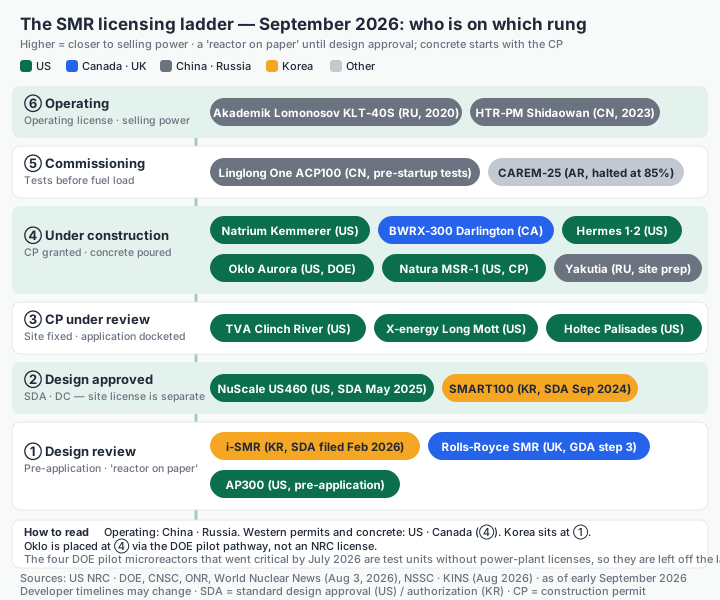
2. Project by project: the current rung (early September 2026; Clinch River and Natrium updated October 2)
Rungs ⑥ and ⑤: operating, commissioning, late construction
| Project | Reactor, output, country | Current stage | Target, customer |
|---|---|---|---|
| Akademik Lomonosov | KLT-40S LWR, 2 × 35 MWe, Russia | Operating since May 2020, Pevek | Local power and heat |
| HTR-PM Shidaowan | High-temperature gas reactor, 2 × 250 MWt → 210 MWe, China | Operating since December 2023 | Grid |
| Linglong One ACP100 | Integral LWR, 125 MWe, China | Pre-commissioning: cold tests done October 2025; pre-startup tests still under way as of early August 2026 | H1 2026 target missed |
| RITM-200N Yakutia | LWR, 55 MWe, Russia | Construction license April 2023; site preparation (camp, roads) since early 2024 | Completion 2028 |
| CAREM-25 | Integral LWR, about 30 MWe, Argentina | Halted at roughly 85 percent complete, September 2024; CNEA (Argentina’s atomic energy commission) cut 58 percent of its staff in June–July 2026 | Undecided |
Rungs ④ and ③: under construction, construction permit under review
| Project | Reactor, output, country | Current stage | Target, customer |
|---|---|---|---|
| Natrium Kemmerer 1 | Sodium fast reactor, 345 MWe (500 MWe with storage), US | Under construction: CP March 4, 2026; nuclear construction from April 23 | Fuel load 2030, commercial 2031. Meta: up to 8 units (January 2026). Bechtel announced on September 22 that it is leaving the project; TerraPower plans to rebid the EPC contract and says the schedule is unaffected |
| BWRX-300 Darlington 1 | BWR, 300 MWe, Canada | Under construction: Licence to Construct April 2025, construction from May; Licence to Operate applied for March 25, 2026 | Grid connection end-2030. OPG (Ontario’s public utility) |
| Hermes 1 / Hermes 2 | Fluoride-salt-cooled high-temperature reactor, 35 MWt test unit / 50 MWe, US | Under construction: Hermes 1 CP December 2023, nuclear construction May 2025; Hermes 2 CP November 2024, construction from April 17, 2026 | Hermes 1 complete 2028 (company; NRC permit deadline April 2029). Hermes 2 power 2030 to TVA (Tennessee Valley Authority, the US federal utility), then Google 50 MW PPA |
| Oklo Aurora-INL | Sodium fast reactor, up to 75 MWe class, US | Building under the DOE pilot pathway at Idaho National Laboratory: construction from September 2025; Preliminary Documented Safety Analysis approved June 11, 2026; no NRC application yet | Company target 2028. Meta Ohio 1.2 GW |
| Xe-100 Long Mott | High-temperature gas reactor, 4 × 80 MWe, US | CP under review: docketed May 2025; environmental review done May 2026; safety evaluation targeted November 2026 | CP early 2027, operation early 2030s. Dow self-supply; Amazon 5 GW partnership |
| Holtec SMR-300 Palisades | LWR, 2 × 340 MWe, US | CP Part 1 under review: filed December 31, 2025, docketed February 27, 2026; Holtec asked for a December 2026 decision, NRC targets H1 2027 | Part 2 filing mid-2027. Michigan grid |
| TVA Clinch River BWRX-300 | BWR, 300 MWe, US | CP issued: docketed July 2025; staff safety evaluation recommended issuance June 2026; Commission hearing August 13; NRC issued the permit September 30 (14-month review, four months ahead of schedule) | Early 2030s. TVA (no construction date announced) |
| Natura MSR-1 | Molten-salt research reactor, 1 MWt, US | NRC CP held since September 2024; also on the DOE pilot pathway (nuclear safety design agreement approved July 2026) | Criticality after 2026. Research |
| DOE pilot program, 11 projects | Microreactors and test reactors, US | Selected August 2025; four critical by July 4, 2026 (Antares, Valar, Deployable, Aalo) | Test reactors |
Rungs ② and ①: design approved, design under review
| Project | Reactor, output, country | Current stage | Target, customer |
|---|---|---|---|
| NuScale US460 | Integral LWR, 6 × 77 MWe, US | SDA granted May 29, 2025 (the 50 MWe design was certified January 2023) | First batch around 2030. TVA–ENTRA1 6 GW agreement (non-binding) |
| SMART100 | Integral LWR, 100 MWe, Korea | Standard Design Authorization granted September 26, 2024 | Saudi build pursued with Saudi Arabia’s KA-CARE |
| Rolls-Royce SMR | LWR, 470 MWe, UK | GDA step 3: entered July 2024, completion targeted August 2026 (DAC unconfirmed as of early September) | Wylfa, 3 units (contract April 2026); ČEZ, Czechia; chosen by Sweden’s Vattenfall June 15, 2026 |
| Westinghouse AP300 | LWR, 300 MWe, US | NRC pre-application (plan submitted May 2023); UK GDA entry approved August 2024 | Design Certification targeted 2027 |
| i-SMR | Integral LWR, 4 × 170 MWe, Korea | SDA under review: filed February 27, 2026; 13 supplementary items; test results due June 2028 | Approval 2028, construction 2030, operation 2035. Buyer undecided (PPA talks) |
3. Who leads: three yardsticks
Yardstick 1, operating record: China and Russia
In September 2026, the number of SMRs selling electricity in the West is still zero. But both countries’ first units are either icebreaker reactors moved ashore (KLT-40S, RITM-200) or an extension of a state research program (HTR-PM), with operator, regulator and money inside a single state structure, so the first-of-a-kind cost question never arose. Even so, Linglong One has not reached criticality five years after construction began in 2021, and a unified system does not make a first SMR easy.
Yardstick 2, Western regulatory passage: United States and Canada
Three projects hold construction permits and have poured nuclear concrete: Natrium, Darlington BWRX-300 and Kairos Hermes. Darlington is the first of them in operating-license review, for two reasons.
- BWRX-300 had completed CNSC Vendor Design Review phases 1 and 2, shrinking the issues to reopen at the construction-license stage.
- The buyer is Ontario’s public utility, so the power always had a taker.
The NuScale–UAMPS project (a Utah municipal-utility consortium) was canceled in November 2023 on rising costs and too few utilities subscribing; a first unit gets none of the benefits of serial production; and regulators had limited review staff.
What changed in 2026 is speed: the 18-month deadline in Executive Order 14300, Part 53 taking effect, the Clinch River safety evaluation landing five months early, and the Xe-100 environmental review closing under a streamlined procedure. Faster review does not, however, lower the cost of the first unit.
Yardstick 3, commercial contracts: US developers tied to hyperscalers
Google–Kairos 500 MW by 2035, Amazon–X-energy 5 GW by 2039, Meta–Oklo 1.2 GW and Meta–TerraPower up to eight units (January 2026) are the headline deals. Not one of these reactors has been licensed to operate, and most of the power dates fall after 2030. A contract is evidence of demand, not of a reactor.
4. Korea on the same ruler
Korea’s position is the first rung. As covered in our i-SMR status report, the i-SMR (4 × 170 MWe, total program budget KRW 399.2 billion, about $295 million) filed for Standard Design Authorization on February 27, 2026 and is at the start of review.
- The KINS review plan reported on August 27 lists 13 supplementary items and sets test-result submission for June 2028, leaving almost no slack against the “approval in 2028” target.
- Gijang County was confirmed as the candidate site in June; the plan is construction in 2030 and operation in 2035.
- The SMR Special Act passed the National Assembly on February 12, 2026 and took effect on September 11, 2026. The NSSC’s “SMR regulatory framework roadmap (2026–2030)” puts SMR-specific technical standards and the associated law amendments in 2028. Review and rule-writing run in parallel; Korean environmental groups argue that “licensing has started while the regulatory framework is still being built” and want the standards first.
- At a September 1 forum on private-sector SMR development, GS Energy, SK Innovation and POSCO Holdings presented participation plans, but what they asked for was permission for long-term power purchase agreements and inclusion in the 12th Basic Plan for Electricity Supply and Demand.
Korea already holds some pieces.
- SMART100, Korea’s second SMR standard design, received Standard Design Authorization in September 2024; KAERI (Korea Atomic Energy Research Institute), KHNP (Korea Hydro & Nuclear Power, the state utility that runs all Korean reactors) and Saudi Arabia’s KA-CARE are pursuing a Saudi build.
- KAERI has developed high-temperature gas reactor technology for hydrogen since 2004 and partnered with POSCO E&C on an indigenous design, and its molten-salt reactor concept for ships was reported to have received approval in principle from the American Bureau of Shipping in July 2026.
- Doosan Enerbility (Korea’s reactor-vessel manufacturer) supplies NuScale’s main components and reserved forgings for 16 Xe-100 units with X-energy (December 2025); Hyundai E&C, Samsung C&T and Daewoo E&C are tied to Holtec Palisades, NuScale Romania and the i-SMR respectively.
Weighing strengths and weaknesses equally. The strength is a manufacturing supply chain that has actually produced large-reactor main components, the position that receives work first as Western SMRs move into construction. The weaknesses are three: nobody has been assigned the first-of-a-kind cost, no buyer for the electricity exists yet, and the regulator’s review staff and standards must keep pace with the project.
Spent fuel does not disappear because the reactor got smaller; see our Korean piece on waste volume (in Korean).
5. Technology branches: light water first, fuel decides the rest
Light-water reactors dominate the ladder from top to bottom: NuScale, BWRX-300, i-SMR, AP300, Rolls-Royce, Linglong One. (Designs above 300 MWe, like the 470 MWe Rolls-Royce unit, are still called SMRs in the industry.) Regulators have reviewed the technology for 60 years, so criteria, interpretations and staff exist, and the fuel is the same below-5-percent uranium, so a supply chain exists; Korea chose an integral LWR for the i-SMR on the same calculation.
Natrium (sodium fast reactor), Xe-100 (high-temperature gas), Kairos (fluoride-salt-cooled) and Oklo (fast reactor) mostly use HALEU, high-assay low-enriched uranium enriched to 5–20 percent uranium-235, just under the 20 percent HEU threshold (weapons-grade is around 90 percent) and chosen to run fuel longer in a smaller core.
Only one Western company is producing at this assay today: Centrus, which runs the only US facility licensed to enrich up to 19.75 percent, in Piketon, Ohio. By June 2026 it had filled its entire pilot contract, delivering more than 1,900 kg to DOE; in July 2026 it moved toward commercial production under a $900 million DOE contract, but its initial commercial plant is targeted for 2029, with 12 metric tons per year after that. A pilot output of about 900 kg per year is small against several commercial-scale reactors, so the non-LWR schedules depend on fuel as much as on licensing. Ranking reactors this way is slower and far less exciting than a press release. It is also harder to fake.
Where this goes next
Watch four things through the end of 2026: whether TVA sets a construction start for Clinch River after the NRC issued its CP on September 30, whom TerraPower picks to replace Bechtel on Natrium, whether Rolls-Royce SMR receives its DAC, and whether Linglong One loads fuel. In Korea, the KINS supplementary-item schedule and the 2028 rule-writing target will show whether the i-SMR’s 2028 date is a plan or a hope.
Industry note
On the ladder, revenue arrives first on the upper rungs. Doosan Enerbility (KRX: 034020) makes main components and forgings for permitted US and Canadian projects, Hyundai E&C (KRX: 000720) is Holtec’s EPC partner at Palisades, and Centrus (NYSE: LEU) produces HALEU; NuScale (NYSE: SMR) and Oklo (NYSE: OKLO), still on the design and DOE rungs, move most on approval news. The full value chain is in our Korean guide to SMR and nuclear stocks (in Korean).
This section is provided to help understand the industry and is not a recommendation to buy or sell any security. Investment decisions and their consequences are the reader’s own.
Sources: US NRC releases and project pages (NuScale US460 SDA, 2025; Natrium CP and Part 53 final rule, 2026; Clinch River, Long Mott, Palisades dockets); US DOE Reactor Pilot Program (2025, 2026); Executive Order 14300 (2025); CNSC Darlington project page, REGDOC-3.5.4; UK ONR GDA guidance; World Nuclear News (Aug 3, 2026 Linglong One; Sept 30, 2026 Clinch River construction permit; Sept 22, 2026 Bechtel and TerraPower; Darlington operating-license application; Oklo, 2026); ANS Nuclear Newswire (Holtec, Clinch River, Kairos, Centrus, 2026); Nuclear Engineering International (CAREM, 2024; Yakutia); Argentine press (CNEA cuts, 2026); Kairos Power, TerraPower, Oklo, Centrus, Dow, Vattenfall releases; NSSC/KINS i-SMR review plan and SMR regulatory roadmap (2026); KAERI SMART100 release (2024); Doosan Enerbility release (2025)