Reprocess or bury? The world map of spent-fuel policy, and why Korea can't decide
France and Japan reprocess spent fuel; Finland and the US bury it. Korea does neither. Why the split exists, and how a US treaty keeps Korea undecided.
Data as of September 3, 2026 — statistics, prices, schedules and regulatory status in this article were checked on this date. Where a different date is given in the text, that date takes precedence.
Every fuel assembly that leaves a reactor core has to go somewhere, and for seventy years the nuclear world has argued over where.
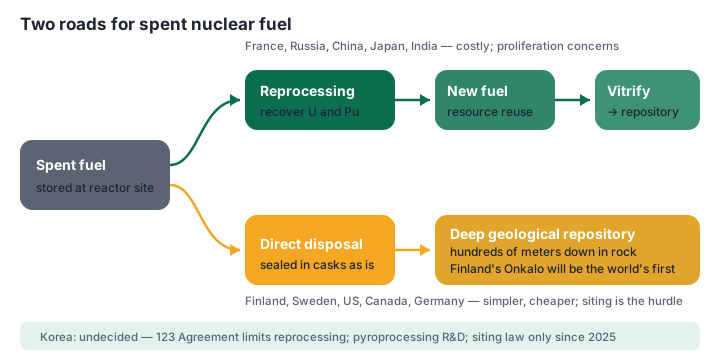
There are only two real destinations. Reprocessing dissolves the fuel and pulls out the uranium and plutonium that can be used again. Direct disposal leaves the fuel as it is, seals it in a container and buries it in deep rock.
Every nuclear country has, sooner or later, picked one. South Korea, which operates the world’s sixth-largest fleet of operable reactors, has spent decades picking neither.
I work in nuclear and radiation in Korea, and the “undecided” label on my own country comes up in every conversation about waste. This article lays out the two roads, who is on which, and the three constraints that keep Korea parked at the junction.
Key takeaways
- Reprocessing wins on resource reuse and high-level waste volume; direct disposal wins on cost and proliferation risk. Neither is a settled “right answer.”
- Korea cannot reprocess without US consent under the US–Korea 123 Agreement, has researched an alternative called pyroprocessing that does not separate pure plutonium, and has deferred the decision while pools fill up.
- Whichever road a country takes, it ends at a deep geological repository. Korea only passed the law to start looking for one in 2025.
1. Why anyone would “burn” spent fuel again
Spent fuel is not spent in the everyday sense. By weight it is still mostly uranium, and it now contains plutonium that was created in the reactor. Reprocessing is the chemical separation of those two materials so they can be made into new fuel; the genuinely useless remainder is melted into glass (vitrified) for eventual burial.
- The case for reprocessing: uranium imports fall, and the volume of high-level waste that finally needs a repository is much smaller than the original fuel. For a country with no uranium of its own, that has obvious appeal.
- The caveats: only the high-level volume shrinks. The process generates additional intermediate- and low-level waste, so total waste grows. And the separated plutonium has to be stored and accounted for indefinitely, which is a real headache today for the United Kingdom and Japan, both sitting on large civil plutonium stockpiles.
- The case against: cost, and proliferation. Separated plutonium is weapons-usable material, so any reprocessing plant comes wrapped in international safeguards and diplomacy. The plant itself is a very large chemical facility that handles intensely radioactive liquids, with all the radiation-protection burden that implies.
2. Who reprocesses and who buries
The table below reflects national policy as of September 2026.
| Camp | Countries | Notes |
|---|---|---|
| Reprocessing | France, Russia, China, Japan, India | France’s La Hague is the reference plant. China’s first 200-tonne-a-year demonstration plant appears to have started operating in 2025, according to satellite analysis by the International Panel on Fissile Materials (May 2026), with a second complete and a third under construction. Japan has been preparing its Rokkasho plant for decades. |
| Direct disposal | Finland, Sweden, United States, Canada, Germany | Finland’s Onkalo will be the world’s first deep geological repository for spent fuel. |
| Undecided | South Korea and others | Storing at reactor sites while the decision is deferred. |
The direct-disposal argument is short: reprocessing is expensive and carries proliferation risk, and the technology to bury fuel safely in deep rock already exists. Finland has taken that argument furthest.
On 4 August 2026 STUK, the Finnish regulator, found no safety obstacle to an operating licence for Onkalo; the government’s licence decision is the last step, and Posiva aims to be ready to start disposal by the end of 2026. We cover Onkalo and its rivals in our tour of the world’s repositories.
Note what the two camps have in common. France still needs a repository for its vitrified waste; Finland still needs one for its untouched fuel. Reprocessing changes what goes into the ground and how much, not whether a hole in the rock is needed at all.
3. Why Korea is on neither road
Korea’s position is not indecision in the ordinary sense. Three constraints overlap, and each one blocks a different exit.
The US–Korea 123 Agreement
The name comes from Section 123 of the US Atomic Energy Act, which requires a bilateral agreement before the United States can export reactors, components or nuclear material to another country. Every country that buys American nuclear technology signs one.
- What it means for Korea: most Korean reactors are US designs or their Korean descendants (the exceptions are three Canadian CANDU units at Wolsong and two French-designed units at Hanul), and fuel produced in them or from US-supplied material counts as “US-obligated” material. The Atomic Energy Act requires US permission before that fuel can be reprocessed, and the agreement gives each side consent rights over any change to the fuel’s form.
- The current text: the previous agreement had been in force since 1974. Its replacement, signed in June 2015, runs for 20 years. It lets Korea run the front end of pyroprocessing (converting fuel from oxide to metal, with no plutonium separated), set up a high-level commission to keep discussing the rest, and gave advance consent to ship US-obligated spent fuel abroad for reprocessing into mixed-oxide fuel. It did not give advance consent for reprocessing on Korean soil.
- Where it stands: conventional reprocessing is effectively off the table for Korea. Talks on revising the agreement have been under way since 2025. In a joint fact sheet after the October 2025 summit, the White House said it “supports the process that will lead to” Korean civil enrichment and reprocessing, and working-level rounds continued into June 2026, with Seoul seeking long-term advance consent.
Washington’s reluctance is usually explained in nonproliferation terms: approving reprocessing for an ally on the same peninsula as North Korea’s weapons program sets a precedent the United States has not wanted to own, whatever the technical merits.
Pyroprocessing, Korea’s attempted third way
Because of that constraint, KAERI (Korea Atomic Energy Research Institute, the state nuclear research body) spent years developing pyroprocessing, a dry electrochemical process in which the plutonium is never separated in pure form and stays mixed with other elements. The pitch is that this carries much less proliferation risk than the aqueous process used at La Hague or Rokkasho.
- How far it got: KAERI has validated the process flow with simulated fuel, and the United States and Korea ran a ten-year Joint Fuel Cycle Study (2011–2021) on it, which ended without a policy recommendation either way.
- Where it is contested: whether it can be made commercial, and whether it would ever be cheaper than simply burying the fuel, remain open questions. Assessments inside and outside Korea disagree. Critics disagree with the premise. Frank von Hippel of Princeton and Jungmin Kang, writing in the Bulletin of the Atomic Scientists in January 2022, argue that the plutonium-bearing product is far easier to purify than untouched spent fuel, that the joint study’s cost estimates were unrealistic, and that a large flow of separated actinides would make Korea a latent nuclear-weapon state. A US Department of Energy review by six national laboratories reached a blunter verdict: pyroprocessing is reprocessing, and it carries proliferation risk.
The storage clock
While the decision waited, spent fuel kept arriving. KHNP (Korea Hydro & Nuclear Power, the state utility that operates all of Korea’s reactors) has been storing it in pools and dry casks inside plant fences, and at some sites saturation is now in view.
Korea’s Special Act on High-Level Radioactive Waste Management, passed by the National Assembly in February 2025, sets out for the first time a legal procedure for choosing a repository site, with targets of an interim storage facility by 2050 and a disposal facility by 2060. The siting process itself has barely begun.
Put the three together and Korea’s “undecided” status is the sum of a diplomatic constraint, a technical uncertainty and the absence of a social consensus. The bill for not deciding is already being paid, in the form of new on-site storage buildings at every operating plant. What happens to that fuel when a reactor is retired is a separate problem; see how Korea is decommissioning its first reactor, Kori-1.
4. Where this goes next
The 2015 agreement’s 20-year term ends in 2035, and the revision talks that began in 2025 will decide whether domestic pyroprocessing, full reprocessing in Korea, or neither is written into the next text. Meanwhile the 2025 act has started a repository siting clock that will run for decades and, on the evidence of Finland and Sweden, will succeed only if a host community volunteers. The practical bet for the next ten years is on neither road but on the parking lot: more interim storage, at more sites, for longer.
Industry note
Whichever road Korea takes, the near-term demand is for storage and containers, and the longer the decision is deferred, the more of it is needed. Doosan Enerbility (KRX: 034020), Korea’s reactor-vessel manufacturer, has extended its heavy-forging business into spent-fuel casks and other back-end equipment. KEPCO Engineering & Construction (KRX: 052690), the state-owned nuclear design firm, covers the design and safety assessment of storage and disposal facilities, and a repository build would draw on the same radiation-management and civil-engineering supply chain as decommissioning.
This section is provided to help understand the industry and is not a recommendation to buy or sell any security. Investment decisions and their consequences are the reader’s own.
Sources: IAEA, spent fuel management status and trends; Korea Atomic Energy Research Institute, pyroprocessing research presentations; Special Act on High-Level Radioactive Waste Management (Republic of Korea, 2025); World Nuclear Association, country profiles and processing of used nuclear fuel; Congressional Research Service, “U.S.-Republic of Korea Nuclear Cooperation Agreement” (Insight IN10304, June 30, 2015); Kang and von Hippel, Bulletin of the Atomic Scientists (January 2022); International Panel on Fissile Materials blog (May 2026); White House, U.S.–ROK joint fact sheet (November 2025); STUK and Posiva announcements on Onkalo (August 2026).