Are radon spas good for you? Misasa, Bad Gastein and the hormesis debate, with the actual numbers
Homes cut radon, spas sell it. Misasa and Bad Gastein radon levels vs Korea's 148 Bq/m³ guideline, the dose of one spa hour, and what hormesis evidence shows.
Data as of September 3, 2026 — statistics, prices, schedules and regulatory status in this article were checked on this date. Where a different date is given in the text, that date takes precedence.
44,000. That is the number of becquerels of radon in one cubic meter of air inside the Heilstollen, the “healing gallery” at Bad Gastein in the Austrian Alps. It is about 300 times South Korea’s indoor radon guideline of 148 Bq/m³, and people ride a small train into the mountain to breathe it.
Misasa, a spa town in Japan’s Tottori Prefecture, advertises itself as one of the world’s leading radium springs, and a few Korean spas market a “radium bath” too. The question comes up as Korean travelers head for Japanese hot-spring towns this autumn: in Rakuten Travel’s bookings for the Chuseok holiday, Korea’s harvest break, the onsen region of Oita ranked second among Japan destinations, Korean daily Aju Business Daily reported in August 2026. Public-health agencies from Seoul to Washington tell you to reduce radon at home; spas tell you to soak in it.
One of them must be wrong — or so it seems. This article puts the two side by side with the measured numbers, then looks at the “hormesis” argument that radon spas lean on and at what radiation-protection bodies make of it.
Key takeaways
- Bath air at Misasa runs roughly 800–5,300 Bq/m³ (about 2,100 in the hospital’s inhalation room); the Bad Gastein gallery averages about 44,000 Bq/m³. Korea’s indoor guideline is 148 Bq/m³, the same number as the US EPA action level of 4 pCi/L and above the WHO reference level of 100.
- Dose is concentration times time. One hour in the Misasa inhalation room is about 0.01 mSv; a year in a home at 148 Bq/m³ is about 4–8 mSv depending on the coefficient. That is why homes and spas are managed differently — not a contradiction.
- Hormesis advocates cite Misasa epidemiology, animal studies and pain trials, but the large low-dose datasets (INWORKS) show risk rising with dose, ICRP and BEIR VII keep the linear no-threshold model, and UNSCEAR does not endorse a benefit. Neither the added risk of a spa visit nor its therapeutic effect has been demonstrated.
1. Same radon, different numbers
The radon in a spa is the same gas as the radon in a basement. Uranium in rock decays through radium to radon; radon dissolves in groundwater, comes up with the spring, and escapes into the bathhouse air. What differs is the concentration and the time you spend in it — the measured concentrations first.
- Misasa, Japan — The spring water carries about 440 Bq of radon per liter (Okayama University measurement, 1984; individual sources vary widely). Air in a bathroom fed by the spring measured about 800 Bq/m³, and a hydrotherapy room with a large Hubbard tank about 5,300 Bq/m³ (both 1984). The Okayama University hospital’s “inhalation room”, where patients inhale spring vapor in a room kept at 48 °C, measured about 2,100 Bq/m³ in 2003. Under Japan’s Onsen Act, water qualifies as a hot spring on radon content at 74 Bq/kg or more; the Ministry of the Environment’s guideline classifies it as a “radioactive (therapeutic) spring” from 111 Bq/kg.
- Bad Gastein, Austria — The former gold-mine gallery averages about 44,000 Bq/m³ of radon, at 37–41 °C and 70–100% humidity. It has operated as a treatment facility for rheumatic patients since 1952.
- A Korean home — The guideline is 148 Bq/m³, a recommended level under the Indoor Air Quality Control Act rather than an enforceable limit: one-fifth of an ordinary Misasa bathroom, one three-hundredth of the Bad Gastein gallery.
Two reference points help an international reader place that 148. The US Environmental Protection Agency (EPA) sets its action level at 4 pCi/L — the same value in US units, which EPA’s own page rounds to 150 Bq/m³ — and recommends considering a fix from 2 pCi/L (75 Bq/m³); the World Health Organization (WHO) recommends a national reference level of 100 Bq/m³, not to exceed 300 Bq/m³ where 100 cannot be reached (both as published on the agencies’ websites as of September 2026: EPA page updated November 2025, WHO fact sheet dated January 2023). Korea’s guideline therefore sits at the US level and somewhat above the WHO level.
One more note on Korea: its Hot Springs Act defines a hot spring by temperature (25 °C or more) and a handful of chemical parameters such as nitrate nitrogen; it has no radioactivity criterion at all. A Korean “radium spa” label tells you nothing about how much radon is actually there.
2. Why it is not a contradiction: time
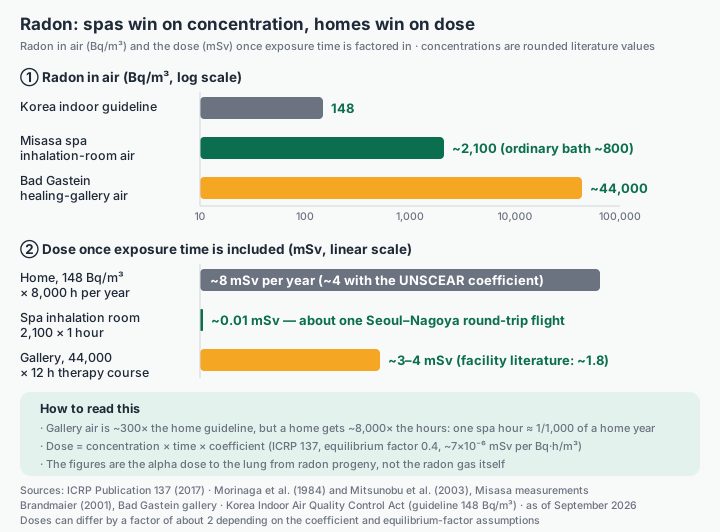
Dose from radon is concentration × time × coefficient. Using the coefficient the International Commission on Radiological Protection (ICRP) published in 2017 in Publication 137 (about 7 × 10⁻⁶ mSv per Bq·h/m³ at an equilibrium factor of 0.4), the three cases work out like this.
- Home — Breathing 148 Bq/m³ for 8,000 hours a year (22 hours a day indoors) gives about 8 mSv — about 4 mSv with the older coefficient from UNSCEAR, the UN Scientific Committee on the Effects of Atomic Radiation. Either way, roughly a chest CT (about 7 mSv) every year.
- Note that 148 is the guideline ceiling; the winter average in Korean apartment buildings is about 74 Bq/m³ (National Institute of Environmental Research survey, 2019–2020). The often-quoted statistic that radon makes up half of the average Korean’s roughly 3 mSv of annual natural background is computed from that average and the UNSCEAR coefficient, so a home near the guideline gets more than that from radon alone.
- Misasa inhalation room — One hour at 2,100 Bq/m³ is about 0.01 mSv — about the cosmic-ray dose of a Seoul–Nagoya round-trip flight (our Korean piece on cosmic radiation in flight (in Korean); for the extreme version of the same question, see Artemis and space radiation) — and one-tenth of a chest X-ray (about 0.1 mSv). Five sessions over a three-night stay would be around 0.05 mSv.
- Bad Gastein therapy course — A course totaling 12 hours in the gallery per year comes to about 1.8 mSv by the facility’s own literature, or 3–4 mSv with the ICRP 137 coefficient under the same equilibrium-factor assumption. That exceeds the 1 mSv annual public dose limit, but it is classified as medical exposure, to which dose limits do not apply — which is why in Austria it requires a physician’s examination and prescription.
Eight thousand hours at home, one hour in a bath: that is why the two are regulated differently, and why radon guidelines are annual averages rather than spot values. Two technical footnotes follow.
The harm comes less from radon gas itself than from its short-lived progeny — polonium-218 and polonium-214 — which lodge in the lung and emit alpha particles (our Korean explainer on alpha radiation (in Korean)). Two other progeny, lead-214 and bismuth-214, also emit gamma rays, so in a high-concentration gallery external exposure is assessed separately. The gallery train driver’s occupational dose of about 15 mSv per year (100 hours in the gallery) is calculated from radon inhalation alone.
3. “A little radiation is good for you”: the case for hormesis
The scientific rationale that radon spas cite is the hormesis hypothesis — the idea that a small stressor wakes up the body’s defenses and leaves it healthier. Its evidence comes in three strands.
- Misasa epidemiology — Okayama University researchers followed 3,083 residents of the high-radon part of Misasa (indoor average about 60 Bq/m³) and 1,248 residents of a control area (about 20 Bq/m³) from 1976 to 1993, an average of 14 years (Ye et al., 1998). All-cause mortality did not differ. Stomach cancer was lower in the high-radon area — a relative risk of 0.70 in men and 0.58 in women, the male figure not statistically significant. An earlier analysis of the same population reported total cancer mortality at 0.67 times the control area, a figure hormesis proponents often quote.
- Cell and animal studies — The same university has published a series of papers reporting higher antioxidant-enzyme activity and reduced inflammation in mice that inhaled radon.
- Clinical trials — Randomized trials of radon spa therapy in rheumatic patients, including the German-Austrian IMuRa trial, reported reduced pain and lower analgesic use. A meta-analysis published in 2026 in Cureus (8 studies, 2,152 patients, 5 of them randomized) concluded that pain reduction was significant beyond 12 weeks, though not within 12 weeks.
4. The counter-reading of the same data
The radiation-protection side reads the same material differently.
- The limits of the epidemiology — In the same Misasa cohort, lung cancer was higher in the high-radon area (relative risk 1.65 in men, not statistically significant), and the authors themselves noted that they could not measure individual exposure or adjust for smoking and diet. A 2000 case-control study that did measure individual exposure (28 lung cancer cases against 36 controls; Sobue et al.) concluded that it found no pattern of risk different from that seen in other countries.
- The large low-dose datasets — INWORKS, the study of about 310,000 nuclear-industry workers in France, the UK and the US, reported in its 2023 analysis that solid-cancer mortality rose in proportion to dose even below a cumulative 100 mGy. No sign of benefit appeared at low doses.
- Attribution of the effect — In the gallery, 37–41 °C heat and near-saturated humidity act together with several weeks of rest, so it is hard to isolate radon’s share of any pain relief. The meta-analysis authors listed self-reported outcomes and possible publication bias among their limitations.
This is why the ICRP (Publication 103) and the US National Academies’ BEIR VII report keep the linear no-threshold model — a risk proportional to dose all the way down — as the basis of protection, and why UNSCEAR does not consider a beneficial effect at low doses to be established. Hormesis is not built into the protection system. Low-dose effects are too small to detect in individual studies, and that difficulty is evidence neither of benefit nor of harmlessness.
5. So can you go to the spa?
Put side by side, the two cases lead to a restrained conclusion.
- A short soak — The added risk is on the order of 0.01 mSv, a size no individual study can resolve. There is no established reason to skip an onsen trip over radon. (For scale, see our banana-equivalent-dose explainer.)
- A therapeutic effect — This cannot be called proven either. Pain relief has been reported, but whether radon itself is responsible is unclear. Even Germany’s Federal Office for Radiation Protection (BfS) treats radon therapy as something a physician prescribes after weighing pain relief against lung-cancer risk, and does not recommend radon use for wellness purposes. Drinking radon-rich spring water or repeating inhalation sessions as therapy is where the dose starts to need accounting.
- Back home — Ventilate (our Korean guide to radon at home (in Korean)). Where radon actually matters is not the one hour in the bath but the 8,000 hours in the house.
Where this goes next
The 2026 meta-analysis will not be the last word; its authors called for larger trials with objective endpoints. On the protection side, ICRP has been reviewing its 2007 general recommendations since 2021, with a new set expected around 2030 (per ICRP’s website, as of September 2026), and how to treat risk below about 100 mGy is one of the open questions in that review. Nothing in either track is likely to change the arithmetic above: for a visitor, radon exposure is a matter of hours, not years.
Health note — This article is general information from a radiation-protection perspective and does not replace medical advice.
Sources: ICRP Publication 137 (2017), radon dose coefficients, and ICRPaedia, “Calculating Radon Doses”; ICRP Publication 103 (2007); UNSCEAR 2019 Report, Annex B; US National Academies, BEIR VII (2006); WHO, “Radon and health” fact sheet; US EPA, “What is EPA’s action level for radon”; Morinaga, Mifune and Furuno, Radiation Protection Dosimetry 7 (1984), Misasa water and air radon measurements; Mitsunobu et al., Journal of Radiation Research 44 (2003), Misasa inhalation-room measurements; Korea National Institute of Environmental Research, residential radon survey (2019–2020); Germany’s Federal Office for Radiation Protection (BfS), guidance on radon therapy; Ye et al., Japanese Journal of Cancer Research 89 (1998), Misasa cohort; Sobue et al., Journal of Radiation Research 41 (2000), Misasa case-control study; Brandmaier, “Radiation protection in the Gasteiner Heilstollen” (2001, IAEA INIS); Richardson et al., BMJ 382 (2023), INWORKS; Cureus (2026), meta-analysis of radon spa therapy; Japan Ministry of the Environment, Guidelines for Mineral Spring Analysis (2014 revision); Korea Hot Springs Act enforcement decree; Korea Indoor Air Quality Control Act enforcement rules; Aju Business Daily, August 20, 2026, on Rakuten Travel Chuseok booking data; ICRP, “The System of Radiological Protection for the Next Decades” (review of Publication 103, icrp.org)