Korea is asking whether to build more reactors — what the September 2026 public deliberation is really about
Korea's two new large reactors and one SMR are already decided. The September–December 2026 deliberation asks what role nuclear should play for 2040 — here are both sides.
Data as of September 22, 2026 — statistics, prices, schedules and regulatory status in this article were checked on this date. Where a different date is given in the text, that date takes precedence.
Nineteen reactors’ worth of extra electricity demand, and it showed up on a single forecast in four months.
On August 20, 2026, in a National Assembly office building in Seoul, the committee drafting Korea’s next 15-year power plan put that new number on the table. Peak electricity demand in 2040 is now forecast at 158.4–165.0 GW, up from the 131.8–138.2 GW the same committee had forecast in April. The gap is about 27 GW, the output of nineteen large reactors of 1.4 GW each.
Holding that number, the Ministry of Climate, Energy and Environment starts a citizen-jury deliberation in September on one question: what role should nuclear play? I work in the nuclear field, but this article does not argue a side. It puts the arguments for and against on the same scale and reports what each one weighs.
Key takeaways
- The two large reactors and one small modular reactor (SMR) in Korea’s 11th Basic Plan are already decided, with candidate sites chosen in June 2026. The September–December deliberation asks what role nuclear should play in the 12th Basic Plan, which runs to 2040 — not a specific number of additional units.
- The case for building more rests on carbon-free baseload, the 2040 demand re-forecast, the low cost of the existing fleet and a supply chain that is still running. The case for caution rests on new-build cost overruns abroad, the absence of a spent-fuel repository, local acceptance and the falling price of solar and storage.
- Korea’s 2017 deliberation on two half-built reactors used a 471-citizen jury and took three months. The January 2026 process took two forums and a phone poll. On September 22 the government confirmed the new round will also use a citizen jury, run by an 11-member deliberation committee over about three months, though it will not decide how many reactors to add.
1. The plan behind the question
Korea decides what power plants to build through a single document, and the deliberation only makes sense once you know how that document works.
- Basic Plan for Long-term Electricity Supply and Demand. A rolling 15-year plan, revised roughly every two years, that sets the national demand forecast and the generation mix to meet it. A reactor that is not in the plan does not get built; a reactor that is in the plan still needs a site, licenses and a budget.
- The 11th Basic Plan was confirmed in February 2025. It includes two new large reactors (2.8 GW combined, targeted for 2037–38) and one SMR (0.7 GW, targeted for 2035–36).
- The 12th Basic Plan is now being drafted. It extends the horizon to 2040, and the demand re-forecast of August 20 is its starting point. On September 22 the ministry reported a public-deliberation plan to the Cabinet: an 11-member committee (including a neutral chair, with no nuclear-industry stakeholders) will run about three months of deliberation by a representative citizen jury. Because that process needs to feed into the plan, the government draft was pushed back from October to December, ahead of confirmation during the regular parliamentary session that runs to December.
- Ministry of Climate, Energy and Environment is the new owner of the plan. It was created in October 2025 by merging the environment ministry with the energy functions of the former Ministry of Trade, Industry and Energy (MOTIE), so this is its first Basic Plan.
- KHNP (Korea Hydro & Nuclear Power) is the state utility that operates all of Korea’s reactors and would build any new ones. KEPCO (Korea Electric Power Corporation), its parent, is the near-monopoly buyer and seller of electricity. NSSC (Nuclear Safety and Security Commission) is the independent regulator that licenses reactors; it plays no part in deciding how many to build.
2. What has already been decided
A common misreading, in Korea as much as abroad, is that the autumn deliberation will decide the fate of the two new reactors. It will not.
The government reconfirmed the 11th Plan’s two large units and one SMR in January 2026. It held two public forums, on December 30, 2025 and January 7, 2026, and commissioned polls of about 3,000 people in which 62–70 percent supported going ahead with new construction.
On January 26 it announced that the units would “proceed as planned.” On June 17, KHNP’s site selection committee chose Yeongdeok County, on the east coast in North Gyeongsang Province, as the candidate site for the two large reactors, and Gijang County in Busan, next to the existing Kori plant, for the SMR.
So the real question for the September–December deliberation is narrower and larger at the same time: with 27 GW more demand forecast for 2040, should the 12th Plan write in additional reactors and SMRs beyond the three already committed? The government has said the deliberation itself will not settle a specific number, only nuclear’s role among the alternatives. The decisions so far, and the ones still ahead (as of September 22, 2026):
| Date | Step | Status |
|---|---|---|
| Feb 2025 | 11th Basic Plan confirmed: 2 large units + 1 SMR | Done |
| Dec 2025–Jan 2026 | Two public forums on the 11th Plan units (Dec 30, Jan 7) | Done |
| Jan 26, 2026 | “Proceed as planned” (polls 62–70% in favor) | Done |
| Jun 17, 2026 | KHNP names Yeongdeok (large units) and Gijang (SMR) | Done |
| Aug 20, 2026 | 2040 demand re-forecast: 158.4–165.0 GW | Done |
| Sept 22, 2026 | Public-deliberation plan (citizen jury, ~3 months) confirmed | Done |
| Dec 2026 | Government draft of the 12th Plan (pushed back from October) | Ahead |
| By Dec 2026 | Climate Response Commission and Assembly reports; plan confirmed | Ahead |
The answer will shape the electricity bills Koreans pay in 2040; the same demand forecast is also what is driving the data-center grid debate.
3. The case for building more
- Carbon-free baseload. Korea’s reactors run at a capacity factor in the mid-80s regardless of weather (84.6 percent in 2025). As coal plants close, the options usually named for carrying nights and winters are nuclear and renewables backed by storage and pumped hydro. Gas fills the gap in between but leaves carbon behind.
- The 2040 demand. The re-forecast raised semiconductor clusters to 24.6 GW (from 4 GW in April) and AI data centers to 11.9 GW (from 4 GW). Critics call the numbers inflated. If the forecast errs the other way, the price is blackouts or expensive imported gas.
- Low settlement prices. In 2025 the Korea Power Exchange (KPX, which runs the wholesale market) settled nuclear output at about KRW 79 per kWh (about 5.9 US cents) against KRW 158 (about 11.7 cents) for gas. A larger nuclear share lowers KEPCO’s average purchase cost.
- A supply chain that is still alive. Shin-Hanul units 3 and 4 are under construction, so Korea’s design, heavy-forging and construction ecosystem is busy. The cost of reviving a supply chain that has gone cold is something the United States and Europe have already paid.
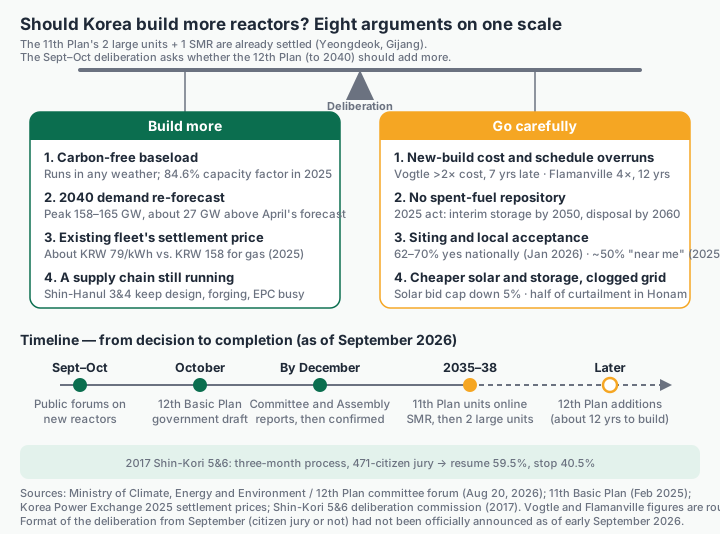
4. The case for caution
- Construction cost and schedule. The KRW 79 figure describes reactors whose construction cost has long been paid off. For a new plant, construction cost goes straight into the price of power, and the budget for Shin-Hanul 3 and 4 alone is about KRW 12.3 trillion (about $9.1 billion). Vogtle 3 and 4 in the United States were planned at about $14 billion with completion in 2016–17 and ended above $30 billion in 2023–24; Flamanville 3 in France went from EUR 3.3 billion to about EUR 13 billion and twelve years late. Korea has built its recent units close to budget, though Shin-Kori 3 and 4 ran years late after a scandal over forged component test certificates; a plan cannot guarantee which record a new site repeats.
- No repository. Korea has no site for a final spent-fuel repository. The special act passed in 2025 targets interim storage by 2050 and a disposal facility by 2060; see our survey of the world’s repositories and our Korean explainer on how much waste Korea holds (in Korean). Managing the existing fleet’s fuel already stretches into the 22nd century, and new reactors add volume and time to that.
- Siting and local acceptance. In Yeongdeok, 86 percent of residents supported hosting the plant in a local survey. But in the national survey by the Korea Energy Information Culture Agency, a state-funded public information body, for the fourth quarter of 2025, only 49.9 percent agreed to a reactor “in the area where I live” (56.3 percent in the same agency’s June 2026 survey). National support and local acceptance are different questions.
- Cheaper solar and storage, and a clogged grid. The price cap in Korea’s fixed-price solar auction for the first half of 2026 was about KRW 148 per kWh (about 11 cents), down 5 percent in a year, and bids in the central contract market for battery storage fell from the KRW 30s to the KRW 20s per kWh (roughly 2 cents). The constraint is transmission. Half of all renewable curtailment in January–May 2026 happened in Honam, the southwestern region with the densest solar, and new solar there gets grid access only in stages through 2031 — constraints reactors on the east coast share.
5. How Korea asked the question in 2017, and how it asked in 2026
The reference point is the 2017 deliberation on Shin-Kori units 5 and 6, two reactors that were already under construction when a new government paused them. A commission chaired by Kim Ji-hyung was launched on July 24, 2017. It phoned about 20,000 people, drew a 500-person citizen panel from them, and 471 of those citizens completed a month of study and a three-day residential debate before answering on October 20: 59.5 percent to resume construction, 40.5 percent to stop.
The same panel also backed reducing nuclear’s share of the mix over time, 53.2 percent. Supporters and opponents had read the same material in the same room.
The January 2026 process, by contrast, was two forums and a telephone and automated-response poll. Korean environmental groups criticized it for providing too little information and for questions that leaned toward one answer. On September 22 the government confirmed the new round will look more like 2017 than January: a representative citizen jury studies and debates nuclear’s role, then answers before-and-after surveys, over about three months. Minister Kim Sung-hwan drew one boundary, however: how many reactors to add “may not fall within the deliberation committee’s scope,” so this round covers nuclear’s role among several alternatives for future demand, not a number. The differences, side by side:
| Item | 2017 Shin-Kori 5&6 | Jan 2026 | Sept–Dec 2026 |
|---|---|---|---|
| Question | Resume two half-built units? | Keep the 11th Plan’s 2 + 1 units? | Nuclear’s role in the 2040 mix (not a specific number) |
| Method | 471-citizen jury, deliberation | Two forums, poll of ~3,000 | Citizen jury, ~11-member committee |
| Duration | About three months | Under a month | About three months |
| Result | Resume 59.5% / stop 40.5% | 62–70% in favor; proceed | Ahead |
The credibility of the result will still rest on whether the participants read the eight arguments above from the same set of materials.
6. The author’s scale
I will not say which side is heavier. What I will say is this: a reactor takes about twelve years from decision to grid, and renewables take about as long for the transmission lines to catch up. The 2017 deliberation took three months; the January 2026 decision took less than one.
The cost that has actually grown is not the decision itself but the years lost each time a new government reversed the last one, and construction starts and grid lines were pushed back with it. Whether Korea builds more reactors or concentrates on solar, storage and wires, an answer by December that the next government does not overturn would be cheaper than either conclusion.
Where this goes next. The dated events are the roughly three-month citizen-jury deliberation that started September 22, the now-December draft of the 12th Plan, and its confirmation before the Assembly session ends in December. Watch two things in the draft: whether it writes in reactors beyond the 2 + 1 already committed, and whether it names a deliberation format that both sides can accept. Beyond that, the 11th Plan’s SMR is targeted for 2035–36 and its two large units for 2037–38; anything added by the 12th Plan would come after that.
Industry note. More reactors would engage Doosan Enerbility (KRX: 034020), the reactor-vessel manufacturer, KEPCO E&C (KRX: 052690) for design and Hyundai E&C (KRX: 000720) for construction; see our Korean guide to nuclear stocks (in Korean). A solar-and-storage path would engage LG Energy Solution (KRX: 373220), Samsung SDI (KRX: 006400) and Hanwha Solutions (KRX: 009830). Either way the evening peak through the mid-2030s is likely met by gas, Korea Gas Corporation’s (KRX: 036460) business. A Basic Plan entry is not an order, and a 15-year plan is revised many times.
This section is provided to help understand the industry and is not a recommendation to buy or sell any security. Investment decisions and their consequences are the reader’s own.
Sources: Ministry of Climate, Energy and Environment and the 12th Basic Plan general committee, fifth public policy forum (August 20, 2026); Ministry of Climate, Energy and Environment, public-deliberation plan reported to the Cabinet (September 22, 2026); Ministry of Trade, Industry and Energy, 11th Basic Plan for Long-term Electricity Supply and Demand (February 2025); Ministry of Climate, Energy and Environment, results of the new-reactor public opinion polls (January 2026); Korea Hydro & Nuclear Power, new-reactor site selection (June 17, 2026); Shin-Kori 5&6 Public Deliberation Commission, final result via Korea Policy Briefing (October 2017); Korea Power Exchange, 2025 Electricity Market Statistics; Special Act on High-Level Radioactive Waste Management (2025); first-half 2026 solar fixed-price contract auction notice; Korea Energy Information Culture Agency, national energy awareness survey (Q4 2025 and June 2026); Korea Hydro & Nuclear Power 2026 business report (2025 capacity factor); Georgia Power and EDF disclosures on Vogtle 3&4 and Flamanville 3 (rounded).