Kori-1: how South Korea's first commercial reactor decommissioning is actually going
Korea approved its first reactor decommissioning, Kori-1, in June 2025; work began in November. The 2037 schedule, KRW 1.07 tn cost and the dry-storage catch.
Data as of September 3, 2026 — statistics, prices, schedules and regulatory status in this article were checked on this date. Where a different date is given in the text, that date takes precedence.
On the coast of Gijang County, at the eastern edge of Busan, a 587 MW (gross) Westinghouse pressurized-water reactor that made electricity for 39 years is being taken apart. Kori-1 began commercial operation in April 1978 as South Korea’s first commercial nuclear power plant, was permanently shut down in June 2017, and in June 2025 became the first Korean reactor to receive a decommissioning approval. In November 2025 the first contractors moved in.
Korea operates 26 reactors and exports them, but has never dismantled one. Here is where the project stands as of September 2026, why shutdown-to-approval took eight years, and what decides whether the 2037 finish date holds.
Key takeaways
- Korea’s first commercial reactor decommissioning is in its execution phase: NSSC approval on June 26, 2025, and non-controlled-area dismantling by a Doosan Enerbility-led consortium since November 2025 (KRW 18.4 billion, about $14 million, running to 2028).
- The sequence is non-radiological areas first, then spent fuel to on-site dry storage by 2031, then decontamination and dismantling of the radiological area to 2035, then site restoration by 2037. Estimated cost: KRW 1,071.3 billion, about $790 million.
- The critical path is the dry storage facility: the county government and environmental groups fear it becomes permanent storage by default, and its licensing pace decides the whole schedule.
1. The cast, for readers outside Korea
- KHNP (Korea Hydro & Nuclear Power) is the state utility that operates every reactor in Korea, a subsidiary of the national utility KEPCO. It owns Kori-1, wrote the decommissioning plan, pays for the work out of its decommissioning reserve and awards the contracts.
- NSSC (Nuclear Safety and Security Commission) is Korea’s nuclear regulator, the counterpart of the US NRC. It approves decommissioning and inspects it.
- KINS (Korea Institute of Nuclear Safety) is the technical body that carried out the safety review on which NSSC decided.
- Doosan Enerbility is Korea’s manufacturer of reactor vessels and steam generators, now lead contractor for the first dismantling work.
- KEPCO KPS is the KEPCO group’s plant maintenance company, whose crews already service Korea’s reactors.
- HJ Shipbuilding & Construction is a Busan-based shipbuilder and construction contractor, the third consortium member.
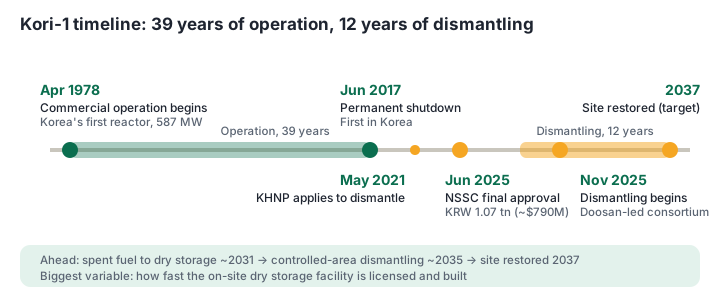
2. Timeline: eight years from shutdown to the first cut
Milestones and plan dates, as of September 2026:
| Date | Event |
|---|---|
| Apr 1978 | Commercial operation begins (587 MW, Westinghouse PWR) |
| Jun 2017 | Permanent shutdown, the first in Korea |
| May 2021 | KHNP submits its final decommissioning plan and applies for approval |
| Jun 2025 | NSSC grants Korea’s first decommissioning approval (216th meeting, June 26) |
| Nov 2025 | Doosan-led consortium starts dismantling in the non-controlled area |
| 2031 | Spent fuel moved from the pool to on-site dry storage (plan) |
| 2035 | Radiological-area dismantling complete (plan) |
| 2037 | Site restoration complete (target) |
Eight years passed between shutdown and approval because the steps run in series. KHNP first had to write a final decommissioning plan and hold public hearings in the host community, which took until May 2021. NSSC then reviewed it for four years, on the basis of KINS’s safety review and a preliminary review by its expert committee.
The other reason is physics. Almost all the radioactivity in a shut-down reactor is in the spent fuel, so until the fuel leaves, the plant is a fuel store with a reactor attached and real dismantling cannot start. Kori-1’s fuel is still in the pool, and moving it out is what stretches the project into the 2030s.
In industry terms this is immediate dismantling, 12 years from approval to a restored site, rather than the decades of “safe storage” some US and UK plants chose first. It is an ambitious choice for a first project.
3. What is happening on site now
A nuclear site divides into a radiologically controlled area, holding the reactor and its primary circuit, and a non-controlled area where radiation never exceeds regulatory limits. The work under way is in the second.
On November 4, 2025, Doosan Enerbility announced a contract with KHNP for dismantling in the non-controlled area and the yard, as lead of a consortium with HJ Shipbuilding & Construction and KEPCO KPS. The scope is secondary-side equipment such as turbines and piping, in phases through 2028, for about KRW 18.4 billion (about $14 million). The regulator’s stated logic is to start with the least radioactive facilities, limiting worker exposure and any spread of contamination.
For the companies it is a proving ground: equipment, crews and procedures get tested on the easy part before anyone cuts into the reactor building. NSSC has said it will keep inspectors on site daily, receive progress reports every six months and publish the inspection results.
4. The hard part: 2031 to 2037
The plan after 2028 runs in this order:
- Spent fuel out, by 2031. The fuel assemblies move from the pool into dry casks, sealed metal containers cooled by air and, in KHNP’s Kori design, housed inside a building, at a new dry storage facility on the Kori site.
- Decontamination and dismantling of the controlled area, by 2035. Surfaces are decontaminated chemically or by blasting, and the reactor vessel and its internals are cut with remote and robotic tools where people cannot work. This is the robotic and remote-handling work described in our Korean guide to the four stages of decommissioning (in Korean).
- Waste sorting and site restoration, by 2037. The government’s policy briefing on the approval (June 2025) puts total material at about 170,000 tonnes, of which roughly 160,000 tonnes is expected to be cleared as non-radioactive after measurement. The rest goes to Korea’s low- and intermediate-level repository at Gyeongju, operating since 2015; see our tour of the world’s repositories.
The whole program is costed at KRW 1,071.3 billion, about $790 million, funded from the reserve KHNP set aside during operation. KHNP says any overrun will be covered from cash or corporate bonds. Decommissioning projects abroad have a long record of overrunning both budget and schedule, and Kori-1 has no local precedent to calibrate against.
5. The dry storage problem
Everything in section 4 depends on the dry storage facility, which is also the project’s political fault line.
KHNP’s board approved a basic plan for on-site dry storage at Kori in February 2023, sized for at least 2,880 fuel assemblies, with operation targeted for 2030 after roughly seven years of design, licensing and construction. The plan predated any Korean law on high-level waste, and the host county, Gijang, objected on exactly that ground: the facility was being pushed through without the resident-consent procedure a law would require. Environmental groups went further: the Busan Federation for Environmental Movements warned that if the national interim storage site is delayed, the Busan, Ulsan and South Gyeongsang region “becomes a nuclear waste dump” (as reported by the Busan Ilbo, February 2023).
As of August 2026, that timetable has already moved. KHNP has not yet filed the Kori application; it told the regulator it would file in December 2026, and NSSC says it aims to bring the Kori and Hanul applications to the commission in the first half of 2029 (a sister application for the Hanbit site was filed in April 2026). Kori’s pools were 93.4% full as of March 2026, with saturation expected in 2032, so the facility that was supposed to open in 2030 now has almost no float before the 2031 fuel-removal date (Yonhap and News1, August 4, 2026, citing NSSC).
The fear that “temporary” becomes permanent has a basis in the national calendar. Korea’s Special Act on High-Level Radioactive Waste Management, passed in February 2025, finally created a site-selection process, but its own targets are an interim storage facility by 2050 and a deep repository by 2060. The Act caps on-site storage at what a plant produces in its design life and requires the fuel to move out as soon as the interim facility opens, but those are promises on paper. Fuel that goes into Kori’s dry casks in 2031 is therefore planned to stay there for about two decades, and Korea has still not decided between reprocessing and direct disposal; see reprocessing versus disposal, and why Korea is the undecided country.
From the engineering side, dry cask storage is mature technology used at dozens of sites in the US, and leaving the fuel in a pool inside a plant that is supposed to be dismantled is the worse option. But the community is being asked to trust a national schedule that has slipped for decades, and Korea’s only existing dry storage is at the Wolsong heavy-water reactor site; this will be its first for light-water fuel.
NSSC has said the licensing will go through public hearings and a full review of radiological impact, geology and hazard vulnerability. How quickly that happens is the single biggest variable in the 2037 date.
6. What Korea gets from doing this
Kori-1 is not a one-off. Wolsong-1, a heavy-water reactor taken offline in May 2018 with its permanent closure confirmed in December 2019, is next in line, and the older units of a 26-reactor fleet will follow over the coming decades. Every procedure written and every mistake made at Kori-1 becomes the template.
It is also the track record Korea needs abroad. More than 200 reactors worldwide are already permanently shut down, and the market forecasts Korean media like to quote, on the order of KRW 500 trillion (about $370 billion), are cumulative sums spread over decades, paid ultimately from utilities’ decommissioning reserves and therefore from electricity bills.
Only a handful of countries, the US and Germany among them, have taken commercial reactors all the way to a released site. Korean companies have not completed one yet, and no export customer will take that on faith; the reference project has to exist first.
Korean daily Asia Economy reported in June 2025 that, on the government’s own 2015 count, Korea holds 96 decommissioning technologies, 38 core ones developed by KAERI (Korea Atomic Energy Research Institute) and 58 commercialized by KHNP, and that KHNP has trained about 600 specialists. The same report noted that operating data from real decommissioning sites is still thin and that decontamination of highly contaminated equipment in particular is likely to depend on foreign technology. In short: prepared on paper, unproven in practice.
Three things to watch:
- Dry storage licensing. Watch for KHNP’s license application, promised for December 2026, the public hearings in Gijang, and whether NSSC keeps its first-half-2029 review target. Every month of slippage there moves 2031, 2035 and 2037 together.
- Schedule discipline. Whether the non-controlled-area work finishes by 2028 as contracted is the first measurable test of the Korean supply chain.
- The site’s future. What replaces Kori-1 after 2037 (reuse, a new plant or green space) has not been decided and will need the same community that is arguing about dry storage today.
Where this goes next. The dated events ahead are the dry storage license application (promised for December 2026) and its hearings, the 2028 end of the current contract and the tendering of the controlled-area work that follows it, and NSSC’s semiannual inspection reports. Those reports will be the first public record of how a Korean decommissioning performs against its plan.
Industry note. On the Kori-1 site: KHNP (unlisted), owner and project manager; Doosan Enerbility (KRX: 034020), lead dismantling contractor; KEPCO KPS (KRX: 051600) and HJ Shipbuilding & Construction (KRX: 097230), consortium members. KEPCO E&C (KRX: 052690) covers design and safety assessment; Woojin (KRX: 105840) and Orbitech (KOSDAQ: 046120) work in radiation instrumentation and waste clearance. Revenue from one decommissioning is recognized over more than a decade, and Korean decommissioning-themed shares have a history of moving on headlines rather than contracts.
This section is provided to help understand the industry and is not a recommendation to buy or sell any security. Investment decisions and their consequences are the reader’s own.
Sources: Nuclear Safety and Security Commission (NSSC), decision approving the Kori-1 final decommissioning plan, 216th meeting (June 26, 2025); Korea Policy Briefing (korea.kr), “Korea’s first nuclear plant, Kori-1, to be dismantled after 47 years” (June 2025); Doosan Enerbility, press release on the Kori-1 non-controlled-area decommissioning contract (November 2025); World Nuclear News, “Decommissioning of oldest Korean reactor approved” (June 2025) and “KHNP applies to dismantle Kori 1” (May 2021); World Nuclear Association, Nuclear Power in South Korea country profile (updated June 2026); Busan Ilbo, report on KHNP’s board decision on the Kori dry storage facility (February 2023); Asia Economy, “Dismantling has begun, but the tasks start now” (June 2025); Korea’s Special Act on High-Level Radioactive Waste Management (2025); Yonhap and News1, reports on NSSC’s dry-storage licensing schedule (August 4, 2026).