Korea's SMR program in 2026: where i-SMR really stands, and what the new SMR Act changes
Korea's i-SMR filed for design approval in Feb 2026, but test results are due June 2028 and commercial operation is targeted for 2035. The real timeline.
Data as of October 2, 2026 — statistics, prices, schedules and regulatory status in this article were checked on this date. Where a different date is given in the text, that date takes precedence.
Try to follow Korea’s SMR program for even a week and you run into a law, a regulator’s roadmap, a candidate site and a queue of corporate sponsors, all arriving at once. Not all of it moves the reactor forward.
On September 1, 2026, one piece of that arrived at Seoul National University’s Nuclear Policy Center, where GS Energy, a private Korean power company, hosted a policy forum on building a “private-sector-led SMR business model.” SK Innovation presented a Korea–US cooperation model built around TerraPower. POSCO Holdings said it wants small modular reactors to supply the 1.7 GW of electricity its hydrogen-based steelmaking will need.
GS Energy spoke first, and what it put on the table was a list of four uncertainties: reactor type and technology, revenue structure, community acceptance, and the legal and regulatory framework. Ten days later, on September 11, Korea’s SMR Special Act enters into force.
The simpler question, asked from inside the Korean nuclear sector, is how far along Korea’s own reactor actually is, and what the calendar says.
Key takeaways
- i-SMR (four 170 MWe integral pressurized-water modules, 680 MWe per plant) filed for Standard Design Approval on February 27, 2026. The review has only begun: the regulator’s plan puts the main test results at June 2028, so the “approval by 2028” target has almost no slack.
- The SMR Special Act (in force since September 11, 2026), the regulator’s 2026–2030 roadmap and the Gijang candidate site (chosen in June) are building the frame, with construction targeted for around 2030 and commercial operation for 2035. The construction permit, a buyer for the power and the cost are still blank.
- The leading SMRs abroad aim for first power around 2030, roughly five years ahead. What to watch: the approval date, first-of-a-kind cost, power purchase agreements, and spent fuel.
1. i-SMR in 30 seconds
Korea’s SMR is the i-SMR (innovative small modular reactor). It is an integral pressurized-water reactor, the same basic technology as Korea’s operating fleet, packaged as a 170 MWe module; four modules make one 680 MWe plant.
A dedicated program office, the i-SMR Technology Development Agency, was launched in 2023 and is spending KRW 399.2 billion (about $295 million) in combined government and private funding over 2023–2028. The stated goal is to obtain Standard Design Approval by 2028.
The institutions that appear below, for readers outside Korea:
- NSSC (Nuclear Safety and Security Commission) is Korea’s nuclear regulator, the counterpart of the US NRC.
- KINS (Korea Institute of Nuclear Safety) is the technical body that carries out the safety reviews on which NSSC decides.
- KHNP (Korea Hydro & Nuclear Power) is the state utility that operates all of Korea’s reactors and is the expected owner and operator of the first i-SMR plant.
- Standard Design Approval (SDA) is a site-independent approval of a reactor design intended to be built repeatedly. It is the same concept as the NRC’s SDA: it does not by itself allow construction anywhere. A construction permit and an operating license for a specific site come later.
If you want the basics of what an SMR is and what it does and does not change, see our Korean SMR explainer (in Korean).
2. Where the clock stands
The design review has barely started
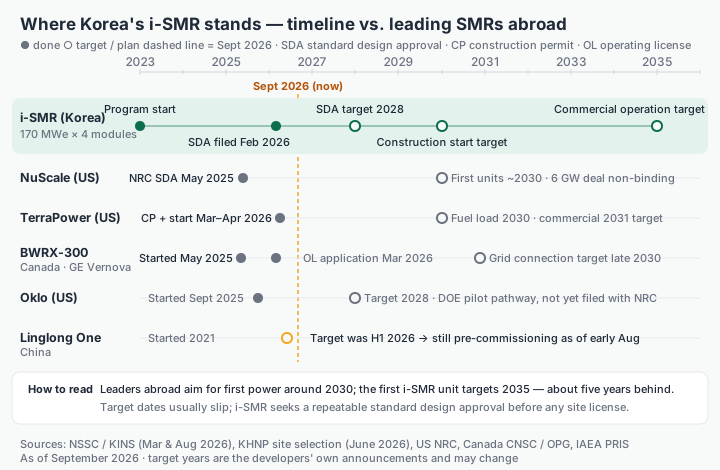
The program office filed the SDA application with NSSC on February 27, 2026. The statutory review period is 24 months, but the review plan that KINS reported on August 27, 2026 shows how much work sits in front of that clock. The document check produced 13 supplement requests; the supplemented documents are due in June 2027, and the main verification test results are due in June 2028 (status as of August 2026).
An NSSC official described the completion date as “fluid.” Read plainly, approval is more likely to come in the second half of 2028 or later, which means the 2028 target has almost no margin. It has not slipped yet, but nothing in the schedule is there to absorb a delay.
The law and the regulator: a framework still under construction
The SMR Special Act passed the National Assembly on February 12, 2026 and took effect on September 11, 2026. Its core is promotional: a national SMR development plan, a promotion committee, and designated R&D zones. On the same day the Act passed, NSSC published its SMR Regulatory Framework Roadmap (2026–2030), which schedules SMR-specific technical standards for 2027 and amendments to the Nuclear Safety Act for 2028.
That means the design review and the writing of the rules it will be judged against are running in parallel. Korean environmental groups made exactly this point in August: licensing has started while the regulatory system is still being built, and they asked the regulator to set the safety standards first. It is a fair criticism of the sequence. Regulators abroad have also written SMR-specific rules while reviewing first applications, but that is context, not an answer to it.
The site: chosen, but the procedure is not
KHNP’s site selection committee confirmed Gijang County in Busan, on the southeastern coast, as the first candidate site on June 17, 2026, with a score of 87.11 against 84.56 for Gyeongju. Gijang already hosts the Kori nuclear plant. The plan from here is SDA in 2028, then public consultation and a construction permit, then construction start around 2030 (Korean outlets give 2029 to the early 2030s) and commercial operation in 2035.
3. Side by side with SMRs abroad
The same five reference projects appear in our world map of SMR licensing in 2026; here they are only the yardstick.
- NuScale (US): its 77 MWe module received NRC Standard Design Approval in May 2025. The 6 GW program with TVA and ENTRA1 remained a non-binding agreement as of August 2026.
- TerraPower (US): NRC construction permit in March 2026 and groundbreaking in Wyoming in April. Targets are fuel loading in 2030 and commercial operation in 2031.
- GE Vernova–Hitachi BWRX-300 (Canada): construction at Darlington began in May 2025, the operating license application was filed in March 2026, and grid connection is targeted for late 2030.
- Oklo (US): construction of the first Idaho unit started in September 2025, but under the US Department of Energy’s pilot-program authorization pathway rather than NRC licensing; a formal NRC application has not yet been filed. The company targets operation in 2028.
- Linglong One (China): construction began in 2021 with commercial operation targeted for the first half of 2026. As of early August, World Nuclear News still described it as in pre-commissioning tests, with no announcement of fuel loading or criticality, so completion is not officially confirmed.
The leading group abroad is aiming at first power around 2030; i-SMR is aiming at 2035, about five years behind. Two qualifications matter.
Nuclear target dates generally slip, in every country, and i-SMR is following the NuScale-style route of securing a repeatable standard design approval before any site-specific license, which front-loads the paperwork. Korea’s reactor is one of the credible candidates, neither ahead of the pack nor out of it.
4. What the private sector asked for on September 1
The forum is worth a closer look because it shows where Korean industry thinks the bottlenecks are; GS Energy’s four uncertainties are listed above. SK Innovation’s contribution was a Korea–US model in which it works with TerraPower, whose Natrium reactor is the one already under construction in Wyoming. POSCO Holdings’ 1.7 GW figure is the power its hydrogen reduction steelmaking would need, which is about two and a half i-SMR plants.
The two concrete requests were to allow long-term power purchase agreements (PPAs) for SMR output and to write SMRs into the 12th Basic Plan for Long-term Electricity Supply and Demand, the government’s rolling 15-year plan that determines which power plants get built. In Korea’s market, where the state utility KEPCO is the near-exclusive buyer of electricity, neither is a given. A reactor with no buyer for its power does not get built, and what industry asked for on September 1 was, in effect, a buyer.
5. Four realistic things to watch
- Licensing pace. If SDA slips past 2028, construction and operation slip with it. The signals come in order: document supplements in June 2027, then test results in June 2028.
- First-of-a-kind cost. The first US SMR project (NuScale with UAMPS, a group of Utah municipal utilities) was canceled in 2023 after cost increases. No public estimate exists yet for the first i-SMR plant, and the cost of new nuclear build is an open question in Korea as much as anywhere.
- A buyer for the power. The PPA and Basic Plan requests from September 1 are the tell. Watch whether the 12th Basic Plan, when it is drafted, includes SMR capacity.
- Spent fuel. A smaller reactor does not make waste disappear, and some analyses find that certain SMR designs produce more waste per unit of electricity, not less; see our Korean SMR explainer (in Korean). Gijang, home to the Kori plant, will not be able to avoid that discussion.
6. Who builds it: the i-SMR value chain
If i-SMR reaches construction, the work flows in order: design, then major components, then instrumentation and control, then construction. The table maps the Korean nuclear value chain onto i-SMR, listing only roles confirmed in public disclosures (as of September 2026). The full value chain is in our Korean guide to nuclear stocks (in Korean).
| Stage | Company | Link to i-SMR |
|---|---|---|
| Design | KEPCO E&C (KRX: 052690) | Participates in developing the i-SMR standard design and obtaining SDA |
| Components | Doosan Enerbility (KRX: 034020) | Korea’s reactor-vessel manufacturer. Investing KRW 806.8 billion (about $600 million) in a dedicated SMR plant in Changwon, March 2026–June 2031; production building targeted for 2028 |
| I&C | Woojin (KRX: 105840) | Nuclear instrumentation supplier; developing instruments within the i-SMR program |
| Construction | Hyundai E&C (KRX: 000720) | EPC partner for Holtec’s SMR-300 (two units at Palisades, Michigan). NRC docketed the part-one construction permit application in February 2026 |
| Construction | Samsung C&T (KRX: 028260) | Early NuScale investor (most of the stake sold in 2025); participating in FEED for the Romanian SMR project |
| Construction | Daewoo E&C (KRX: 047040) | i-SMR development agreement with KHNP (2023); SMR cooperation with KEPCO KPS, the utility’s maintenance subsidiary (2025) |
| Abroad | NuScale (NYSE: SMR) | Holds NRC Standard Design Approval; 6 GW program is non-binding |
| Abroad | GE Vernova (NYSE: GEV) | Developer of BWRX-300; first unit under construction in Canada |
The field is wide, but i-SMR revenue for Korean companies only becomes real once a construction permit follows the SDA, and the earliest realistic point for that is the second half of 2028 or later.
Where this goes next. With the Act in force since September 11, the next dated events are the first meeting of the promotion committee it creates, the drafting of the 12th Basic Plan, and the June 2027 document deadline at KINS. None of them will tell you whether Korea’s SMR succeeds. Together they will tell you whether the 2028–2030–2035 calendar is still intact, and that is the one thing worth tracking.
My own take: that June 2027 document deadline matters more than any forum headline. It will not trend. That is exactly why it is worth watching.
Industry note. The listed companies with a public role in i-SMR or in overseas SMR projects are KEPCO E&C (KRX: 052690), Doosan Enerbility (KRX: 034020), Woojin (KRX: 105840), Hyundai E&C (KRX: 000720), Samsung C&T (KRX: 028260) and Daewoo E&C (KRX: 047040) in Korea, and NuScale (NYSE: SMR) and GE Vernova (NYSE: GEV) abroad. For the Korean companies, i-SMR-specific revenue depends on a construction permit that cannot come before late 2028; the two US names are listed as overseas reference projects, not i-SMR suppliers.
This section is provided to help understand the industry and is not a recommendation to buy or sell any security. Investment decisions and their consequences are the reader’s own.
Sources: Nuclear Safety and Security Commission (NSSC), press release on the start of the i-SMR Standard Design Approval review (March 2026), KINS review plan report (August 2026), and SMR Regulatory Framework Roadmap 2026–2030 (February 2026); Korea Policy Briefing, passage of the SMR Special Act (February 2026); Korea Hydro & Nuclear Power, site selection committee result (June 2026); Seoul National University Nuclear Policy Center and GS Energy, policy forum on a private-sector SMR business model (September 1, 2026); US NRC licensing records (NuScale SDA, May 2025; TerraPower construction permit, March 2026; Holtec Palisades docketing, February 2026); Canadian Nuclear Safety Commission, Darlington New Nuclear Project status; World Nuclear News, Linglong One status (August 2026); Doosan Enerbility disclosure on the Changwon SMR plant (2026); IAEA PRIS.