Korean builders are lining up to build Western SMRs, but few contracts are signed
Samsung C&T, Hyundai E&C and Doosan Enerbility are signing on to US and European SMR projects. What is a contract, what is an MoU, and the risks (Oct. 2026).
Data as of October 5, 2026 — statistics, prices, schedules and regulatory status in this article were checked on this date. Where a different date is given in the text, that date takes precedence.
On September 29, the US Nuclear Regulatory Commission issued the first US construction permit for a GE Vernova Hitachi BWRX-300, for the Tennessee Valley Authority (TVA) at Clinch River, Tennessee. TVA and GE Vernova call it the first for a commercial small modular reactor (SMR) in the United States; the larger sodium-cooled Natrium plant was permitted in March.
The team TVA named in January 2025 to plan, design and potentially build it is Bechtel, Sargent & Lundy and GE Hitachi. No Korean company is on that list.
Yet in the week before the permit, Samsung C&T signed a four-way memorandum on the same reactor type for Europe and a binding term sheet with Kairos Power. In August, Hyundai E&C and Doosan Enerbility both signed with TerraPower.
Western SMR developers are moving from licensing to construction, and Korean firms are entering through side doors: as construction partner, equipment maker or minority investor. Which doors are actually open?
Key takeaways
- Doosan Enerbility, Korea’s reactor-vessel maker, holds the firmest positions, as a component supplier to TerraPower, Rolls-Royce SMR and NuScale. The builders’ roles are earlier-stage: Samsung C&T’s Kairos deal is a binding term sheet subject to regulatory approvals, and the other builder arrangements are MoUs or framework agreements.
- At Clinch River, which TVA and GE Vernova call the first US permit for a commercial SMR, no Korean firm is named. At TerraPower’s Natrium plant, Bechtel’s exit, confirmed September 21-22, left the lead construction role to be rebid, and no replacement has been named.
- Korea’s pitch is a repeat-build record on large reactors, with Barakah as the proof. That record includes years of delay, and none of it has been tested on an SMR yet.
1. Why SMR projects suddenly need builders
For years the SMR story was about designs and licenses. In 2026 it became about concrete. The NRC issued TerraPower’s Natrium construction permit in March, Kairos broke ground on its Hermes 2 plant in April, and Ontario Power Generation is already building the first BWRX-300 at Darlington after receiving its license to construct in April 2025.
Natrium, Hermes and Darlington are the three Western projects that our SMR status map lists as holding construction permits and having poured nuclear concrete.
The Clinch River review took 14 months, four months ahead of schedule, according to World Nuclear News (WNN). A permit is not a construction start. TVA has announced no construction date and says it is still negotiating cost sharing with its industry partners, WNN reported.
Developers are reactor designers, not general contractors. Kairos says it will lead the nuclear island itself but wants partners for the rest of the plant, and Fluor, NuScale’s longtime engineering partner, had sold its entire NuScale stake by April 2026, according to trade press reports.
Korean builders have their own push. Korean daily Seoul Economic Daily reported in May 2026 that domestic builders are turning to nuclear and data centers because rising costs and a housing slump have squeezed margins.
2. Who is where: Korean firms in Western SMR projects (as of October 2026)
The table lists only roles I could confirm in company releases, WNN or SEC filings. “MoU” and “framework” mean non-binding.
| Firm | Project | Role | Status |
|---|---|---|---|
| Samsung C&T | Kairos Hermes 2, US | Power systems and balance-of-plant EPC team; up to $100M | Binding term sheet, announced Sept. 21 (WNN, Sept. 22) |
| Samsung C&T | BWRX-300, Central/Eastern Europe and UK | EPC capability in a four-way MoU | MoU, Sept. 22 |
| Samsung C&T | NuScale Doicești, Romania | FEED participation; EPC award not confirmed | 2023 MoU; Romania approved investment Feb. 2026 |
| Hyundai E&C | Holtec Palisades, US | Balance-of-plant design, EPC partner | MoU and teaming; no contract reported |
| Hyundai E&C | TerraPower Natrium, US | EPC right for up to 8 later units | Framework, announced Aug. 14 and 18 |
| Doosan | TerraPower Natrium, US | Core barrel, guard vessel, internal supports | Manufacturing contract, Aug. 2026; value undisclosed |
| Doosan | Rolls-Royce SMR, UK and Czechia | Reactor vessel pre-production work, with Škoda JS | Selected May 28; terms not disclosed |
| Doosan | NuScale, US | Forgings for 12 upper vessels | Orders placed; in production |
| Doosan | X-energy Xe-100, US | Forgings capacity | Reservation, Dec. 2025 |
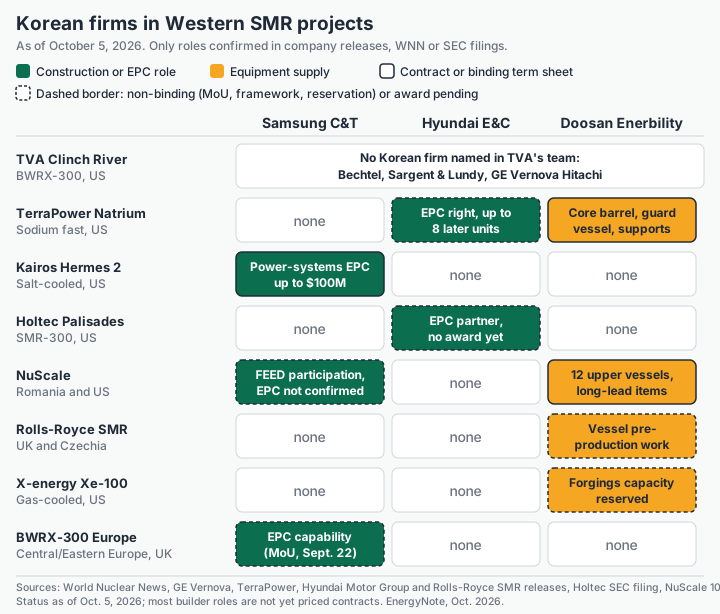
Some details change how to read the rows.
- Samsung C&T and Kairos: The deal combines direct investment and in-kind engineering services, subject to regulatory approvals, and builds on an August 18 memorandum with Barnard Construction (WNN, September 22). Kairos keeps the nuclear island. Hermes 2 is a 50 MWe plant in Oak Ridge, Tennessee, and reports differ on whether it starts operating in 2030 or 2031.
- Samsung C&T in Europe: The BWRX-300 memorandum was signed in New York with GE Vernova, Hitachi and Poland’s SGE, which has decisions in principle for 26 units, and a UK proposal for 14 is under consideration, per GE Vernova. In Romania, shareholders of state utility Nuclearelectrica approved the Doicești investment on February 12, subject to confidential conditions, POWER magazine reported. Samsung C&T joined the front-end design study in July 2024, according to Korea Economic Daily, but I could not confirm an EPC award.
- Hyundai E&C and Holtec: Holtec’s 2026 SEC filing, an S-1 for an IPO that Holtec postponed in mid-September according to WNN, describes an MOU for joint delivery of the two Palisades units, while trade press calls Hyundai E&C the exclusive EPC delivery partner. Seoul Economic Daily called it the “front-runner” for a KRW 1.3 trillion (about $960 million) Palisades contract in May. Holtec filed the first part of its construction permit application on December 31, 2025, and the NRC review is expected to conclude in the first half of 2027, according to ANS.
- Hyundai E&C and TerraPower: The framework gives Hyundai E&C the right to serve as EPC partner for up to eight follow-on Natrium units, according to its own release. TerraPower’s own release says the framework carries completion, price and performance guarantees; Hyundai’s release, which describes only a “right to serve as the EPC partner,” does not. Neither release describes a role at Kemmerer Unit 1.
- Doosan: Rolls-Royce SMR selected it with Škoda JS for pre-production work, with contract terms not disclosed, and the Wylfa investment decision is not expected until 2029. The X-energy item is a capacity reservation, not a purchase order. Natrium’s reactor vessel itself goes to HD Hyundai, a different Korean company, according to Nuclear Engineering International.
3. What Korean firms bring
The core argument is repetition. Barakah in the UAE was four APR1400 reactors, with construction of Unit 1 starting in July 2012 and Unit 4 entering commercial operation in September 2024, a record we reviewed at the five-year mark. Hyundai E&C and Samsung C&T were both on that Korean team.
At home, Hyundai E&C leads the Shin-Hanul 3 and 4 main works with a 55 percent share of a KRW 3.1 trillion (about $2.3 billion) contract signed in December 2023. Samsung C&T leads Saeul 3 and 4, and Saeul 3 received its operating license on December 30, 2025.
Doosan has supplied every set of APR1400 main components in Korea, part of a division of labor drawn in our map of Korea’s nuclear industry.
A second asset is balance sheet. Samsung C&T is putting money in alongside its engineering, and Hyundai E&C’s framework carries guarantees, according to TerraPower. For a developer without a track record, a builder that shares risk is a selling point.
My own reading is that this is also the weak point. Barakah’s lesson was that Korea’s edge is building the same design again and again, and an SMR that has never been built is not that.
4. Where it could go wrong
- Paper is not contracts: Of the nine rows above, only Doosan’s NuScale and Natrium items involve contracts or work orders. The builder rows are a term sheet, MoUs and a framework. A framework can be real and still never produce a unit.
- The Westinghouse shadow: KEPCO and KHNP settled Westinghouse’s intellectual-property claims over the APR1400 on January 16, 2025, with confidential terms. Reported terms, unconfirmed by the companies, bar Korean reactor bids in North America, which is why the proposed US-Korea nuclear package contemplates a waiver for two APR1400s. Those terms concern Korean-designed reactors while the SMR roles here sit on other companies’ designs, and I found no public statement on how the settlement applies to them.
- First-of-a-kind cost: The Institute for Energy Economics and Financial Analysis (IEEFA), a US research group critical of nuclear expansion, argued in May 2024 that SMRs are “too expensive, too slow and too risky.” It points to NuScale’s Utah project, whose cost estimate had jumped to $9.3 billion by the time it was cancelled in November 2023, against about $3 billion promised in 2016. Kairos CEO Mike Laufer says in the Samsung announcement that the company has a “disciplined delivery model,” which is a claim and not yet a result.
- Concentration: SMR Intel, an industry analysis site, warned that putting Natrium’s vessel and internals in Korean hands means a shift in Korean industrial policy, trade dynamics or US export-control alignment would become a program-level risk. That is one analyst’s view. Doosan’s X-energy and NuScale work raises the same question.
- The Bechtel warning: Bechtel and TerraPower said on September 22 they would move forward separately on Natrium, TerraPower will rebid the EPC contract, and TerraPower says the schedule holds, according to WNN. Neither company explained publicly: a WARN notice says only that they could not agree on how to move to the next phase, and Nuclear Engineering International reports, without naming a source, that the sticking points were commercial terms and pricing. If so, a newcomer should expect hard bargaining over price and risk.
5. Where this goes next
Four events will show whether the doors are real: TVA’s construction start and cost-sharing deal, TerraPower’s EPC rebid, the NRC’s Palisades decision in 2027 with any Hyundai E&C award, and definitive Samsung C&T documents with Kairos.
Demand is not the issue. Hyperscaler contracts and grid constraints keep pushing developers to build, and the open question is who carries the first-of-a-kind risk.
Reading the releases side by side, what stands out to me is how many are labeled MoU, framework, term sheet or reservation. The signed work is mostly steel, not concrete.
Industry note. Companies named here include Samsung C&T (KRX: 028260), Hyundai E&C (KRX: 000720) and Doosan Enerbility (KRX: 034020) in Korea, plus GE Vernova (NYSE: GEV), part of the joint venture that designs the BWRX-300, and NuScale (NYSE: SMR). Most agreements above are non-binding or unpriced, so announcements say little about revenue.
This section is provided to help understand the industry and is not a recommendation to buy or sell any security. Investment decisions and their consequences are the reader’s own.
Sources: World Nuclear News on the TVA Clinch River construction permit (Sept. 30, 2026), Samsung C&T and Kairos Power (Sept. 22, 2026), the BWRX-300 Europe MoU (Sept. 23, 2026), Bechtel and TerraPower (Sept. 22, 2026), Doosan Enerbility and Natrium (Aug. 21, 2026), Rolls-Royce SMR suppliers (May 28, 2026), X-energy and Doosan (Dec. 2025), Holtec and Hyundai E&C (Feb. 2025) and TVA’s contractors (Jan. 2025); GE Vernova press releases on the BWRX-300 MoU and the Clinch River permit (Sept. 22 and 29, 2026); TerraPower release on the Korean agreements (Aug. 14, 2026); Hyundai Motor Group release and UPI on the Hyundai E&C-TerraPower framework (Aug. 2026); Nuclear Engineering International on the Korean Natrium alliance (Aug. 2026) and on Bechtel’s exit (Sept. 24, 2026); WNN on Holtec’s IPO postponement (Sept. 2026); Korea Economic Daily on Samsung C&T and the Romanian design study (July 2024); Fluor and trade-press reports on its NuScale stake sale (Feb. to Apr. 2026); Korea JoongAng Daily on Samsung C&T and NuScale (June 2023); Korea Times on Doosan and Rolls-Royce SMR (May 28, 2026); Seoul Economic Daily on Korean builders (May 25, 2026); POWER magazine on the Doicești decision (Feb. 2026); ANS Nuclear Newswire on Holtec Palisades (Apr. 2, 2026); Holtec Nuclear S-1/A filing and NuScale 10-K for fiscal 2025 (SEC); Cowboy State Daily and Construction Dive on Bechtel and the WARN notice (Sept. 2026); SMR Intel on Samsung C&T-Kairos and Doosan-Natrium (2026); Westinghouse release on the KEPCO and KHNP settlement (Jan. 16, 2025); IEEFA, “SMRs: Still Too Expensive, Too Slow and Too Risky” (May 2024); EnergyNote posts on Barakah, Korea’s nuclear industry map, SMR status and the US-Korea package.