Korea's spent nuclear fuel in 2026: pool saturation dates, dry storage plans and the road to a repository
Kori's pools are 93% full and Hanbit saturates in 2030. Where Korea's spent fuel sits, what dry storage is planned, and how the 2025 waste act works.
Data as of September 10, 2026 — statistics, prices, schedules and regulatory status in this article were checked on this date. Where a different date is given in the text, that date takes precedence.
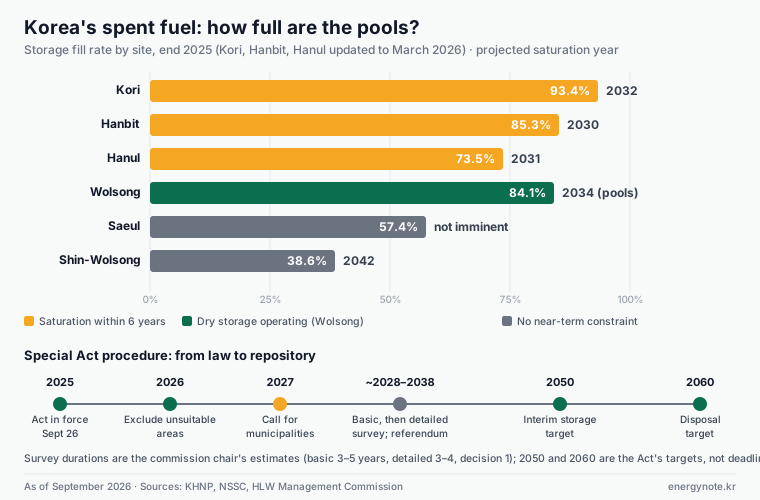
Every fuel assembly ever discharged from a South Korean power reactor is still where it was unloaded: in a pool or a dry container inside the fence of one of five coastal plants. At the end of 2025 that came to about 24,500 pressurized-water-reactor assemblies and 526,000 CANDU bundles, and at the oldest site, Kori, the pools were 93.4 percent full as of March 2026.
Korea has no interim storage facility, no repository site and, until last year, no law to find one. This article sets out the inventory site by site, what dry storage exists and what is being licensed, how the 2025 Special Act’s site-selection procedure works, and which dates decide whether the plan holds.
Key takeaways
- The pools at Hanbit, Hanul and Kori are projected to fill in 2030, 2031 and 2032. Korea’s only dry storage is for CANDU fuel at Wolsong; the first light-water dry storage application, for Hanbit, was filed in April 2026 and is not expected to reach a regulator’s vote before the first half of 2028.
- The Special Act on High-Level Radioactive Waste Management (in force September 26, 2025) targets an interim storage facility by 2050 and a repository by 2060, caps on-site storage at each plant’s design-life output and requires the fuel to leave once interim storage opens.
- The nine-member commission created by the Act is excluding unsuitable areas in 2026 and plans to invite municipalities to apply in 2027; its chair puts site selection alone at 9 to 13 years.
1. Who holds the fuel, and who decides
- KHNP (Korea Hydro & Nuclear Power), the state utility, operates all 26 licensed reactors, stores the fuel on its sites and applies for every storage license.
- NSSC (Nuclear Safety and Security Commission) is the regulator, Korea’s counterpart of the US NRC; KINS (Korea Institute of Nuclear Safety) does its technical reviews.
- KORAD (Korea Radioactive Waste Agency) runs the low- and intermediate-level repository at Gyeongju and is the sole body allowed to build high-level waste facilities.
- The High-Level Radioactive Waste Management Commission, under the Prime Minister, runs site selection under the 2025 Act; nuclear policy sits with the Ministry of Climate, Energy and Environment since October 2025.
The full cast, from uranium purchase to decommissioning, is in our map of Korea’s nuclear industry.
2. The inventory, site by site
Korea stores two kinds of fuel. Kori, Saeul, Hanbit, Hanul and the Shin-Wolsong units are pressurized-water reactors whose fuel comes in assemblies of roughly 0.4 to 0.5 tonnes of uranium; the four Wolsong CANDU units (one permanently shut) use natural-uranium bundles of about 20 kg, discharged a few at a time every day, so that Wolsong’s cumulative count runs into the hundreds of thousands. The unit list is in our reactor fleet map.
Storage status by site. Counts and fill rates are KHNP figures as of December 31, 2025, as reported by Korean daily Herald Business (May 28, 2026); the March 31, 2026 rates are from the NSSC’s August 4, 2026 report to the presidential office (Yonhap). Saturation years are those reported for the National Assembly’s 2026 audit (Energy Daily, September 8, 2026); for the PWR sites they match the government’s February 2023 projection, while Wolsong’s pool date has moved from 2037 to 2034.
| Site | Stored, end 2025 | Fill rate (Dec 2025 → Mar 2026) | Projected saturation |
|---|---|---|---|
| Kori | 7,471 assemblies | 92.9% → 93.4% | 2032 (2028 without added dense racks) |
| Hanbit | 7,619 assemblies | 84.5% → 85.3% | 2030 |
| Hanul | 7,548 assemblies | 73.5% → 73.5% | 2031 |
| Saeul | 896 assemblies | 57.4% | not imminent |
| Shin-Wolsong | 999 assemblies | 38.6% | 2042 |
| Wolsong (CANDU) | 526,412 bundles, pools plus dry | 84.1% | 2034 (pools) |
The Kori figure covers the pools of Kori 1 to 4 and Shin-Kori 1 and 2 together, and its 2032 date assumes the denser racks KHNP installs when a unit’s license is extended. The 2023 projection assumed continued operation for aging units, which pulled most dates forward by one or two years, and put lifetime generation at about 794,000 bundles and assemblies.
The pools are already run as one system. Korean daily Money Today reported in January 2026 that Hanbit 1’s pool, with 2,105 positions, held more than 1,900 assemblies and that fuel was being moved into the pools of units 3 to 6 to make room, a practice the paper called “pool juggling.” At Kori the pool of the shut-down unit 1 still holds its fuel, and the decommissioning plan cannot reach the reactor until that fuel is in dry storage; see our Kori-1 decommissioning tracker.
3. Wolsong: the dry storage Korea already runs
Korea’s only dry storage is at Wolsong in Gyeongju, on the southeast coast, because CANDU reactors produce far more bundles than a pool can hold. Three generations of air-cooled concrete storage stand there outdoors.
| Facility | In service | Capacity | Status (Sept 2026) |
|---|---|---|---|
| Concrete canisters, 300 | 1992 | 162,000 bundles | Full since 2010 |
| MACSTOR-400, 7 modules | 2010 | 168,000 bundles | Filling |
| MACSTOR-400, 7 more modules | March 2022 | 168,000 bundles | Filling |
The second MACSTOR phase is the nearest precedent for the fights now under way at the PWR sites. KHNP applied in April 2016; the NSSC approved the license change at its 113th meeting on January 10, 2020; a government-run local deliberation in Gyeongju returned 81.4 percent support; construction began in August 2020 and operating approval came on March 4, 2022. Each module is a concrete block about 22 m long holding bundles in sealed steel baskets cooled by natural air convection.
Dry capacity at Wolsong now totals 498,000 bundles. At the National Assembly’s audit in September 2026 lawmakers were told the canisters are at 100 percent and the MACSTOR modules at 76.9 percent (Energy Daily, September 8, 2026); the pools are projected to fill in 2034.
4. Dry storage for the PWR sites: three applications, one regulator
KHNP’s board approved a basic plan for dry storage at Kori in February 2023 and for Hanbit and Hanul in April 2023, each sized as the minimum needed to keep the reactors running until a national interim facility opens. All three use the same concept: fuel sealed in metal casks stored inside a building rather than on an open pad. The system design went to international tender in July 2023; Doosan Enerbility won the overall design in November 2023, and cask manufacturing is reserved for domestic contractors.
Status of the three applications, as of September 2026.
| Site | Planned facility | Application | NSSC target |
|---|---|---|---|
| Hanbit | 4,810 assemblies in 130 casks; operation July 2030 | Filed April 2026 | Vote in H1 2028 |
| Kori | At least 2,880 assemblies; operation 2031 | Planned December 2026 | Vote in H1 2029 |
| Hanul | Size not yet published; operation 2031 | Planned by end 2026 | Vote in H1 2029 |
Hanbit is the pilot, and its schedule shows how little float there is. The application needs a facility-plan approval in March 2027, a building permit in October 2027, a cask design approval in January 2028 and the operating-license amendment in May 2028 to open in July 2030, the year the pool fills (Electric Times, June 30, 2026). The NSSC has said the reviews will include public hearings and full assessments of radiological impact, geology and hazard vulnerability; KHNP’s draft facility plan under the Act was open for inspection by residents of Yeonggwang and neighboring Gochang County until August 18, 2026, followed by briefings and debates in both counties on September 1 to 4.
For Kori and Hanul the targets are tighter still: filings at the end of 2026, a vote in the first half of 2029 and operation in 2031, the year Hanul’s pools are projected to fill and the year Kori-1’s decommissioning plan needs its fuel out of the pool.
The local argument, in the communities’ own terms
Every host community has objected, and the objection is the same: a facility approved as temporary, with no national destination in sight, is permanent by default. Uljin County and its council opposed the Hanul plan in 2023 as being pushed “without legal basis,” and a council member cited a 1999 written government assurance that no further nuclear-related buildings would be added at the site (Daegu MBC, September 2023). Gijang County, host of Kori, objected in 2023 that the plan preceded any law requiring resident consent; in September 2024 a county councilor revealed that KHNP had drilled 15 geological boreholes on and around the site under groundwater-development notifications, without the county governor being told.
At Hanbit the dispute has moved to the facility’s size. Honam-region groups argue that KHNP’s 4,810-assembly capacity, derived as 7,619 assemblies through 2025 plus 6,014 more through 2050 minus 8,825 pool positions (4,808, rounded to 4,810), counts fuel from license extensions beyond the units’ design lives, which end between 2025 and 2042, and so breaches Article 36(6) of the Act (Namdo Ilbo, September 7, 2026).
KHNP’s answer is that 2050 is the Act’s own interim-storage target. Which reading the NSSC adopts will set the template for Kori and Hanul.
5. The Special Act and its commission
The Special Act on High-Level Radioactive Waste Management passed the National Assembly on February 27, 2025, by 190 votes to 8 with 27 abstentions, after nine years of failed bills; it was promulgated on March 25 as Act No. 20843 and took effect on September 26, 2025. Its main provisions:
- Targets. An interim storage facility before 2050 and a disposal facility before 2060, stated as targets the government must work toward rather than as binding deadlines.
- Commission. A High-Level Radioactive Waste Management Commission under the Prime Minister with nine members and a vice-minister-rank chair. Kim Hyun-kwon, a former Democratic Party lawmaker born in North Gyeongsang, took office as chair on October 3, 2025, and the nine-member body was completed on April 8, 2026, when four members nominated by the National Assembly joined the five government appointees.
- Site selection. The commission identifies candidate areas for a basic survey; mayors and county heads apply; a basic survey and then a detailed survey follow, each ending in a commission evaluation; the site is chosen after a local referendum under the Local Referendum Act and a commission vote.
- Host support. A support committee under the Prime Minister, a support plan and a special support fund for the host and surrounding areas.
- On-site storage. An operator wanting dry storage must adopt a facility plan with local input. Capacity is capped at the amount projected over the reactors’ design life (paragraph 6), fuel from other plants may not be brought in, and the fuel must move out as soon as the interim facility is complete.
- Research. An underground research laboratory. Taebaek, a former mining town in Gangwon Province, was selected on December 18, 2024; the KRW 513.8 billion (about $380 million) facility is planned for 2026 to 2032, though some geologists question whether its mixed rock is representative of a repository site.
The procedure and the time each step is expected to take, from the chair’s own account (Electric Times, June 17, 2026; Today Energy, September 7, 2026) and the 2021 second basic plan.
| Step | What happens | Expected duration |
|---|---|---|
| Exclusion | Rule out earthquake, fault and volcanic zones; identify candidate areas | 2026 |
| Call for applicants | Municipalities apply after consulting residents | From 2027 |
| Basic survey | Literature and field survey of applicant sites | 3 to 5 years |
| Detailed survey | Boreholes and underground characterization | 3 to 4 years |
| Referendum and decision | Local referendum, commission vote | About 1 year |
Where it stands as of September 2026: the commission’s fourth meeting on May 15, 2026 settled how an expert committee would be organized and started the exclusion work; the 35 experts, in four fields (siting, storage and transport, disposal, communication), were appointed over the summer and held their first meeting on August 21, 2026; a draft third basic plan is due in October 2026 and a final version by year end, ahead of the 2027 call. The chair cites a November 2025 survey in which 71 percent of respondents said they would accept a facility chosen through the Act’s procedure, and concedes that expanding on-site storage while no final destination exists requires transparent disclosure and democratic participation by the communities next to the plants.
6. The options still on the table
Reprocessing. Whether Korea buries its fuel intact or reprocesses it first changes what a repository must hold, and Korea has not chosen. Conventional reprocessing needs US consent under the 2015 US–Korea nuclear cooperation agreement, which runs to 2035; KAERI’s pyroprocessing has a pathway through a bilateral commission but no approval, and the November 2025 joint fact sheet recorded US support for a process toward Korean reprocessing without changing the agreement’s text. The arguments are in our comparison of reprocessing and direct disposal; interim storage is needed on either road.
What others do. Finland’s Onkalo passed its regulator’s safety review in August 2026 and awaits an operating-license decision; Sweden is building at Forsmark; France’s Cigéo is in licensing; the United States has a stalled repository for spent fuel. Across those programs community consent, not geology, decided the outcome, which is why the Korean Act spends more articles on procedure and support than on rock. The country-by-country picture is in our tour of the world’s repositories.
Where this goes next
Three dated things will show whether the plan is real. The first is the Hanbit application: a facility-plan approval by March 2027 keeps the July 2030 opening possible. The second is the first half of 2029, when the Kori and Hanul applications are due for a vote and Kori-1’s fuel-removal date is two years off.
The third is the 2027 call for candidate sites. Nine attempts since 1986 ended without a site; the difference this time is a statutory procedure with a referendum at the end.
If no municipality applies, or the surveys run at the slow end of the 9-to-13-year range, the 2050 target moves, and with it the promise in every dry storage license that the fuel will leave. The pools were the first temporary solution; the casks now being licensed are the second.
Industry note. The near-term work is casks and buildings, not repositories. Doosan Enerbility (KRX: 034020) holds the overall design of KHNP’s light-water dry storage system (November 2023); SeAH Besteel (a subsidiary of SeAH Besteel Holdings, KRX: 001430) makes spent-fuel transport casks and has exported dual-purpose casks to the United States; KEPCO E&C (KRX: 052690) covers design and safety assessment of storage facilities. Cask orders follow the NSSC’s licensing calendar.
This section is provided to help understand the industry and is not a recommendation to buy or sell any security. Investment decisions and their consequences are the reader’s own.
Sources: KHNP, spent fuel storage status by plant, quarterly dataset (Korea public data portal, latest quarterly release); Herald Business, report on spent fuel saturation and Korean disposal technology (May 28, 2026, KHNP figures as of end 2025); Yonhap and News1, NSSC report to the presidential office on dry-storage licensing and pool fill rates (August 4, 2026); Energy Daily, “2026 audit: spent fuel storage saturation imminent” (September 8, 2026); Money Today, “Pool juggling of spent fuel” (January 13, 2026); Electric Times, Hanbit dry storage schedule (June 30, 2026), KHNP dry-storage design tender (July 27, 2023), February 2023 saturation recalculation (February 10, 2023) and Wolsong MACSTOR report (April 4, 2023); Namdo Ilbo, Hanbit capacity dispute (September 7, 2026); Daegu MBC, Uljin County opposition to Hanul dry storage (September 2023); Open News, Gijang County boreholes (September 20, 2024); Busan Ilbo and Newsis on KHNP’s Kori board decision (February 2023); Electronic Times on the NSSC’s MACSTOR approval (January 10, 2020), Yeongnam Ilbo on the Wolsong dry storage facilities and the Gyeongju deliberation result (July 2021) and Nate News on the MACSTOR completion (March 15, 2022); Korea Law Information Center, Special Act on the Management of High-Level Radioactive Waste (Act No. 20843) and National Assembly bill summary; World Nuclear News, “South Korea enacts legislation on high-level waste” (February 2025); Ministry of Climate, Energy and Environment, commission fourth meeting release (May 15, 2026); Electric Times and Today Energy interviews with commission chair Kim Hyun-kwon (June 17 and September 7, 2026); Asia Today on the third basic plan (August 20, 2026); Newspim, chair profile (October 2, 2025); Hankook Ilbo, Taebaek URL selection (December 17, 2024); Korea Energy Economy News on the Taebaek geology debate (June 2025); World Nuclear Association, Nuclear Power in South Korea (2026).