How Korea's reactors are designed for earthquakes and tsunamis: the numbers, site by site
Korea's reactor seismic design basis explained: 0.2g vs 0.3g, the 2016 Gyeongju quake, post-Fukushima sea walls, and what critics say, site by site.
Data as of September 29, 2026 — statistics, prices, schedules and regulatory status in this article were checked on this date. Where a different date is given in the text, that date takes precedence.
At 8:32 p.m. on September 12, 2016, a magnitude-5.8 earthquake, the strongest ever instrumentally measured in South Korea, struck about 27 kilometers from the Wolsong nuclear site outside Gyeongju, and instruments there recorded shaking strong enough to trigger a manual reactor shutdown. Four units went off line as a precaution; none was damaged, and the recorded shaking stayed below the plant’s design limit. It was still the closest a Korean reactor site has come to testing the number engineers had written into its blueprints decades earlier.
That number is the safe-shutdown earthquake, or SSE: the ground motion a plant’s safety systems must survive without losing the ability to shut down and stay cool. This article lays out those numbers for Korea’s fleet, how regulators arrived at them, what changed after 2016, and what the plants’ flood defenses look like on paper, every figure dated and sourced.
Key takeaways
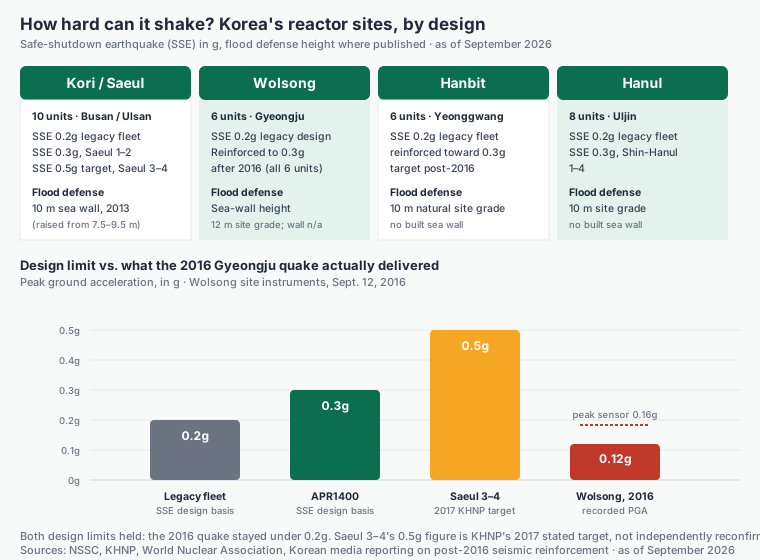
- Korea’s older reactors were designed to a safe-shutdown earthquake of 0.2g; the APR1400 fleet built from Shin-Kori 3 (2016) onward uses 0.3g, and Saeul 3 and 4 were targeted for an exceptional 0.5g under a 2017 KHNP plan. The 2016 Gyeongju M5.8 quake pushed the older fleet’s reinforcement target from 0.2g to 0.3g.
- Post-Fukushima upgrades raised Kori’s coastal barrier to 10 meters by 2013 and added sealed watertight doors fleet-wide from 2014; Hanbit and Hanul rely on 10–12 meter natural site grade instead of a built wall.
- Critics, including a Seoul National University environmental-policy professor and Gyeongju and Ulsan civic groups, argue the Busan-Ulsan reactor cluster near millions of residents and a once-undisclosed 2009–2012 finding on the Yangsan fault show regulators underweighted local seismic hazard for years.
1. What the numbers mean, and Korea’s two design generations
Seismic design for a reactor starts with a single figure: peak ground acceleration, expressed as a fraction of Earth’s gravity, “g.” A design of 0.2g means the plant’s safety-related structures must keep working through shaking that would accelerate the ground at up to 20 percent of gravity; 0.3g raises that to 30 percent. In the Gal unit still used in some Korean engineering documents, 0.2g is 196 Gal and 0.3g is 294 Gal.
Korea’s fleet was built in two generations on this measure.
- 0.2g (roughly magnitude 6.5-equivalent): the original basis for every Korean unit built before the APR1400, covering the Westinghouse and Framatome units at Kori and Hanul, all twelve OPR1000s, and the CANDU units at Wolsong. Our reactor fleet map lists every one of these units by site.
- 0.3g (roughly magnitude 7.0-equivalent): the basis for the APR1400, starting with Shin-Kori 3 and 4 (now Saeul 1 and 2, commercial operation 2016 and 2019) and carried through Saeul 3 and 4 and the Shin-Hanul units. Our APR1400 explainer covers the design in full; the reactor uses the same 0.3g basis at Barakah in the United Arab Emirates, a lower-hazard site.
One exception stands out. After the contentious 2017 public deliberation on Shin-Kori 5 and 6, now Saeul 3 and 4, KHNP announced on November 7, 2017 that it would strengthen those two units beyond the standard APR1400 basis, to a magnitude-7.4 equivalent, or 0.5g, its highest domestic seismic standard at the time. Whether that figure survived unchanged into final licensed design was not confirmed here.
Japan sets no single national figure; its plants carry site-specific ground motions, called Ss, and post-Fukushima reassessments pushed several well above Korea’s numbers, Kashiwazaki-Kariwa to 1,000 Gal (about 1.0g) after a 2007 earthquake there and Takahama 3 and 4 to 700 Gal (0.7g) in 2014, reflecting Japan’s denser pattern of shallow crustal faults. The United States likewise has no uniform figure: the NRC requires a site-specific probabilistic hazard analysis, and post-Fukushima it recalculated hazard curves for every operating plant instead.
2. How the design basis gets set, and what 2016 changed
Korea’s design earthquakes come from probabilistic seismic hazard analysis, the method IAEA Safety Guide SSG-9 recommends: geologists combine the historical earthquake catalog, mapped and inferred faults, and regional ground-motion models to estimate the shaking a site could see over a long return period, then set the design basis at or above that estimate. Korea has run this process, under successive versions of its technical standards, since Kori 1’s site was reviewed in the 1970s.
The 2016 Gyeongju earthquake tested those assumptions like no prior event. Peak ground acceleration recorded at the Wolsong site, reported at roughly 0.12g and, at one building-wall sensor, as high as 0.1585g, exceeded the 0.1g threshold for a manual shutdown, though it stayed below the 0.18g automatic-trip level and well under the 0.2g design basis. Within weeks the NSSC and Korea’s trade ministry set a target of reinforcing every operating reactor from the 0.2g, magnitude-6.5 basis to 0.3g, magnitude 7.0, by April 2018, and moved up a nationwide stress test from end-2019 to end-2018, prioritizing Wolsong and Kori for completion by end-2017.
The reinforcement program ran into a credibility gap of its own. By November 2017 KHNP had reported 21 of 24 units physically complete, but the NSSC’s independent review had cleared only two, Kori 1 and Wolsong 1, a lag between utility self-reporting and verified sign-off.
The six Wolsong-site units were eventually confirmed reinforced to the 0.3g standard, Korean media reporting on KHNP’s seismic program shows. No source consulted here gives one consolidated cost for the reinforcement program alone; the broader package of post-Fukushima seismic, flood and hydrogen-safety measures across the fleet cost roughly $1 billion between 2011 and 2017, per KHNP figures reported by S&P Global Platts.
On November 15, 2017, a magnitude-5.4 earthquake struck Pohang, about 40 kilometers from the Wolsong cluster, Korea’s most damaging quake on record by building-damage count. It was not, however, a natural tectonic event: peer-reviewed studies published in Science in 2018 concluded it was very likely induced by fluid injected into a fault zone at a nearby enhanced-geothermal-system pilot project. The quake still sharpened attention on the seismic hazard of the Gyeongju-Pohang-Ulsan corridor where most of Korea’s reactors sit, even though its cause was unrelated to nuclear operations.
Both earthquakes fed into a longer dispute over one structure: the Yangsan fault, which runs roughly north-south past the Kori, Saeul and Wolsong sites. A government-funded survey by the Korea Institute of Geoscience and Mineral Resources concluded in 2009-2012 that the fault was active, but Korean outlets including Newsmin later reported that officials withheld the finding over concern about public alarm, a decision that only drew scrutiny after 2016. In response, the government launched a 20-year, four-phase national active-fault survey running from 2017 to 2036, led by KIGAM, which resurveyed the Yangsan and Ulsan faults first and then moved through the western Gyeongsang basin, the Gaeum fault system near Uiseong, and Yeongdeok by 2021.
No single, undisputed government determination on the fault’s current activity status turned up in the sources here; that is a question worth an independent check.
3. Tsunami and flooding: Fukushima’s other lesson
Fukushima Daiichi’s reactors were built to a tsunami design basis of about 5.7 meters; the wave that struck on March 11, 2011 reached roughly 14-15 meters, well beyond it. Korean regulators and KHNP treated that gap, not the earthquake itself, as the more direct lesson for Korea’s coastal sites.
Kori, at the mouth of Busan’s Gijang County, got the most visible upgrade. Its concrete coastal barrier, which had stood 7.5 to 9.5 meters depending on the section, was extended to a uniform 10 meters over a 2.1-kilometer run, finished in 2013 at a reported cost of about KRW 16.6 billion (roughly $12 million). Hanbit and Hanul, by contrast, sit on natural site grades of roughly 10 to 12 meters above sea level, and KHNP’s post-Fukushima planning treated that elevation itself as adequate, forgoing a built barrier at either site.
Wolsong’s own coastal barrier height was not confirmed in the sources checked here and should not be assumed to match Kori’s; a separate, unrelated planning document put the site’s typhoon-related maximum predicted seawater rise at under 2 meters, which is not a tsunami design basis.
Across every site, KHNP installed a new generation of sealed watertight doors from March 2014, designed to seal tighter as outside water pressure rises and light enough, at about 157 kilograms, for operators to close by hand in minutes. Portable diesel generators and pump trucks were stationed at each site as a backup power and cooling source independent of the fixed emergency generators, which post-Fukushima reviews found could themselves flood if their buildings were not sealed.
4. The regulatory frame
The NSSC (Nuclear Safety and Security Commission) took over as Korea’s independent regulator on October 26, 2011, split out from the ministry that had combined promotion and oversight, a change made directly in response to Fukushima. KINS (the Korea Institute of Nuclear Safety), its technical review arm, carries out the seismic and flood-hazard analysis behind every siting and licensing decision, a process our guide to Korea’s licensing ladder covers in full.
Site seismic and flood criteria sit in the NSSC’s Rule on Technical Standards for Reactor Facilities, most recently amended in August 2021, which tracks the IAEA’s SSG-9 (seismic hazards in site evaluation) and SSG-18 (flood and hydrological hazards). Two review mechanisms apply once a plant is operating. Korea decided in 1999 to adopt the IAEA’s Periodic Safety Review framework and wrote it into law in 2001; it re-examines a plant’s safety case, seismic and flood basis included, roughly every ten years, most consequentially when a plant seeks continued operation, a process our Kori-1 decommissioning piece touches on for the unit that did not get one.
Separately, the NSSC built a stress-test guideline modeled on the European Union’s post-Fukushima stress tests, first applied to the continued-operation cases of Kori 1 and Wolsong 1 and later folded into the accelerated 2016-2017 reassessment.
5. What critics say
The strongest recurring criticism is not about any single number but about geography: Korea’s densest reactor cluster, Kori and Saeul together, sits closer to a major metropolitan population than almost any comparable site worldwide. More than 3.8 million people live within 30 kilometers of Kori, and a lawmaker has cited roughly 5 million within 50 kilometers who would be difficult to evacuate in a severe accident. Yun Sun-jin, a professor at Seoul National University’s Graduate School of Environmental Studies, argues that concentrating many reactors on a few sites carries risks that current cost assessments do not price in, and that Korea still lacks a way to quantify site-level risk, the chance of a simultaneous, multi-unit accident, separate from each reactor’s own risk figures.
Civic groups in Gyeongju and Ulsan press a related, more specific argument: that regulators and KHNP underweighted the region’s fault activity for years, pointing to the unreleased 2009-2012 KIGAM finding on the Yangsan fault as evidence. Groups including the Gyeongju Federation for Environmental Movements and the Collective Action for a Nuclear Free Society protested the Wolsong 1 continued-operation decision in 2015, arguing it proceeded despite the unit failing IAEA-referenced standards, a dispute distinct from but running alongside the seismic one; Wolsong 1 shut down for good in December 2019, on separate economic grounds. None of this amounts to a peer-reviewed hazard reassessment, and KHNP and the NSSC maintain the post-2016 reinforcement and ongoing fault survey answer the underlying concern; both sides deserve a place in any fair account.
6. Site by site: what is published
Figures as of September 2026. Saeul’s 0.5g figure for units 3 and 4 reflects KHNP’s 2017 stated target and was not independently reconfirmed as the final licensed value.
| Site | Units | SSE (g) | Flood defense |
|---|---|---|---|
| Kori / Saeul | 10 | 0.2g legacy fleet; 0.3g Saeul 1–2; 0.5g target, Saeul 3–4 | 10 m coastal barrier, completed 2013 |
| Wolsong | 6 | 0.2g legacy, reinforced to 0.3g post-2016 | 12 m natural site grade; sea-wall height not published |
| Hanbit | 6 | 0.2g legacy fleet | 10 m natural site grade, no built wall |
| Hanul | 8 | 0.2g legacy; 0.3g Shin-Hanul 1–4 | 10 m natural site grade, no built wall |
Industry note. KHNP, the operator, is unlisted. Doosan Enerbility (KRX: 034020) supplies the reactor vessels, steam generators and other heavy components that carry Korea’s seismic design margins into the plants it builds; KEPCO E&C (KRX: 052690) performs much of the site seismic and hazard-analysis engineering behind NSSC licensing submissions.
This section is provided to help understand the industry and is not a recommendation to buy or sell any security. Investment decisions and their consequences are the reader’s own.
Where this goes next
The national active-fault survey runs through 2036, and its later phases, covering ground Korea has not systematically mapped before, are the next real test of whether the post-2016 reassessment was thorough enough. I found the gap between KHNP’s 2017 completion claims and the NSSC’s slower verified sign-off more telling than any single g-value: a design number is only as good as the review that checks it was actually built.
Sources: World Nuclear Association, “Nuclear Power Plants and Earthquakes” and “Nuclear Power in South Korea” country profile (accessed Sept. 2026); World Nuclear News, “IAEA reviews seismic safety at Korean plants” (Aug. 2017); 2016 Gyeongju earthquake and 2017 Pohang earthquake overview pages, Wikipedia, cross-checked against primary reporting; POWER magazine, “South Korean Nuclear Plants Shut Down After Record Earthquake” (Sept. 2016); Kim, S. et al. and Grigoli, F. et al., “Assessing whether the 2017 Mw 5.4 Pohang earthquake … was an induced event,” Science (2018); Edaily, on Wolsong 1’s recorded peak ground acceleration during the 2016 earthquake; Hankook Ilbo, on the pre-2016 0.2g/magnitude-6.5 seismic design basis (Sept. 2016); eDaily and eToday, on the post-2016 reinforcement target, the November 2017 NSSC-review gap (21 of 24 reported complete, 2 verified), Wolsong reinforcement to 0.3g, the accelerated stress-test schedule, and Shin-Kori 5 and 6’s 0.5g target (Nov. 7, 2017); Munhwa Ilbo, on the completed 0.3g reinforcement of Wolsong’s six units; eToday and Segye Ilbo, on the Kori coastal barrier extension to 10 meters (2013, ~KRW 16.6 billion) and later reinforcement; Gyeongsang Ilbo (Ksilbo), on the Hanbit and Hanul natural site-grade flood approach; Seoul Shinmun, on KHNP’s post-Fukushima watertight-door development (installed from March 2014) and on 2022 flood-warning reporting; S&P Global Platts, on post-Fukushima safety spending via KHNP figures cited in our APR1400 explainer; Newsmin, on the withheld 2009-2012 KIGAM finding on the Yangsan fault; Kyunghyang Shinmun, on the national active-fault survey program (2017-2036); Edaily and USJournal, on Kori-area population figures and Prof. Yun Sun-jin’s site-risk critique; AsiaOne, via University of Chicago Atomic Age blog, on Wolsong 1 continued-operation protests; IAEA Safety Guides SSG-9 and SSG-18, for the site-evaluation methodology referenced throughout.