How Korea decides whether a 40-year-old reactor keeps running: the continued-operation process, step by step
How Korea renews a reactor license: safety review, hearings and NSSC vote, timed on Kori 2's 48-month case, plus the nine-unit queue as of September 2026.
Data as of September 13, 2026 — statistics, prices, schedules and regulatory status in this article were checked on this date. Where a different date is given in the text, that date takes precedence.
On September 11, 2026, Hanbit unit 2 on Korea’s west coast reached the end of its 40-year operating license and stopped. Nothing had broken. The unit joined Kori 3, Kori 4 and its sister Hanbit 1 in a queue of reactors that are legally “operating” but cannot generate until the regulator says so, and that morning the regulator considered the first item in their file and put it off to a later meeting.
The rules behind that queue are spelled out in the Nuclear Safety Act and its decrees. Korea has now run the full course once, with Kori 2. This article walks the process step by step, times each step on Kori 2’s record, and lays out where the nine remaining units stand as of September 13, 2026.
Key takeaways
- Korean licenses carry a design-life date, 40 years for pressurized water reactors and 30 for CANDUs. Running past it needs a periodic safety review with two extra chapters, public hearings on a radiological impact study, a technical review by KINS and a vote by the NSSC, all leading to a license amendment good for 10 years.
- Kori 2 took 48 months from filing to restart: PSR filed April 4, 2022, approved November 13, 2025 at the third sitting, back on the grid April 4, 2026. The 10 years run from the 2023 expiry date, so the three years off line are gone.
- Since the December 2022 decree change, filings must come 10 to 5 years before expiry. That fixes the timing for units expiring after 2030, not for the four units already off line (3,800 MW) or the five expiring by early 2029.
1. The legal frame: a license with a date in it
Every Korean reactor is run by KHNP (Korea Hydro & Nuclear Power, the state utility) and licensed by the NSSC (Nuclear Safety and Security Commission), with technical reviews by KINS (Korea Institute of Nuclear Safety), the three bodies at the top of Korea’s nuclear industry map. The license is issued under Article 20 of the Nuclear Safety Act. It names a design-life expiry date.
That date is not the anniversary of commercial operation. For Kori 2 the NSSC’s file gives first criticality on April 9, 1983, commercial operation on July 25, 1983, and design-life expiry on April 8, 2023, exactly 40 years after the chain reaction first started. When the date arrives, the reactor must stop.
“Continued operation” (계속운전) is the route past that date. It is not a new license but an amendment of the existing one under Article 20, granted on a periodic safety review under Article 23, in 10-year steps. The mechanism dates from 2005, when the enforcement decree and rules were amended and the science ministry, then the regulator, issued the technical-standards notice; Kori 1 used it in December 2007 to run from 30 to 40 years, and Wolsong 1 in February 2015.
Two rules matter for timing.
- The filing window. The decree originally required the safety review to be filed 5 to 2 years before expiry. Presidential Decree No. 33193, promulgated December 30, 2022, moved the window to 10 to 5 years before expiry, so that a review can finish before the unit has to stop. Kori 2, filed 12 months before expiry, missed even the old window, and on October 27, 2022 the NSSC referred KHNP to prosecutors for the late filing (Kyunghyang Shinmun); the offense carries a fine of up to KRW 3 million (about $2,200).
- Public consultation. A 2015 amendment (Article 103) requires the operator to publish a draft radiological environmental impact assessment for public viewing and to hold public hearings before it applies for the license change. The hearing results go into the application.
2. What KHNP has to file
The core document is the periodic safety review, or PSR (주기적안전성평가), which every operating reactor undergoes once a decade under the IAEA model. For continued operation the PSR grows two chapters. The NSSC’s Kori 2 decision lists the result as 16 evaluation items: the 14 standard PSR factors, from design and actual plant condition to aging, safety analysis, organization and emergency planning, plus item 15, a lifetime assessment of major components for the extra decade, and item 16, the radiological environmental impact assessment for the extended period.
A second track carries the license-change application: the revised Final Safety Analysis Report with the new operating period, an aging-management program, time-limited aging analyses, and the final radiological impact assessment with the public comments folded in. KINS reviews both against today’s standards. For Kori 2 that meant 87 newer standards, 82 US NRC regulatory guides and 5 industry standards, that a 1983 plant had never been assessed against.
That comparison produced 31 gaps, graded with the IAEA’s method as 3 high, 3 medium, 18 low and 7 without safety effect, and 20 safety measures. Examples are replacing seismic instruments, adding a radiation alarm to diversify the containment-vent isolation signal, and updating cable and valve qualification procedures. Most wait for the next three refueling outages.
3. The steps, timed on Kori 2
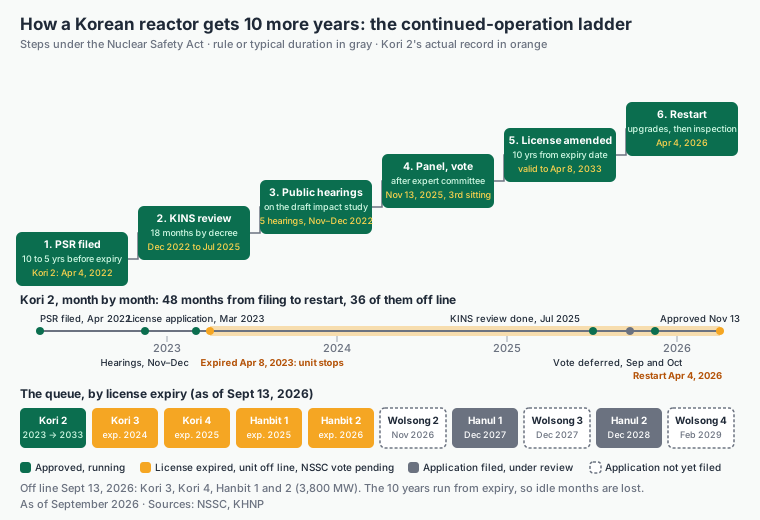
The table below sets the rule against Kori 2’s actual record, taken from the NSSC’s November 13, 2025 decision document. Steps 2 and 3 overlap in practice. The hearings happen while KINS is starting its review.
| Step | What the rule says | Kori 2, actual |
|---|---|---|
| 1. PSR filed | 10 to 5 years before expiry (5 to 2 before Dec. 2022) | Apr. 4, 2022, 12 months before expiry; docketed Dec. 22, 2022 |
| 2. KINS review | 18 months under the decree, longer with supplement rounds | Dec. 2022 to July 2025, about 31 months |
| 3. Hearings, application | Draft impact study published; hearings; then license change filed | Viewing July 8 to Oct. 25, 2022; 5 hearings Nov. 28 to Dec. 28; application Mar. 30, 2023 |
| 4. Expert committee | NSSC’s advisory committee reviews KINS’s findings | Seven sessions, Mar. 21 to Sept. 5, 2025 |
| 5. NSSC vote | Nine commissioners decide in open session | Deferred Sept. 25 and Oct. 23; approved Nov. 13, 2025 |
| 6. Restart | Upgrades, then the NSSC’s periodic inspection | Restarted Apr. 4, 2026; KHNP had aimed for February |
Two things in the record are easy to miss. The application was supplemented three times, in April and September 2024, and the National Assembly Research Service counted two full rounds of resubmission before approval (Energy Daily, September 7, 2026). And the vote took three sittings: at the first, commissioners said the file did not explain clearly enough how the 1983 Westinghouse unit differs from the APR1400, whose accident-management plan had already been approved, and how that plan’s approval overlaps with the continued-operation item itself (Edaily, September 25, 2025); the second sitting ended with a request for further reference material (Kyunghyang, October 23, 2025).
The public stage is short on paper. The viewing period drew 179 comments, of which 48 were reflected and 2 partly; the five hearings drew 88, of which 9 were reflected, the NSSC recording that the rest fell outside what the impact study is required to contain. Two earlier attempts, in Ulju County and at the Busan Chamber of Commerce, broke up when residents and environmental groups blocked the stage, saying the risks had not been explained and demanding expert-led sessions (Electimes, December 2022).
4. Why the lost years are lost
The extension runs “10 years from the design-life expiry date,” to April 8, 2033 in Kori 2’s case. The clock does not pause while the unit waits. Kori 2 was off line for 36 months and will get about seven years of generation from a 10-year permit.
The cost is real money. Korea Economic Daily calculated Kori 2’s first two idle years, April 2023 to April 2025, at KRW 1.54 trillion (about $1.14 billion): KRW 549.5 billion in lost sales plus KRW 987.4 billion in extra LNG fuel to replace the output (April 2025). The same paper put Hanbit 2’s expected 10 months off line at roughly KRW 440 billion (about $326 million) in added LNG cost (September 11, 2026).
Why so long? The decree’s 18 months is a review clock, and every supplement request restarts part of it. The NSSC chair, Choi Won-ho, has said the accident-management-plan reviews added to the workload have stretched a short-staffed secretariat (Asia Today, July 2026), and the Research Service noted that Kori 3 and 4 have been through six rounds of questions and supplements, Hanbit 1 and 2 and Hanul 1 and 2 five, and Wolsong 2 to 4 four.
5. The queue as of September 13, 2026
Nine units still need a decision. The dates follow our fleet map and the filings the NSSC and Korean press have reported.
| Unit | License expiry | Filed | Stage (Sept. 13, 2026) |
|---|---|---|---|
| Kori 3 | Sept. 28, 2024 | License change Nov. 2023 | Off line; items tabled Sept. 11, re-deliberation pending; vote target H2 2026 |
| Kori 4 | Aug. 6, 2025 | License change Nov. 2023 | Off line; same file as Kori 3 |
| Hanbit 1 | Dec. 22, 2025 | PSR June 2023; license change Aug. 2024 | Off line since Dec. 9, 2025; tabled Sept. 11; vote target H1 2027 |
| Hanbit 2 | Sept. 11, 2026 | With Hanbit 1 | Off line since Sept. 11; vote target H1 2027 |
| Wolsong 2 | Nov. 1, 2026 | Safety assessment June 2024; PSR cleared July 24, 2025 | License application not yet filed; no vote date |
| Hanul 1 | Dec. 22, 2027 | PSR Oct. 2023, cleared July 24, 2025; application filed | Under review; no date |
| Wolsong 3 | Dec. 29, 2027 | With Wolsong 2 | Application not yet filed |
| Hanul 2 | Dec. 28, 2028 | With Hanul 1 | Under review; no date |
| Wolsong 4 | Feb. 7, 2029 | With Wolsong 2 | Application not yet filed |
On September 11 the NSSC’s agenda carried, for the first time, the accident-management-plan approvals and license-change items for all four off-line units, which share one Westinghouse three-loop design. The commission discussed them and deferred (Money Today, Asiae). On August 4 it had told the presidential office it would vote on Kori 3 and 4 in the second half of 2026; if approval comes around year end, the five months of upgrades and inspection that Kori 2 needed put restart in the first half of 2027.
Wolsong is the odd case. Its three CANDU units reach 30 years from November 2026, KHNP held its hearing in Gyeongju on April 8, 2025 with about 670 residents (Seoul Shinmun), and the NSSC cleared unit 2’s PSR with six improvement items, but KHNP has not filed the license application; Asia Today reported in July that doubts about the units’ economics are behind the delay. Wolsong 2 will stop on November 1 either way.
6. The contested points
The argument in Korea is not mainly about whether a 40-year-old reactor can be safe. It is about who decides, on what standards. And about how the timing was handled.
- The phase-out years. The Moon Jae-in government’s 2017 energy-transition roadmap ruled out life extensions, and KHNP did not file for Kori 2 until after the March 2022 election; the PSR went in on April 4, 2022, five weeks before the new government took office. Supporters of nuclear power call the three idle years a policy cost; environmental groups reply that the late filing broke the decree’s deadline, which is why they call the review itself unlawful (Korean Federation for Environmental Movements, 2025).
- Which standards. At the October 2024 audit, Democratic Party lawmaker Park Ji-hye said the Kori 2, 3 and 4 environmental assessments were built on NUREG-0555, a 1978 US guide withdrawn in 1999, when the law requires the latest standards; KHNP’s president answered that current standards were reflected (Pressian). She also noted 3.64 million people live within 30 km of the plants seeking extensions.
- Severe accidents and disclosure. Ulsan anti-nuclear groups argued in August 2022 that the draft impact study did not model severe or multi-unit accidents and that the PSR itself should have been published before residents were asked to comment (OhmyNews). At Wolsong, the Gyeongju Federation for Environmental Movements points to three heavy-water leaks in 18 months, the last of 208 kg at unit 4 on July 1, 2026, and a higher incident rate at the old units than at Shin-Wolsong.
- A process that never says no. The Research Service’s audit brief observed that no continued-operation application has ever been rejected and asked the NSSC to set explicit denial criteria and end points for supplement rounds. The other reading of the same record is that the supplement rounds are the review: Kori 2 came out with 20 safety measures and needed three sittings.
- The government’s position. The 11th Basic Plan for Electricity Supply and Demand, confirmed February 21, 2025, counts its 2038 nuclear capacity of 35.2 GW (35.2 percent of generation) on the assumption that units reaching design life keep running. President Lee Jae-myung, in office since June 2025, has said reactors past their term should be extended “if safety is assured” within a rational mix (press conference, September 11, 2025, via Kyunghyang), which is why the phase-out debate has shifted from whether to how fast.
My own reading, for what it is worth, is that both camps are describing the same fact. The reviews are thorough, and they are late. A process that takes three to four years cannot start one year before expiry without idling the plant, and the 2022 decree change only fixes that for units that expire from the 2030s on.
Local consent is the other unsettled piece. The hearings are a legal step, not a veto. The September 2026 deliberation on new reactors is testing whether that should change (our report).
7. How three other countries do it
Korea’s 10-year step is short by international standards, and its expiry-date stop is unusual. As of September 2026:
| Country | Base term | Extension | Where it stands |
|---|---|---|---|
| Korea | Design life: 40 yrs PWR, 30 yrs CANDU | 10-year continued-operation approvals via PSR and license change | 1 approved (Kori 2), 9 in queue, 4 off line |
| United States | 40-year license | 20-year renewals under 10 CFR Part 54: to 60, then 80 | 25 units at 13 plants licensed to 80 years, 3 more under review (NRC, Sept. 8, 2026) |
| Japan | 40 years in principle | One 20-year extension to 60; since June 6, 2025, outage time for unforeseeable reasons is excluded, with NRA checks every 10 years after year 30 | GX Decarbonization Power Supply Act, passed May 31, 2023 |
| France | No fixed term | 10-yearly periodic reviews (VD); generic decision of Feb. 23, 2021 for 900 MWe units beyond 40 years, applied unit by unit | 32 units in the fourth review cycle, running to 2031 |
The US and Japan grant 20 years at a time, and France grants none but re-examines every 10 years. Korea grants 10 and starts the clock at expiry. Kori 1, which went from 30 to 40 years in 2007 and stopped in 2017, is now the country’s first decommissioning case, tracked in our Kori 1 post; the OPR1000s reach 40 years from 2035, and the APR1400s, built to a 60-year component design life (our APR1400 explainer), are decades further out.
Where this goes next
Three dates will tell. The NSSC’s re-deliberation on the Kori 3 and 4 file, promised for the second half of 2026; Wolsong 2’s stop on November 1 without an application on the table; and the first half of 2027, when Hanbit 1 and 2 are due for a vote and the Honam region will have been short two reactors for the better part of a year.
If the Kori 3 and 4 decision comes in fewer sittings than Kori 2’s three, the process will have learned something. If not, the queue behind it stretches to 2029.
Sources: NSSC, 224th meeting agenda item 1, Kori 2 continued-operation approval (Nov. 13, 2025), and Korea Policy Briefing fact-check on the Kori 2 review (Oct. 24, 2025); Edaily on the first deferral (Sept. 25, 2025); Kyunghyang on the second (Oct. 23, 2025); Nuclear Safety Act Articles 20, 23 and 103, Enforcement Decree Articles 36–38 (Presidential Decree No. 33193, Dec. 30, 2022) via the Korea Law Information Center; NSSC Nuclear Safety Information Center, continued-operation overview and Kori 2 unit page; Korea Electric Association journal on the continued-operation system (2024); Seoul National University Atomic Wiki, continued operation; Kyunghyang Shinmun on the NSSC’s referral of KHNP (Oct. 27, 2022); Electimes on the Kori 2 review schedule and hearings (Dec. 2022); OhmyNews on the Ulsan groups’ press conference (Aug. 23, 2022); Pressian on the National Assembly audit (Oct. 14, 2024); Korea Economic Daily on Kori 2 idle costs (Apr. 7, 2025) and Hanbit 2 (Sept. 11, 2026); World Nuclear News on the Kori 2 approval (Nov. 2025) and restart (Apr. 2026); Korean Federation for Environmental Movements release on the Kori 2 review (2025); Newsis on Hanbit 1 (Dec. 24, 2025); Busan Ilbo on the NSSC chair’s remarks (May 20, 2026) and the NSSC report to the presidential office (Aug. 4, 2026); Asia Today on the Kori 3–4 schedule and Wolsong (July 19, 2026); Money Today and Asiae on the NSSC meeting of Sept. 11, 2026; Energy Daily on the National Assembly Research Service audit brief (Sept. 7, 2026); Seoul Shinmun on the Wolsong hearing (Apr. 8, 2025) and the government’s stance (Nov. 14, 2025); Ministry of Trade, Industry and Energy, 11th Basic Plan for Electricity Supply and Demand (Feb. 21, 2025); Gyeongju Federation for Environmental Movements statement (July 2, 2026); US NRC, subsequent license renewal status page (updated Sept. 8, 2026); World Nuclear News and NucNet on Japan’s GX law (2023) and Japan Today on its entry into force (June 2025); ASN/ASNR, continued operation of the 900 MWe reactors beyond 40 years (Feb. 2021)