Korea's nuclear reactor fleet, site by site — every unit, its type, age and status (September 2026)
All 32 South Korean reactor units by site: type, capacity, commercial-operation date and status as of September 2026, with license-renewal dates through 2029.
Data as of September 13, 2026 — statistics, prices, schedules and regulatory status in this article were checked on this date. Where a different date is given in the text, that date takes precedence.
On September 11, 2026, the 40-year operating license of Hanbit unit 2, a Westinghouse reactor on Korea’s southwest coast, runs out. The unit stopped that day and joined two Kori units and its sister Hanbit 1 in a queue for license renewal, without leaving the official count of 26 “operating” reactors. A list of Korean reactors has to carry that kind of detail, and most lists in English do not.
This article is the list: every reactor unit in South Korea, site by site, with reactor type, rated capacity, commercial-operation date and status as of September 6, 2026, followed by a reading of the fleet as a whole. The institutions behind it are mapped in our guide to Korea’s nuclear industry.
Key takeaways
- Korea has 32 reactor units on five coastal sites: 26 licensed as operating (26,050 MW), 4 under construction (Saeul 3 and 4, Shin-Hanul 3 and 4) and 2 permanently shut (Kori 1, Wolsong 1). Three of the 26, Kori 3, Kori 4 and Hanbit 1, are off line with expired licenses, awaiting renewal.
- The fleet is bimodal: nine units are past 30 years and four past 40, while twelve OPR1000s from 1995–2015 form the backbone and four APR1400s supply a fifth of capacity. Ten units, 8,450 MW, need a continued-operation decision by 2029.
- Saeul 3 has held an operating license since December 30, 2025 and was cleared on September 4, 2026 to resume commissioning after an August trip; it counts as under construction until commercial operation, targeted for October.
1. How to read the tables
All Korean reactors are run by KHNP (Korea Hydro & Nuclear Power, the state utility) and licensed by the NSSC (Nuclear Safety and Security Commission), on technical reviews by KINS (Korea Institute of Nuclear Safety). An operating license runs for the design life, 40 years for pressurized water reactors and 30 for the CANDU heavy-water units; running longer requires a separate “continued operation” approval, granted in 10-year steps.
Four reactor families appear in the tables.
- WH 2-loop / 3-loop: Westinghouse pressurized water reactors bought as turnkey plants in the 1970s–80s (Kori 1–4, Hanbit 1–2). Hanul 1 and 2 are the French equivalent, Framatome’s CP1 design.
- CANDU-6: Canadian pressurized heavy-water reactors using natural uranium (Wolsong 1–4).
- OPR1000: the 1,000 MW Korean Standard Nuclear Plant, derived from Combustion Engineering’s System 80 (Hanbit 3–6, Hanul 3–6, Shin-Kori 1–2, Shin-Wolsong 1–2).
- APR1400: the 1,400 MW successor and Korea’s export design (Saeul 1–4, Shin-Hanul 1–4).
Capacities are the rated (gross) figures KHNP and the NSSC use, in MW; net output is a few percent lower. Commercial-operation dates are the NSSC’s.
2. Kori and Saeul: the Busan–Ulsan cluster
The Kori site in Gijang County, at the eastern edge of Busan, is where Korean nuclear power began; the Saeul site next door in Ulju County, Ulsan, holds its newest units. Saeul 1–4 were called Shin-Kori 3–6 until November 2022. Status as of September 2026.
| Unit | Type, MW | Commercial operation | Status (Sept. 2026) |
|---|---|---|---|
| Kori 1 | WH 2-loop, 587 | Apr. 29, 1978 | Permanently shut June 18, 2017; decommissioning approved June 26, 2025 |
| Kori 2 | WH 2-loop, 650 (NSSC lists 685) | July 25, 1983 | Operating; continued operation approved Nov. 13, 2025 to Apr. 8, 2033 |
| Kori 3 | WH 3-loop, 950 | Sept. 30, 1985 | Off line; license expired Sept. 28, 2024; vote planned H2 2026 |
| Kori 4 | WH 3-loop, 950 | Apr. 29, 1986 | Off line; license expired Aug. 6, 2025; vote planned H2 2026 |
| Shin-Kori 1 | OPR1000, 1,000 | Feb. 28, 2011 | Operating |
| Shin-Kori 2 | OPR1000, 1,000 | July 20, 2012 | Operating |
Kori 2 is the precedent for every renewal that follows: its license expired on April 8, 2023, the NSSC approved continued operation on November 13, 2025, and the unit returned to service in April 2026, so the extension to April 2033 yields about seven years of generation. On August 4, 2026 the NSSC told the presidential office it plans to vote on Kori 3 and 4 in the second half of this year. Kori 1’s dismantling is tracked in our Kori 1 decommissioning post.
| Unit | Type, MW | Commercial operation | Status (Sept. 2026) |
|---|---|---|---|
| Saeul 1 | APR1400, 1,400 | Dec. 20, 2016 | Operating |
| Saeul 2 | APR1400, 1,400 | Aug. 29, 2019 | Operating |
| Saeul 3 | APR1400, 1,400 | Target Oct. 2026 | Commissioning: license Dec. 30, 2025; criticality Apr. 12, 2026; trip Aug. 11; restart approved Sept. 4 |
| Saeul 4 | APR1400, 1,400 | Target 2027 | Under construction; operating license targeted Jan. 2027 |
Saeul 3 tripped on August 11, 2026 while operators were raising power again after a test that disconnects the unit from the grid at 80 percent. At 33.9 percent power an operator entered the turbine control valve position limiter setpoint in the closing direction, the valve closed, and the resulting power swing triggered the automatic shutdown; the NSSC classified the event as human error, not a design or equipment fault, and cleared the unit to resume tests on September 4. Unit 4 trails by about a year.
3. Wolsong: the heavy-water site
The Wolsong site in Gyeongju, North Gyeongsang Province, holds Korea’s only heavy-water reactors and its only dry spent-fuel storage. Status as of September 2026.
| Unit | Type, MW | Commercial operation | Status (Sept. 2026) |
|---|---|---|---|
| Wolsong 1 | CANDU-6, 679 | Apr. 22, 1983 | Permanently shut Dec. 24, 2019 (off line since 2018) |
| Wolsong 2 | CANDU-6, 700 | July 1, 1997 | Operating; 30-year license expires Nov. 1, 2026; safety assessment filed 2024, license application not yet filed |
| Wolsong 3 | CANDU-6, 700 | July 1, 1998 | Operating; license expires Dec. 29, 2027; safety assessment filed 2024, license application not yet filed |
| Wolsong 4 | CANDU-6, 700 | Oct. 1, 1999 | Operating; license expires Feb. 7, 2029; safety assessment filed 2024, license application not yet filed |
| Shin-Wolsong 1 | OPR1000, 1,000 | July 31, 2012 | Operating |
| Shin-Wolsong 2 | OPR1000, 1,000 | July 24, 2015 | Operating |
Wolsong 2 is the next hard date after Hanbit 2. KHNP filed its safety assessment for units 2–4 in June 2024, and on July 24, 2025 the NSSC approved the periodic safety review of unit 2 with six safety-improvement items (Kookje Ilbo); KHNP had not yet filed the license application itself as of March 2026 (Asia Today), and the NSSC has named no vote date. The Gyeongju Federation for Environmental Movements, a local environmental group, argues against extension on the record of three heavy-water leaks at the site in 18 months (January 2025, September 2025 and July 1, 2026, the last of 208 kg at Wolsong 4 during maintenance) and a higher incident rate at the older units than at Shin-Wolsong (statement of July 2, 2026).
4. Hanbit: the west-coast site
Hanbit, in Yeonggwang County, South Jeolla Province, is the only site on the Yellow Sea and the one whose renewals matter most to the Honam region’s supply. Status as of September 2026.
| Unit | Type, MW | Commercial operation | Status (Sept. 2026) |
|---|---|---|---|
| Hanbit 1 | WH 3-loop, 950 | Aug. 25, 1986 | Off line since Dec. 9, 2025; license expired Dec. 22, 2025; vote planned H1 2027 |
| Hanbit 2 | WH 3-loop, 950 | June 10, 1987 | Off line since Sept. 11, 2026 (license expired); vote planned H1 2027 |
| Hanbit 3 | OPR1000, 1,000 | Mar. 31, 1995 | Operating |
| Hanbit 4 | OPR1000, 1,000 | Jan. 1, 1996 | Operating |
| Hanbit 5 | OPR1000, 1,000 | May 21, 2002 | Operating |
| Hanbit 6 | OPR1000, 1,000 | Dec. 24, 2002 | Operating |
KHNP applied in August 2024 to run Hanbit 1 to December 2035 and Hanbit 2 to September 2036. With both decisions planned for the first half of 2027, the two units will be off line together for months.
5. Hanul: the largest site
Hanul, in Uljin County, North Gyeongsang Province, is the largest site by capacity, 8,700 MW across eight units, rising to 11,500 MW when Shin-Hanul 3 and 4 are complete. Status as of September 2026.
| Unit | Type, MW | Commercial operation | Status (Sept. 2026) |
|---|---|---|---|
| Hanul 1 | Framatome CP1 (“CPI” in IAEA/WNA lists), 950 | Sept. 10, 1988 | Operating; license expires Dec. 22, 2027; renewal under review |
| Hanul 2 | Framatome CP1, 950 | Sept. 30, 1989 | Operating; license expires Dec. 28, 2028; renewal under review |
| Hanul 3 | OPR1000, 1,000 | Aug. 11, 1998 | Operating |
| Hanul 4 | OPR1000, 1,000 | Dec. 31, 1999 | Operating |
| Hanul 5 | OPR1000, 1,000 | July 29, 2004 | Operating |
| Hanul 6 | OPR1000, 1,000 | Apr. 22, 2005 | Operating |
| Shin-Hanul 1 | APR1400, 1,400 | Dec. 7, 2022 | Operating |
| Shin-Hanul 2 | APR1400, 1,400 | Apr. 5, 2024 | Operating |
| Shin-Hanul 3 | APR1400, 1,400 | Target 2032 | Under construction; permit Sept. 2024, first concrete May 20, 2025 |
| Shin-Hanul 4 | APR1400, 1,400 | Target 2033 | Under construction; first concrete May 29, 2026 |
KHNP submitted the periodic safety reviews for Hanul 1 and 2 in October 2023; on July 24, 2025 the NSSC approved them, as it did Wolsong 2’s, listing seven safety-improvement items, with further core-damage-frequency analysis still running (Kookje Ilbo). The license application has been filed; no NSSC vote has been scheduled.
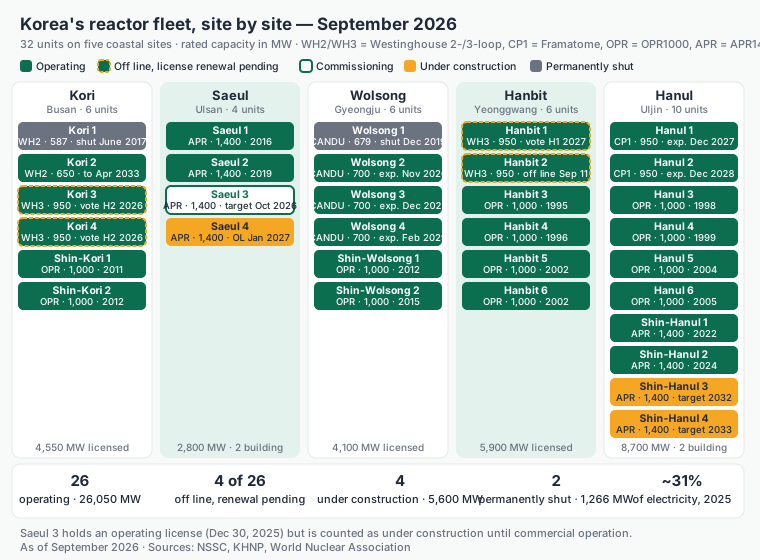
6. The totals, and how Saeul 3 is counted
The official count, used by KHNP, the NSSC and the IAEA, is 26 operating, 4 under construction, 2 permanently shut. Saeul 3 sits in “under construction” despite holding an operating license, because a unit counts as operating from commercial operation (on September 6, KHNP’s real-time page showed 20 of 26 actually generating, the rest in planned outages); when it passes that gate, expected in October, the count becomes 27 and 3. The 26 include Kori 3, Kori 4 and Hanbit 1, whose licenses have expired but which are not permanently shut; strictly, 22 units can generate today, since Hanbit 2 joined the list on September 11.
| Category | Units | Capacity, MW | Notes |
|---|---|---|---|
| Operating (licensed) | 26 | 26,050 | Of which 4 units, 3,800 MW, off line pending license renewal (as of Sept. 13, 2026) |
| Under construction | 4 | 5,600 | Saeul 3 in commissioning; Saeul 4; Shin-Hanul 3 and 4 |
| Permanently shut | 2 | 1,266 | Kori 1 (2017), Wolsong 1 (2019) |
| Total on sites | 32 | 32,916 | Five sites |
In 2025 the fleet produced 184.7 TWh, about 31 percent of Korea’s electricity, according to KHNP citing KEPCO’s Monthly Electric Power Statistics no. 566 (KHNP’s own share, including its hydro plants, was 32.04 percent). The last full official energy review, for 2024, put nuclear at 31.7 percent, 188.8 TWh of 595.6 TWh, the largest single source for the first time in 18 years (Ministry of Trade, Industry and Energy, May 2025).
7. Reading the fleet
Age: four units past 40, nine past 30
Counting from commercial operation, on September 6, 2026 four units are past 40 years (Kori 2, 3, 4 and Hanbit 1, which crossed the line on August 25) and five more are past 30 (Hanbit 2, Hanul 1, Hanul 2, Hanbit 3, Hanbit 4). The four APR1400s are under 10 years old. In between sit the twelve OPR1000s, 12,000 MW or 46 percent of licensed capacity, commissioned between 1995 and 2015 and due for no license decision before the mid-2030s.
The renewal pipeline: ten units, 8,450 MW, by 2029
The decisions the NSSC must take, in order of license expiry, as of September 2026:
| Unit | MW | License expiry | Decision status |
|---|---|---|---|
| Kori 2 | 650 | Apr. 2023 | Approved Nov. 2025 to Apr. 2033 |
| Kori 3 | 950 | Sept. 2024 | Vote planned H2 2026 |
| Kori 4 | 950 | Aug. 2025 | Vote planned H2 2026 |
| Hanbit 1 | 950 | Dec. 2025 | Vote planned H1 2027 |
| Hanbit 2 | 950 | Sept. 11, 2026 (expired) | Vote planned H1 2027 |
| Wolsong 2 | 700 | Nov. 1, 2026 | Safety assessment filed; license application pending |
| Hanul 1 | 950 | Dec. 2027 | Under review, no date |
| Wolsong 3 | 700 | Dec. 2027 | Safety assessment filed; license application pending |
| Hanul 2 | 950 | Dec. 2028 | Under review, no date |
| Wolsong 4 | 700 | Feb. 2029 | Safety assessment filed; license application pending |
Two features stand out. The one decision so far, Kori 2, came 31 months after the license expired, so each unit loses years of its 10-year extension waiting. And by November 2026 five units totaling 4,500 MW, 17 percent of licensed capacity, could be off line at once (Kori 3, Kori 4, Hanbit 1, Hanbit 2, Wolsong 2) unless the NSSC votes first; its chair said in December 2025 that four units would come up in 2026, but the August plan names only Kori 3 and 4.
APR1400 share and site concentration
Four APR1400s supply 5,600 MW, 21 percent of licensed capacity; with the four under construction the design would hold 11,200 of 31,650 MW, about 35 percent, by 2033 if no unit retires. Hanul is the largest single site, but the Kori–Saeul cluster is the densest: ten units on two adjacent sites, seven operating, two under construction and one being dismantled, straddling the boundary between Busan, Korea’s second city, and Ulsan.
What is already decided beyond this list
The 11th Basic Plan for Electricity Supply and Demand adds two large reactors, 2.8 GW for 2037–38, and one SMR of 0.7 GW for 2035–36. On June 17, 2026, KHNP’s site committee named Yeongdeok County, on the east coast, for the large units and Gijang County, beside Kori, for the SMR; whether the 12th Plan adds more is the subject of the September 2026 public deliberation. The SMR, the i-SMR, is still in design review (status report), and the APR1400 in the tables is the unit Korea exported to the UAE and contracted in Czechia in its APR1000 derivative form (export tracker).
How to read “unit X shut down”
Korean headlines use one word, “stopped,” for four different things.
- Planned outage (계획예방정비): the refueling and inspection stop every 18 months or so, lasting one to three months; several units are in one at any time.
- Automatic trip (자동정지): the protection system shuts the reactor down within seconds, as at Saeul 3 on August 11; the NSSC investigates and must approve the restart, which took 24 days in that case.
- License-expiry stop: the operating license ran out (Kori 3, Kori 4, Hanbit 1, and Hanbit 2 from September 11); the unit stays in the “operating” statistics and can return if the NSSC approves continued operation.
- Permanent shutdown (영구정지): a separate NSSC decision that ends the license for good (Kori 1, Wolsong 1), after which the unit moves toward decommissioning.
Only the last removes a unit from the fleet; the first three change the day’s output, not the count.
Where this goes next
Four dates will change this list before the year ends: Hanbit 2’s license expiry on September 11, Saeul 3’s commercial operation targeted for October, the NSSC’s second-half votes on Kori 3 and 4, and Wolsong 2’s expiry on November 1. If all go as planned, Korea ends 2026 with 27 units counted as operating and, for the first time since 2023, no Kori unit waiting for a license.
Sources: NSSC Nuclear Safety Information Center, unit pages for Kori, Saeul, Wolsong, Hanbit and Hanul (operating-license and commercial-operation dates; accessed Sept. 2026); NSSC releases on the Saeul 3 restart approval (Sept. 4, 2026), Kori 2 continued operation (Nov. 13, 2025) and Kori 1 decommissioning (June 26, 2025); NSSC report to the presidential office as reported by Busan Ilbo and News1 (Aug. 4, 2026); KHNP, domestic nuclear operations page (26 units, 26,050 MW; 2025 generation and share citing KEPCO Monthly Electric Power Statistics no. 566) and Saeul 3 first-criticality release (Apr. 12, 2026); KHNP site selection for new reactors (June 17, 2026); Ministry of Trade, Industry and Energy, 2024 energy supply-demand review via Korea Policy Briefing (May 12, 2025); Korea Atomic Industrial Forum, domestic reactor list; World Nuclear Association, Nuclear Power in South Korea (updated June 12, 2026); World Nuclear News on the Saeul 3 operating license (Jan. 2, 2026) and criticality clearance (Apr. 10, 2026), Kori 2 approval (Nov. 13, 2025) and restart (Apr. 7, 2026), and Shin-Hanul 4 first concrete (May 29, 2026); POWER magazine on Saeul 3 (Sept. 1, 2026); Newsis on Hanbit 1 (Dec. 24, 2025) and Saeul 4 (May 2026); Financial News on the nine renewal applications (Dec. 17, 2025); Kookje Ilbo on the Wolsong 2 and Hanul 1–2 periodic safety reviews (July 24, 2025) and Kori 4 (Aug. 7, 2025); Daegu Ilbo on Wolsong 2–4 license dates; Munhwa Ilbo on Hanbit 1–2 (2026); Money Today and Asia Economy on the Saeul 3 trip cause (Sept. 4, 2026); Gyeongju Federation for Environmental Movements statement via Pyeonghwa News (July 2, 2026)