How a nuclear reactor gets licensed in Korea: from site to standard design approval to first power
Korea's reactor licensing ladder: who decides (NSSC, KINS), seven rungs from site plan to commercial operation, real timelines, and why reviews stall.
Data as of September 13, 2026 — statistics, prices, schedules and regulatory status in this article were checked on this date. Where a different date is given in the text, that date takes precedence.
Suppose you read that Korea “approved” a reactor this week. Five different things could have happened: a ministry approved a site plan, the regulator accepted a design, it permitted construction, it licensed operation, or it cleared a unit to restart after a trip. Korean headlines use one verb for all five.
This article lays out the ladder as the law defines it and as the last ten years have actually run it. The institutions are mapped in our guide to who does what in Korea’s nuclear industry. Here the subject is the sequence of decisions.
Key takeaways
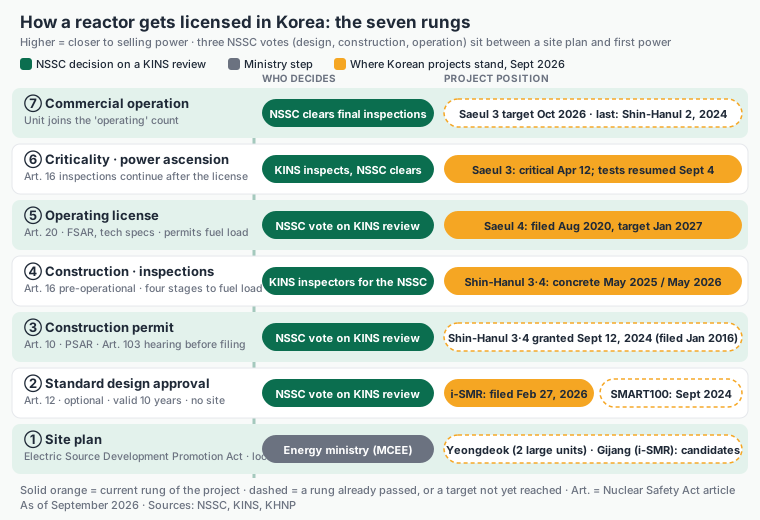
- Korea’s Nuclear Safety Act sets three regulatory gates for a power reactor: standard design approval (Article 12, optional), construction permit (Article 10) and operating license (Article 20), each a vote of the nine-member NSSC on a technical review by KINS. Site selection is a separate ministry decision under a different law.
- The statutory processing period is 24 months per gate. Real cases ran far longer: Shin-Hanul 3 and 4’s construction permit took 8 years and 8 months including a five-year policy pause, Saeul 3’s operating license 5 years and 4 months, and SMART100’s design approval 4 years and 9 months.
- “Approved” needs a rung attached. A design approval lets nobody build; a construction permit lets nobody load fuel; an operating license lets nobody sell power until pre-operational inspections, first criticality and power-ascension tests are done, which is taking Saeul 3 from December 2025 to at least October 2026.
1. Who does what
Korea separates the body that plans reactors from the body that judges their safety, the same split as between the US Department of Energy and the Nuclear Regulatory Commission. The cast is short.
- NSSC (Nuclear Safety and Security Commission): the regulator, a central agency under the Prime Minister. Nine commissioners including the chair, two of them full-time, serve three-year terms renewable once, and decisions need the votes of a majority of all nine (NSSC Act, Article 13). Every permit and license is a resolution at a numbered public meeting, so decisions are cited as “the 228th meeting.”
- KINS (Korea Institute of Nuclear Safety): the technical body that does the review under delegation. It checks the documents, sends rounds of questions to the applicant, writes the safety evaluation the commissioners vote on, and inspects on site.
- Nuclear Safety Expert Committee: outside specialists who pre-review the KINS report. It met six times on Shin-Hanul 3 and 4 and ten times on Saeul 3.
- KINAC (Korea Institute of Nuclear Nonproliferation and Control): the NSSC’s second institute, for nuclear material accounting, physical protection and export control. It sits outside the safety review.
- Ministry of Climate, Energy and Environment (MCEE): the policy ministry since October 2025. Its Basic Plan for Electricity Supply and Demand decides whether a reactor is needed, and it approves the site under the law described in section 2.
- Local governments and residents: formal opinion rights at the site plan and at the radiological report inside the construction permit application. Neither is a veto.
- KHNP (Korea Hydro & Nuclear Power): the state utility that runs every Korean reactor and applies for every construction permit and operating license. Design developers such as the i-SMR agency apply for design approval.
US readers will recognize the shape. The construction permit and operating license are a two-step path like NRC Part 50, with standard design approval playing the role of Part 52’s design certification; Korea has no combined license. Four regulators are compared in our SMR licensing map.
2. The rungs, one by one
Article numbers are from the Nuclear Safety Act as in force in September 2026 (Korea Legislation Research Institute translation); an amendment promulgated on May 19, 2026 (Act No. 21679), in force from November 2026, adds a pre-review procedure for new reactor designs as Article 100-2 and leaves the articles below unchanged. Seven rungs follow.
Site: a ministry decision first
The site is approved under the Electric Source Development Promotion Act, not the safety law: KHNP files an implementation plan, and the energy minister hears the local government heads, consults other ministries and puts it through an inter-ministerial committee. Residents may inspect the plan. Thirty of them can demand a public hearing.
The approved plan is deemed to include the site pre-approval that Article 10(3) of the Nuclear Safety Act allows, so limited site works may begin before the construction permit. It also stands in for about 20 permits under other laws, from roads and rivers to forestry and coastal use. It says nothing about the reactor’s safety.
Standard design approval (Article 12): optional and site-independent
A developer that will build the same design repeatedly can have the NSSC certify it once; the approval is valid for 10 years, and what it covers is not re-reviewed at the permit and license stages. Korean agencies translate it both “approval” and “authorization.” It is one thing.
Three designs have held it: the APR1400 (May 2002), the APR+ (August 2014) and SMART100 (September 26, 2024). The i-SMR filed on February 27, 2026, as tracked in our i-SMR status report. None of this permits construction anywhere.
Construction permit (Article 10): the first hard gate
The operator files six documents: a radiological environmental report, a preliminary safety analysis report (PSAR), a construction quality-assurance program, a decommissioning plan, a statement of purpose and a statement of technical capability. Since a June 2016 rule change, an accident-management plan for severe accidents is required too. The criteria are in Article 11.
Two things come first. Under Article 103 the applicant publishes a draft radiological report for residents, holds a public hearing if the local government head or enough residents demand one, and folds the opinions in. After filing, the NSSC has 60 days to check the documents for adequacy and notify a review plan (Enforcement Decree, Article 18); the Decree then allows 24 months, or 15 for a unit of the same capacity, reactor type and main-equipment design as one already permitted (Article 19). Time the applicant spends supplementing its documents does not count against the 24 months, which is why no real review has matched it.
Pre-operational inspections (Article 16): the years nobody reports
Between the two licenses the NSSC inspects construction and performance in stages, a process Korean releases call 사용전검사, “inspection before use.” It runs in four stages under the Enforcement Rule: structural works and strength tests, system functional tests, cold hydrostatic and hot functional tests, then fuel loading and start-up tests. It continues after the license. This is where finished plants wait.
Operating license (Article 20): the second hard gate
The operator files a final safety analysis report (FSAR), technical specifications, an operating quality-assurance program, an updated radiological report and the accident-management plan, and KINS reviews the plant as built against the PSAR and current standards. The clock is the same 24 months. The license runs for the design life, 40 years for pressurized water reactors and 30 for CANDU units, with continued operation decided later in 10-year steps.
Fuel load, criticality, power ascension, commercial operation
An operating license permits fuel loading, not power sales. Saeul 3 was licensed on December 30, 2025; the NSSC completed nine pre-criticality inspection items, including the fuel-loading inspection and hot functional tests, on April 10, 2026. Criticality, the first self-sustaining chain reaction, came on April 12.
Then come the power-ascension tests. The unit rises in steps and is tested at each plateau, under 31 further inspection items; Saeul 3 tripped on August 11 at 33.9 percent power, the NSSC found operator error, and it cleared the unit to resume on September 4. Commercial operation is targeted for October, ten months after the license.
Afterward: periodic inspections and safety reviews
Article 22 requires periodic inspections and Article 23 a periodic safety review every ten years, the basis for any continued-operation application. The renewal queue is in our reactor fleet map. The table condenses the ladder as of September 2026, merging the last two rungs.
| Rung | Legal basis | Applicant files | Who decides |
|---|---|---|---|
| Site plan | Electric Source Development Promotion Act, Art. 5 | Implementation plan; residents’ hearing | Energy minister (MCEE) after local-government opinions |
| Design approval | Nuclear Safety Act, Art. 12 | Standard safety analysis report | NSSC vote on KINS review; valid 10 years |
| Construction permit | Art. 10 (criteria Art. 11) | PSAR, radiological report, QA program, decommissioning plan | NSSC vote on KINS review; Art. 103 hearing first |
| Pre-operational inspections | Art. 16 | Test and inspection records by stage | KINS inspectors for the NSSC |
| Operating license | Art. 20 (criteria Art. 21) | FSAR, technical specifications, accident-management plan | NSSC vote on KINS review |
| Criticality to commercial operation | Art. 16 continued | Power-ascension test results | NSSC clears each stage |
3. How long it actually takes
The 24-month figure has not described a new-build review in a decade. Dates run from application to NSSC resolution. All are as of September 2026.
| Case | Gate | Applied → decided | Elapsed |
|---|---|---|---|
| Shin-Hanul 3 and 4 | Construction permit | Jan. 8, 2016 → Sept. 12, 2024 (200th meeting) | 8 yr 8 mo, incl. pause Oct. 2017–July 2022 |
| Saeul 3 | Operating license | Aug. 2020 → Dec. 30, 2025 (228th meeting) | 5 yr 4 mo |
| Shin-Hanul 1 | Operating license | Dec. 1, 2014 → July 9, 2021 (142nd meeting) | 6 yr 7 mo; 18 commission discussions |
| SMART100 | Design approval | Dec. 30, 2019 → Sept. 26, 2024 (201st meeting) | 4 yr 9 mo; 2,621 review questions |
| i-SMR | Design approval | Feb. 27, 2026 → target 2028 | Review plan: 13 supplementary items, test results due June 2028 |
Shin-Hanul 3 and 4 show what a pause does. KINS sent two rounds of questions in 2016 and 2017, then the Cabinet’s October 2017 energy-transition roadmap stopped the project; after the July 2022 reversal KHNP moved the technical-standards date from December 2013 to December 2021 and rewrote the PSAR, and KINS sent nine more rounds between August 2022 and July 2024, 1,894 questions. Net of the pause: about four years.
Saeul 3 shows the operating-license stage of the same design. KINS focused on differences from the earlier APR1400 units, the expert committee met ten times, and the commission deferred once, on December 19, 2025, before approving on December 30. Unit 4 targets January 2027.
SMART100 is the reference for the i-SMR. KINS spent 20 months on document adequacy before the formal review began in August 2021, then 32 months and 12 rounds of questions. The i-SMR’s 2028 target holds only if its document stage is much shorter.
4. Where reviews stall
Five causes recur in the NSSC’s own records.
- Policy reversals. Shin-Hanul 3 and 4 lost five years to the 2017 roadmap. Saeul 3 and 4 lost three months in 2017 to a citizens’ jury, which voted 59.5 percent to continue, as told in our APR1400 explainer.
- Earthquakes. The magnitude 5.8 Gyeongju earthquake of September 12, 2016, Korea’s strongest on record, struck three months after the Shin-Kori 5 and 6 (now Saeul 3 and 4) permit. Seismic reassessment held Shin-Kori 4’s license, and for Shin-Hanul 3 and 4 KINS re-ran the site hazard against the Ministry of the Interior and Safety’s fault survey (January 2023), whose 16 segments, finding an expected peak ground acceleration of 0.179 g against the 0.3 g design value.
- Post-Fukushima items. The 2016 accident-management rule pulled severe-accident analysis into every application. Shin-Hanul 1’s license was held over the passive autocatalytic recombiners that control hydrogen and over aircraft impact, and came with conditions (section 5).
- Public opinion and the courts. Hearings rarely stop a project, but the Shin-Kori 5 and 6 permit went to court. In February 2019 the Seoul Administrative Court found the June 2016 resolution unlawful on two points, two disqualified commissioners and a radiological report missing a severe-accident assessment, yet let the permit stand on public-interest grounds; the Seoul High Court agreed in January 2021. Greenpeace Korea, which organized the 560 plaintiffs, argues the rulings prove the review was defective while leaving the reactors untouched.
- Rules written after the application. The SMR Special Act, in force since September 11, 2026, creates a promotion committee under the science minister and five-year development plans, but leaves licensing with the NSSC. The NSSC’s 2026–2030 roadmap puts SMR-specific standards and law amendments in 2028, the year the i-SMR approval is targeted, and Korean environmental groups argue the standards should come first.
From where I sit, the word that decides a Korean review is 보완, “supplement.” A review does not fail. It asks for more, and the calendar belongs to whoever answers slowest.
5. How to read “approved” headlines
- Which rung? “Design approved” means a design on paper, referenceable for 10 years, with no site. “Construction permit” means concrete may be poured, not fuel loaded. “Operating license” means fuel may be loaded; power comes months later.
- “Conditional approval” is common. Shin-Hanul 1’s 2021 license required a final hydrogen-recombiner report by March 2022, talks on flight restrictions before the first refueling outage, and a new aircraft-crash frequency methodology. The unit ran while the conditions were met.
- “Deferred” is not “rejected.” Saeul 3’s December 19 deferral asked for a fuller account of the accident-management plan, resolved eleven days later. On its public record since 2011 the NSSC has never refused a new-build permit or license; it takes longer instead. Critics at the National Assembly’s 2026 audit called this a “supplement until it passes” structure.
- “Cleared to restart” is a different decision. Saeul 3’s September 4 clearance closed an incident investigation under an existing license. It created no new right.
- “Site confirmed” is a utility step. KHNP’s June 2026 naming of Yeongdeok for two large units and Gijang for the i-SMR is a candidate choice; the ministry’s plan and the NSSC’s permit both lie ahead.
Where this goes next
Three dates test the ladder within a year: Saeul 3’s commercial operation in October, the first unit to climb every rung since Shin-Hanul 2 in 2024; Saeul 4’s license, targeted for January 2027; and KINS’s handling of the i-SMR’s 13 supplementary items, which will show whether the document stage takes SMART100’s 20 months. Further out, a construction-permit application for Yeongdeok would put the site rung and Article 103 hearings back in the news for the first time since 2016. Korea has not climbed that rung in a decade.
Sources: Nuclear Safety Act (as in force Sept. 2026; Act No. 21679 of May 19, 2026 for the pre-review amendment; Korea Legislation Research Institute translation) and 2016 consolidated text (Articles 10, 12, 16, 20–23, 103); Nuclear Safety Act Enforcement Decree, Articles 18, 19 and 33 (adequacy check, processing periods and their exclusions, operating-license periods) and Enforcement Rule (application forms); Electric Source Development Promotion Act, Articles 5, 5-2 and 6; NSSC, 199th meeting report on the Shin-Hanul 3 and 4 construction permit review (Aug. 29, 2024) and Korea Policy Briefing release on the 200th meeting (Sept. 12, 2024); NSSC release on the Saeul 3 operating license (228th meeting, Dec. 30, 2025) via Newsis and Asia Today; Insight N Power and Yonhap on Saeul 3 pre-operational inspections (Apr. 10, 2026); NSSC Saeul 3 restart approval (Sept. 4, 2026); Electric Power Journal and World Nuclear News on the Shin-Hanul 1 conditional operating license (July 9, 2021); KINS, Licensing Experiences on the Standard Design Approval of SMART100 (IAEA regional workshop, Apr. 2025); NSSC report on the KINS review plan for the i-SMR standard design approval (Aug. 27, 2026) via Energy Daily; NSSC, SMR Regulatory Framework Roadmap 2026–2030 (Feb. 2026); Ministry of Science and ICT release on the SMR Special Act (Sept. 11, 2026) via Money Today; NSSC English brochure on commission composition (2022); Seoul National University Atomic Wiki on NPP licensing procedure; Kim & Chang case note and Newspim on the Shin-Kori 5 and 6 permit rulings (Feb. 2019, Jan. 2021); Greenpeace Korea statements (2019, 2021); World Nuclear News on the Shin-Hanul 3 and 4 construction permit (Sept. 2024)