[In-depth] Korea's nuclear industry map — who does what, from uranium to decommissioning
Which Korean state and private firms handle each nuclear fuel-cycle and plant-lifecycle stage, and why enrichment and reprocessing stay blank (Sept. 2026).
Data as of September 4, 2026 — statistics, prices, schedules and regulatory status in this article were checked on this date. Where a different date is given in the text, that date takes precedence.
On September 4, Korea’s Nuclear Safety and Security Commission (NSSC, the nuclear regulator) approved the restart of Saeul unit 3, a new reactor that had tripped automatically during commissioning. One short news item named the regulator, its technical reviewer, the operator, the design firm, the main-component maker and the builder. Nuclear news from Korea is hard to follow less because of the technology than because nobody has laid out on a single page who does what.
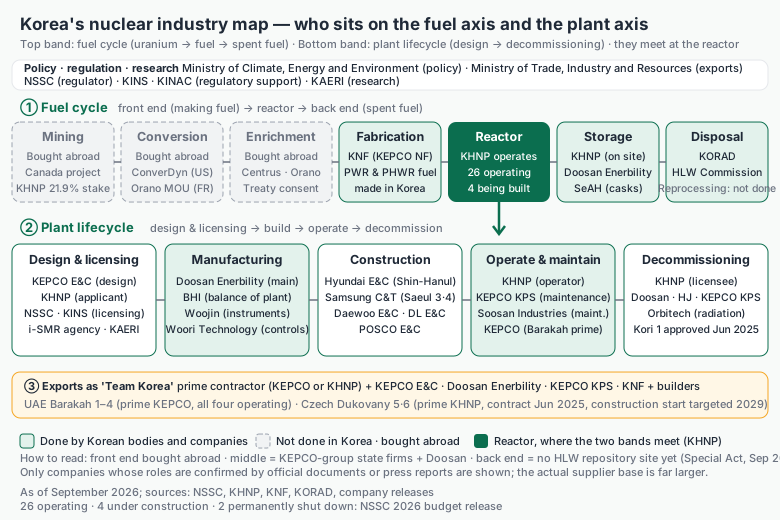
This article draws that page. It merges the nuclear fuel cycle, in which uranium becomes fuel, passes through a reactor and leaves as waste, with the plant lifecycle, in which a plant is designed, built, operated and dismantled, and places Korea’s institutions and companies in each box.
The company tables record only what each firm does; stock-market angles are not covered, and the ticker codes are there to tell same-named companies apart. Unless noted otherwise, the tables are as of September 2026.
Key takeaways
- Korea does not mine, convert, enrich or reprocess uranium. The front end of the fuel cycle is bought abroad, and the back end has no repository site yet.
- Design (KEPCO E&C), operation (KHNP), maintenance (KEPCO KPS) and fuel (KEPCO Nuclear Fuel) are stacked vertically inside the state-owned KEPCO group, while main-component manufacturing (Doosan Enerbility) and construction (large builders) are private.
- Around that skeleton sit private suppliers of instrumentation, controls, balance-of-plant equipment and radiation services, and for exports the whole combination is bundled under the name “Team Korea.”
1. The two axes: fuel cycle and plant lifecycle on one map
The fuel cycle is the journey of the fuel. The front end runs from uranium mining and milling to conversion (into uranium hexafluoride gas), enrichment (raising the uranium-235 share to below 5 percent) and fabrication (making fuel rods and assemblies). The back end is the storage of spent fuel discharged from the reactor, followed by disposal or reprocessing and recycling. We cover the difference between reprocessing and direct disposal separately.
The plant lifecycle is the journey of the facility: design and licensing, main-component and balance-of-plant manufacturing, construction, operation and maintenance (usually 40 to 60 years), and decommissioning. The two axes meet at one point, the reactor, so this map puts the fuel axis on top, the facility axis below, and joins them there.
Some stages Korea does not perform: mining, conversion, enrichment and reprocessing.
- Mining is absent because Korea has no economically viable uranium deposits. Conversion (ore concentrate to uranium hexafluoride) is bought as a service abroad for economic reasons unrelated to any treaty, since a plant would not pay off against Korea’s small demand. Only enrichment and reprocessing are questions of agreements rather than technology. The “reconversion” of enriched uranium hexafluoride back into uranium dioxide powder, however, is done in Korea by KEPCO Nuclear Fuel.
- The US–Korea civil nuclear cooperation agreement (the bilateral treaty that sets the terms under which Korea may use US-origin nuclear material and technology), revised in 2015 and in force since November 2015, opened a “pathway” for uranium enrichment below 20 percent: it can proceed if the two governments agree in writing after consultation in a standing vice-ministerial High-Level Bilateral Commission. For reprocessing, Korea received long-term consent for post-irradiation examination and electrochemical reduction inside existing facilities; the next step, pyroprocessing (a dry reprocessing technique that separates spent fuel electrochemically in high-temperature molten salt), has only a pathway to be pursued through the High-Level Bilateral Commission on the basis of joint US–Korea research. In short, the structure is not “prohibited” but “not without agreement.”
- The joint fact sheet published on November 14, 2025, recording the agreements of the October 29, 2025 US–Korea summit in Gyeongju, included language that the United States supports a process leading to civil uranium enrichment and reprocessing in Korea, consistent with the agreement and in compliance with US law. The first formal follow-up consultation was held in Seoul on June 2–3, 2026, and working-level talks have continued since while both sides prepare high-level negotiations (as of September 2026). The text of the agreement itself has not changed.
2. Policy, regulation and research: the institutions that set the board
Nuclear policy and nuclear safety regulation are deliberately assigned to different bodies. The side that plans the building and operation of plants must not be the side that judges whether they are safe. In the October 2025 government reorganization, nuclear policy moved from the former Ministry of Trade, Industry and Energy to the new Ministry of Climate, Energy and Environment, while nuclear exports stayed with the renamed Ministry of Trade, Industry and Resources.
| Body | Type | Role at this stage | Notes |
|---|---|---|---|
| MCEE | Central ministry (Ministry of Climate, Energy and Environment) | Nuclear policy, industry promotion, oversight of state energy companies, Basic Plan for Electricity Supply and Demand | Launched October 2025 |
| Ministry of Trade, Industry and Resources | Central ministry | Support for nuclear exports, resource development | Holds the export portfolio since the reorganization |
| NSSC | Central administrative agency under the Prime Minister | Licensing decisions (construction permits, operating licenses, decommissioning approvals) and safety regulation | Approved Kori 1 decommissioning in June 2025 |
| KINS | Public institution under the NSSC | Korea Institute of Nuclear Safety: safety reviews and inspections on the NSSC’s behalf | Investigated the Saeul 3 automatic trip |
| KINAC | Public institution under the NSSC | Korea Institute of Nuclear Nonproliferation and Control: nuclear material accounting (safeguards), physical protection, export and import control | Established 2006 |
| KAERI | Government-funded research institute | Korea Atomic Energy Research Institute: reactor and fuel R&D, operates the HANARO research reactor, developed SMART (a small integral reactor) | Established 1959 |
| HLW Commission | Under the Prime Minister (High-level Radioactive Waste Management Commission) | Oversees site selection for high-level waste management facilities | Launched October 1, 2025 |
Reduced to one line for readers outside Korea: the NSSC is the regulator, KINS is its technical support organization, and the Ministry of Climate, Energy and Environment is the policy ministry. The split is the same as between the US Nuclear Regulatory Commission (NRC) and the Department of Energy (DOE).
3. Front end of the fuel cycle: bought abroad, made at home
The front end of the fuel for Korea’s 26 reactors is mostly imported. Uranium concentrate plus conversion and enrichment services are purchased from foreign companies, and the enriched uranium is delivered to KEPCO Nuclear Fuel, which turns it into fuel assemblies.
| Body | Type | Role at this stage | Notes |
|---|---|---|---|
| KHNP | State company (wholly owned KEPCO subsidiary, unlisted) | Korea Hydro & Nuclear Power: buys uranium concentrate, conversion and enrichment services under foreign contracts; holds stakes in overseas mining projects | 21.9 percent of Canada’s Waterbury Lake project (reported June 2025) |
| KEPCO Nuclear Fuel (KNF) | State company (96.36 percent owned by KEPCO, unlisted) | Receives enriched uranium, performs reconversion and fabrication; designs and makes fuel for both pressurized-water and heavy-water reactors | Korea’s only nuclear fuel manufacturer, established 1982 |
| Foreign suppliers | Foreign companies | Mining, conversion, enrichment | Orano (France), ConverDyn (US, conversion), Centrus (US, enrichment) and others |
Limiting the list to confirmed supply contracts:
- Enrichment. In February 2025 KHNP signed a 10-year enriched-uranium supply contract with Centrus of the United States. Korean daily Busan Ilbo reported in February 2025, citing KHNP data, that enriched uranium delivered in 2020–2024 came 38 percent from France, 32 percent from Russia, 25 percent from the UK and 5 percent from China, so the Centrus contract is described as diversification away from Russia.
- Conversion. In September 2025 KHNP signed a long-term contract for converted uranium with ConverDyn of the United States.
- Full-cycle cooperation. In April 2026 KHNP signed a memorandum of understanding with France’s Orano covering uranium supply, conversion and enrichment (not a binding supply contract).
- Mines. KHNP takes part in Canada’s Waterbury Lake uranium project through a Korean consortium with KEPCO Nuclear Fuel, Hanwha and Canada’s Gravis; an additional investment in June 2025 raised the stake to 21.9 percent, and production is scheduled to start in 2032. The Imouraren mine in Niger, in which KEPCO and KHNP invested in 2009, has delivered nothing because production was delayed (reported January 2021).
Only the fabrication stage sits inside Korea, but it is not small. KEPCO Nuclear Fuel makes fuel for both pressurized-water and heavy-water reactors, and it is the fuel supplier in the Barakah and Dukovany export projects as well.
4. Design and licensing: drawing the plant and getting the permit
Design has two layers: nuclear steam supply system (NSSS) design, covering the reactor and its surrounding systems, and architect-engineering, covering the whole plant. Korea is unusual in that KEPCO E&C does both, and the operator, KHNP, applies to the NSSC for permits on the basis of that design.
| Body | Type | Role at this stage | Notes |
|---|---|---|---|
| KEPCO E&C | State company, KOSPI: 052690 | KEPCO Engineering & Construction: NSSS and plant design; designed the APR1400, Korea’s standard 1,400 MW-class large reactor | Listed 2009, KEPCO subsidiary |
| KHNP | State company (unlisted) | As operator, applies for construction permits and operating licenses; secures sites | The licensing applicant |
| i-SMR Agency | Foundation set up jointly by the science and industry ministries (i-SMR Technology Development Agency) | Designs the 170 MWe-class i-SMR small modular reactor; applied for Standard Design Authorization | Launched 2023, 43 participating organizations, application filed February 27, 2026 |
| KAERI | Government-funded research institute | Designed the SMART reactor (SMART100 received Standard Design Authorization in September 2024) | Pursuing cooperation with Saudi Arabia |
Where licensing stands as of September 2026:
- Operating, under construction, shut down. 26 reactors operating, 4 under construction (Saeul 3, which holds an operating license but has not started commercial operation, plus Saeul 4 and Shin-Hanul 3 and 4), and 2 permanently shut down (Kori 1 and Wolsong 1).
- Saeul 3 and 4. Unit 3 received its operating license on December 30, 2025 and is in commissioning; after an automatic trip on August 11 it was cleared to restart on September 4, with commercial operation targeted within the year (originally August). Unit 4 aims to obtain its operating license in January 2027.
- Shin-Hanul 3 and 4. Construction permit September 2024, completion scheduled for 2032–2033.
- i-SMR. Its licensing position is covered in our SMR licensing map.
5. Main components and balance of plant: turning steel into a reactor
The large, tightly regulated equipment, such as the reactor pressure vessel, steam generators, pressurizer and turbine generator, is called the main components (NSSS and turbine island equipment); everything else, from heat exchangers, condensers and containment liner plates to valves and instruments, is the balance of plant (BOP). One company makes the main components, and hundreds of suppliers share the balance of plant.
KOSPI and KOSDAQ, cited in the tables, are the two boards of the Korea Exchange.
| Company | Type | Role at this stage | Notes |
|---|---|---|---|
| Doosan Enerbility | Private, KOSPI: 034020 | Makes APR1400 main components: reactor vessel, steam generators, pressurizer, turbine generator | Shin-Hanul 3 and 4 main-component contract, KRW 2.9 trillion (about $2.1 billion), March 2023 |
| BHI | Private, KOSDAQ: 083650 | Balance of plant: condensers, feedwater heaters, containment liner plates, stainless-steel liners | Supplied Barakah and the US AP1000 at Vogtle; Shin-Hanul 3 and 4 BOP contract KRW 100.1 billion (about $74 million), February 2025 |
| Woojin | Private, KOSPI: 105840 | Nuclear instrumentation: in-core instrumentation (ICI), temperature sensors, control-rod position transmitters | ICI contracts for 2027 planned outages: first lot KRW 8.8 billion (about $6.5 million), February 2026; second lot KRW 10.9 billion (about $8.1 million), June 2026 |
| Woori Technology | Private, KOSDAQ: 032820 | Nuclear instrumentation and control systems (MMIS) and distributed control systems | Production units for Shin-Hanul 3 due for delivery from 2026 |
Doosan Enerbility has supplied every set of APR1400 main components in Korea, and few companies anywhere carry out large-reactor forging through assembly under one roof. It also supplies the main components in the export projects in section 9.
6. Construction: the companies that build
Nuclear construction in Korea is tendered as one large “main facility works” contract, taken by a consortium of several builders. The domestic track record divides cleanly by unit.
| Company | Type | Korean nuclear construction record | Notes |
|---|---|---|---|
| Hyundai E&C | Private, KOSPI: 000720 | Lead contractor for Shin-Hanul 3 and 4 main facility works (55 percent share) | Consortium with Doosan and POSCO E&C, KRW 3.1 trillion (about $2.3 billion), December 2023 |
| Samsung C&T | Private, KOSPI: 028260 | Lead contractor for Saeul 3 and 4 (formerly Shin-Kori 5 and 6) main facility works | Consortium with Doosan and Hanwha E&C, since merged into Hanwha Corporation (2015) |
| Daewoo E&C | Private, KOSPI: 047040 | Wolsong 3 and 4, Shin-Wolsong 1 and 2, among others | Lead construction contractor for Dukovany, Czech Republic |
| DL E&C | Private, KOSPI: 375500 | Hanbit 5 and 6, Shin-Kori 1 and 2, steam generator replacement works | Per reports of June 2026 |
| POSCO E&C | Private (unlisted) | Shin-Hanul 3 and 4 consortium (10 percent share) | High-temperature gas reactor cooperation with KAERI |
7. Operation and maintenance: running the plant for 40 years
Once a plant is complete, the operator KHNP runs it, while the planned outages held roughly every 18 months, when the reactor is shut down for inspection and refueling, and routine day-to-day maintenance go to maintenance contractors.
| Body | Type | Role at this stage | Notes |
|---|---|---|---|
| KHNP | State company (unlisted) | Operates Korea’s 26 reactors; responsible for fuel procurement and waste management | Also the decommissioning licensee |
| KEPCO KPS | State company, KOSPI: 051600 | Routine and planned-outage maintenance of nuclear plants; commissioning maintenance at Barakah | Its predecessor began servicing Kori 1 in 1978; the present company was founded in 1984 |
| Soosan Industries | Private, KOSPI: 126720 | Mechanical and electrical maintenance of nuclear plants (Saeul 1 and 2, Shin-Wolsong 1 and 2, among others) | First private firm in routine nuclear maintenance (2004); won planned-outage work for all four Barakah units (2022) |
| Woojin NTec | Private, KOSDAQ: 457550 | Maintenance of nuclear instrumentation and control equipment, radiation imaging equipment | Woojin affiliate; seeking a role in Kori 1 decommissioning |
| KEPCO | State company, KOSPI: 015760 | Korea Electric Power Corporation: prime contractor for Barakah, with 18 percent of Barakah One and 18 percent of the operating company Nawah Energy | Does not operate reactors in Korea |
KEPCO, the state-owned national utility, occupies two positions on the map. It is the parent of KHNP, KEPCO E&C, KEPCO KPS and KEPCO Nuclear Fuel, and in the UAE’s Barakah project the prime contractor was KEPCO itself, not KHNP.
8. Back end, waste and decommissioning: the clean-up
The back end is the emptiest part of the Korean map. Spent fuel is stored on each plant site; Wolsong already operates a dry storage facility (spent fuel kept outside the pool in metal or concrete casks), and Kori is preparing a license application for a dry storage facility, with operation now targeted for 2031 (per the NSSC’s September 2026 audit report). Only low- and intermediate-level waste is being disposed of, at Gyeongju, and site selection for a high-level repository has only just begun.
We cover how other countries’ repositories are progressing separately.
| Body | Type | Role at this stage | Notes |
|---|---|---|---|
| KORAD | Public institution | Korea Radioactive Waste Agency: operates the Gyeongju low- and intermediate-level repository; sole implementer of high-level waste facilities | Phase 1 underground silos: 37,705 drums to date (reported May 2026) |
| HLW Commission | Under the Prime Minister | Oversees the site-selection process; adopted the site-suitability survey plan in April 2026 | Targets: interim storage by 2050, disposal by 2060 |
| KHNP | State company (unlisted) | On-site spent-fuel storage; decommissioning licensee | In charge of Kori 1 decommissioning |
| Doosan Enerbility | Private, KOSPI: 034020 | Leads dismantling of Kori 1’s non-controlled areas (started November 2025); overall design of KHNP’s dry storage system (November 2023) | Decommissioning consortium with HJ Shipbuilding & Construction and KEPCO KPS |
| SeAH Besteel | Private (subsidiary of SeAH Besteel Holdings, KOSPI: 001430) | Makes spent-fuel transport casks (KN-18); supplies dual-purpose transport and storage casks to Xcel Energy of the US | First delivery (May 2025) under a roughly KRW 35 billion (about $26 million) order won in 2023 |
| Orbitech | Private, KOSDAQ: 046120 | Radiation management, clearance and self-disposal services, equipment inspection | Contracts with KHNP, KNF and KORAD |
The institutional position in three lines:
- High-level waste Special Act. Promulgated March 25, 2025, in force September 26, 2025. The Management Commission launched on October 1, adopted the site-suitability survey plan in April 2026, and plans to exclude unsuitable areas (volcanic and fault zones, for example) within 2026 before opening applications from local governments in 2027.
- Low- and intermediate-level waste. The Gyeongju repository’s Phase 1 underground silos have taken 37,705 drums of a 100,000-drum capacity (reported May 2026); the 125,000-drum Phase 2 near-surface facility finished construction in December 2025 and held its completion ceremony on May 13, 2026.
- Decommissioning. The NSSC approved Kori 1 decommissioning on June 26, 2025 (cost KRW 1,071.3 billion, about $794 million; completion targeted 2037). Progress is tracked in our Kori 1 decommissioning tracker.
9. The export structure: Team Korea
When Korea sells a plant abroad, the companies above are bundled into a single team, known as “Team Korea”: one prime contractor signs with the customer, and design, main components, construction, fuel and maintenance are divided among group affiliates and partners.
| Project | Prime contractor | Participants | Status (September 2026) |
|---|---|---|---|
| Barakah 1–4, UAE | KEPCO | KHNP, KEPCO E&C, KEPCO KPS, KEPCO Nuclear Fuel, Doosan Enerbility, Hyundai E&C and Samsung C&T | Unit 4 in commercial operation since September 2024; all four units operating |
| Dukovany 5 and 6, Czech Republic | KHNP | KEPCO E&C (design), Doosan Enerbility (main components and construction), Daewoo E&C (construction), KEPCO Nuclear Fuel (fuel), KEPCO KPS (commissioning and maintenance) | Contract June 2025; passed the EU’s preliminary foreign-subsidies review June 2026; construction start targeted 2029 |
Talks with Saudi Arabia and other countries have not reached the contract stage and are not in this table.
10. What the map shows
Feature 1: a vertical stack of state companies
Fuel (KEPCO Nuclear Fuel), design (KEPCO E&C), operation (KHNP) and maintenance (KEPCO KPS) all belong to the KEPCO group, while main-component manufacturing (Doosan Enerbility) and construction (the builders) are private. The advantage cited for this structure is that one operator building one standard design over and over has kept construction time and cost predictable. The counter-argument is that when the operator, designer and maintenance firm sit in one group, outside checks are weak, which makes the regulator’s independence all the more important.
Feature 2: the missing links, enrichment, reprocessing and a repository site
The front of the map (mining, conversion, enrichment) and the back (reprocessing, a high-level repository) are empty. The front is filled by foreign contracts; the back has only just entered a process under the Special Act. The debate over securing enrichment and reprocessing rights has arguments on both sides.
- For securing the rights. Fuel supply would become more self-reliant, a route to recycling spent fuel as a resource would open, and Japan already holds the same rights.
- For caution. Opposition in the US Congress and among nonproliferation experts is strong; enrichment and reprocessing plants are expensive and their economics are uncertain at Korea’s small scale; and pyroprocessing research itself is still far from commercial use.
The November 2025 fact sheet is a political agreement on direction, not a revision of the treaty, so for now this box stays “under consultation.”
Feature 3: the private supplier base
Beneath the single main-component maker, companies each hold one box: instrumentation (Woojin), controls (Woori Technology), balance of plant (BHI), maintenance (Soosan Industries, Woojin NTec), radiation management (Orbitech) and casks (SeAH Besteel). The companies named here are only those whose roles could be confirmed from official documents or press reports; the actual supplier base is far larger.
Feature 4: exports are a matter of combination
Barakah and Dukovany use the same reactor family (APR1400 and its APR1000 derivative) and the same companies, but different prime contractors. Which company leads the team and which builder takes construction change from project to project, so when reading export news it is more accurate to check the reactor type, the prime contractor and the participants separately.
This article does not read the map from a stock-market angle. For the licensing position of Korea’s i-SMR see our SMR licensing map, for the decommissioning stage see the Kori 1 tracker, and for the back end see repositories around the world and reprocessing versus disposal.
This section is provided to help understand the industry and is not a recommendation to buy or sell any security. Investment decisions and their consequences are the reader’s own.
Sources: Ministry of Foreign Affairs release on the revised US–Korea nuclear cooperation agreement (2015); US–Korea summit joint fact sheet (Nov. 14, 2025) and Institute for National Security Strategy issue brief no. 761 (Nov. 2025); Newspim on the follow-up consultations (June 2026); Korea Law Information Center, Special Act on the Management of High-Level Radioactive Waste (Act no. 20843); NSSC 2026 budget release and Saeul 3 restart approval (Sept. 4, 2026); NSSC Kori 1 decommissioning approval (June 26, 2025); Newsis on Saeul 4 (May 2026) and on the site-suitability survey plan (April 2026); KHNP releases (Centrus, Sept. 2024 and Feb. 2025; ConverDyn, Sept. 2025; Orano MOU, April 2026); Busan Ilbo on enriched-uranium import shares (Feb. 2025); i-SMR Technology Development Agency website; The Guru on the Waterbury Lake investment (June 2025) and the Imouraren stake (Jan. 2021); KEPCO Nuclear Fuel, KEPCO E&C, KEPCO KPS, KINAC and KAERI websites; KEPCO group company guide (KEPCO Nuclear Fuel shareholding); Hyundai E&C release on the Shin-Hanul 3 and 4 contract (Dec. 2023); Newspim on the Shin-Kori 5 and 6 award (June 2015); Pinpoint News on DL E&C (June 2026); Dailian and CEO Score Daily on Daewoo E&C and Dukovany (April 2026); Economist Korea on the EU foreign-subsidies review (June 2026); KEPCO release on Barakah 4 commercial operation (Sept. 2024); Doosan Enerbility on the Shin-Hanul main-component contract (March 2023) and the start of Kori 1 dismantling (Nov. 2025); BHI nuclear business page; Woojin website, Digital Today and CBC News on the ICI supply contracts (2026); Financial News on Woojin Entech (June 2026); Seoul Economic Daily and EBN on SeAH Besteel cask deliveries (2025); Enet News and Insight N Power on Soosan Industries; eToday on the BHI Shin-Hanul contract (Feb. 2025); Electric Times on the Doosan Enerbility dry-storage design contract (Nov. 2023); Newspim on the Wooree Tech VMI agreement (Aug. 2026); Edaily on Soosan Industries (2025); Orbitech nuclear business page; Korea Economic Daily on the cask market (July 2025); Asia Today on the Gyeongju Phase 2 completion ceremony (May 2026); site reports from the Gyeongju repository (May 2026)