Korea's nuclear exports, project by project — Barakah, Dukovany and what comes next
Korea has delivered Barakah and signed Dukovany; Poland, Sweden and the Netherlands fell away. Every Korean nuclear export by stage, as of September 2026.
Data as of October 2, 2026 — statistics, prices, schedules and regulatory status in this article were checked on this date. Where a different date is given in the text, that date takes precedence.
Sixteen months. That is how long the European Commission spent reviewing the Dukovany contract before deciding, on June 5, 2026, not to open an in-depth investigation into Korea Hydro & Nuclear Power (KHNP) under the EU’s Foreign Subsidies Regulation. The decision left Korea’s second nuclear export where its first, Barakah, stood a decade and a half earlier: contracted, financed and waiting for concrete.
Between those two projects sits a longer list of countries that were in the pipeline in 2023 and are not in it now. This article sorts every Korean nuclear export by stage, from talks to operation, and explains what each stage does and does not mean. The company structure behind the exports is in our map of Korea’s nuclear industry; here the focus is the projects.
Key takeaways
- Korea has one completed export (Barakah, four APR1400 units, all in commercial operation since September 2024) and one signed contract (Dukovany 5 and 6, two APR1000 units, CZK 407 billion, about $18.6 billion, construction start targeted for 2029).
- The January 2025 settlement with Westinghouse ended a two-year intellectual-property dispute but, according to reports the parties have not confirmed, keeps KHNP out of North America, the EU (except Czechia), the UK and Japan. Between late 2024 and August 2025 KHNP left Sweden, Slovenia, the Netherlands and Poland, a list that matches the reported split.
- The live pipeline as of September 2026 is Saudi Arabia (a tender with no award), Vietnam (a partner selection announced for the third quarter of 2026), Turkey and the Philippines (memoranda only), plus SMR study agreements. None is a contract.
1. The export model: who signs, who builds
Korea exports a plant as a package the industry calls “Team Korea.” One prime contractor signs with the customer, and the work is divided among the state-owned KEPCO group and private partners: KEPCO Engineering & Construction (KEPCO E&C) for design, Doosan Enerbility (Korea’s reactor-vessel manufacturer) for the reactor vessel, steam generators and turbine, builders such as Hyundai E&C, Samsung C&T or Daewoo E&C for construction, KEPCO Nuclear Fuel for fuel and KEPCO KPS for commissioning and maintenance.
The prime contractor has changed from project to project. At Barakah it was KEPCO, the national utility; at Dukovany it is KHNP, KEPCO’s subsidiary that operates all of Korea’s reactors. In May 2026 the government set a rule for future bids: KEPCO leads external negotiations for every country, KHNP handles construction and operation under joint prime contracts, and a Nuclear Export Promotion Act to formalize this was planned for 2026 (Seoul Economic Daily, May 14, 2026).
The product is the APR1400, a 1,400 MW-class pressurized water reactor, and its 1,000 MW-class derivative for European grids, the APR1000.
- US NRC. The APR1400 received a standard design approval on September 28, 2018 and a design certification whose final rule took effect on September 19, 2019, originally valid for 15 years and extended to 40 years (to 2059) by an NRC rule change in 2025. A US site license would still be separate.
- European Utility Requirements (EUR). The European version, the EU-APR, was certified as EUR-compliant in October 2017 (World Nuclear News, October 9, 2017); the APR1000 followed in March 2023 (announced March 2). EUR is a utility-side specification, not a license.
2. Barakah 1–4: the reference plant
The Emirates Nuclear Energy Corporation (ENEC) awarded the Barakah contract to a KEPCO-led consortium on December 27, 2009, at a reported 2009 contract value of about $20.4 billion for four APR1400 units; no final cost has been published. It was Korea’s first nuclear export, won against a French consortium of Areva, GDF Suez and Total, and GE-Hitachi.
| Unit | Construction start | Grid connection | Commercial operation |
|---|---|---|---|
| Unit 1 | July 2012 | August 2020 | April 2021 |
| Unit 2 | April 2013 | September 2021 | March 2022 |
| Unit 3 | September 2014 | October 2022 | February 2023 |
| Unit 4 | July 2015 | March 2024 | September 5, 2024 |
Sources for the table: ENEC and the World Nuclear Association (page updated July 16, 2026).
The 2009 plan had unit 1 operating in 2017, so the first unit came roughly four years late, concentrated in commissioning and operator licensing. But the four units arrived roughly a year apart, which is the “repeat build” pattern Korean bidders point to, and the 5.6 GW plant now supplies about a quarter of the UAE’s electricity, according to ENEC.
KEPCO’s stake did not end at handover. In 2016 ENEC and KEPCO formed two joint ventures, Barakah One, which owns the plant and sells its power, and Nawah Energy, which operates it; KEPCO holds 18 percent of each. In June 2019 Nawah signed a long-term maintenance services agreement with KHNP, supported by KEPCO KPS.
Expansion talks are not a project. Talks on two more units were reported in August 2023, but the World Nuclear Association’s UAE profile, as of July 2026, records no concrete progress. What exists is two memoranda signed on November 18, 2025 during a UAE–Korea summit, one between KEPCO and ENEC and one between their subsidiaries, covering SMRs, AI for plant operations and joint projects in third countries; the first such attempt is Vietnam (section 5).
3. Dukovany 5 and 6: the contract that survived three challenges
The Czech project is a state-led new build at the existing Dukovany site, about 150 km southeast of Prague. The owner, Elektrárna Dukovany II (EDU II), is 80 percent held by the state and 20 percent by the utility ČEZ. The tender, launched in 2022, was changed on January 31, 2024 to binding offers for up to four units; Westinghouse was excluded then for not submitting a binding offer, leaving KHNP and EDF.
| Date | Event | Status (as of Sept. 5, 2026) |
|---|---|---|
| April 2024 | European Commission approves Czech state aid for unit 5 | Done |
| July 17, 2024 | KHNP preferred bidder over EDF’s EPR1200, about CZK 200 billion per unit | Done |
| February 2025 | Commission opens a preliminary foreign-subsidies review on its own initiative, following EDF’s objections | Done |
| May 6, 2025 | Brno regional court grants EDF an injunction blocking signature | Overturned |
| June 4, 2025 | Supreme Administrative Court annuls the injunction; EDU II and KHNP sign the same day | Done |
| June 25, 2025 | Regional court rules against EDF; EDF says it will take no further action in Czechia | Done |
| December 2025 | Commission opens an in-depth state-aid inquiry into the expanded two-unit support package | Decision expected in early 2027 |
| February 2026 | Czech–Korean ministerial steering committee; Doosan Škoda Power turbine contract | Done |
| April 2026 | First conceptual design submitted; geological survey (13 km of boreholes) complete | Done |
| June 5, 2026 | Commission decides not to open an in-depth foreign-subsidies investigation | Done |
| 2029 / 2036 | Construction start / first unit in operation | Targets |
The contract covers two APR1000 units of about 1,050 MW each for CZK 407 billion (about $18.6 billion), with electricity priced below 90 euros per megawatt-hour and roughly 60 percent of the work going to Czech companies. KHNP’s statement on the subsidies decision said it had “not received any subsidies that could damage or distort fair competition” in relation to the project.
The three challenges. EDF argued that KHNP’s fixed-price guarantee was unfeasible without illegal state support; the Czech competition authority, two courts and the Commission’s preliminary review each declined to act on that claim. Westinghouse’s objection, that the APR1000 uses its licensed technology, was overtaken by the January 2025 settlement (section 4). Still open is the state-aid case for the second unit: the Commission approved aid for one unit in April 2024, Czechia notified an expanded two-unit support package (a state loan of EUR 23–30 billion plus a 40-year contract for difference) in October 2025, and the Commission opened an in-depth investigation in December 2025. The ministry expects approval around the first quarter of 2027.
The Temelín option. The July 2024 decision included an option for two more units at ČEZ’s Temelín site. As of September 2026 it has not been exercised; Czech ministry statements in 2026 say the units “are also being considered,” and ČEZ has separately contracted Rolls-Royce SMR for early works on small reactors at Temelín.
4. The Westinghouse settlement: what is known and what is not
The APR1400’s lineage runs through the System 80+ design of Combustion Engineering, whose nuclear business passed to ABB in 1990 and to Westinghouse in 2000. In October 2022 Westinghouse sued KEPCO and KHNP in a US federal court, arguing that the design contained Westinghouse-licensed technology and that exporting it required its consent. The suit hung over the Czech bid for two years.
On January 16, 2025 Westinghouse announced a “global settlement agreement” with KEPCO and KHNP: terms confidential, all legal actions to be dismissed, and a statement that the settlement “sets the stage for future cooperation between the parties to advance new nuclear projects globally.” That is the whole public record from the parties themselves.
What has been reported, not confirmed. In August 2025 The Korea Herald and The Korea Times, citing unnamed industry sources, described terms that neither company has confirmed:
- KHNP may bid in the Philippines, Vietnam, Kazakhstan, Morocco, Egypt, Brazil, Argentina, Jordan, Turkey, the UAE, Saudi Arabia and South Africa, plus Czechia, but not in North America, the UK, Japan, Ukraine or other EU countries.
- For each reactor exported, the Korean side would buy about $650 million of Westinghouse goods and services and pay about $175 million in licensing fees, over a 50-year term.
- Korean SMRs would need a Westinghouse “technology independence verification” before export.
KHNP’s president at the time, Whang Joo-ho, declined to confirm specifics but said that, as the party accepting the terms, he could not call them fair, while adding that the company could still profit under them. The presidential office ordered the trade ministry to examine whether the deal had a proper legal basis and followed due process; no result had been published in the sources we checked as of September 2026, and Whang offered to resign in September 2025 amid the controversy. A KHNP–Westinghouse joint venture for the US market was discussed in August 2025, and on August 24, 2026 The Korea Economic Daily reported that Seoul was reviewing a US proposal for a joint equity stake in Westinghouse, a report the government denied the next day, saying Westinghouse is not part of the Korea–US strategic investment program. Neither had produced a signed agreement as of early September.
The reported market split matches what KHNP did next: it withdrew from Vattenfall’s selection in Sweden at the end of 2024, from Slovenia’s JEK2 in January 2025, from the Dutch Borssele project on March 17, 2025 and from Poland’s Pątnów project in August 2025. KHNP cited business priorities, the Czech project and SMRs.
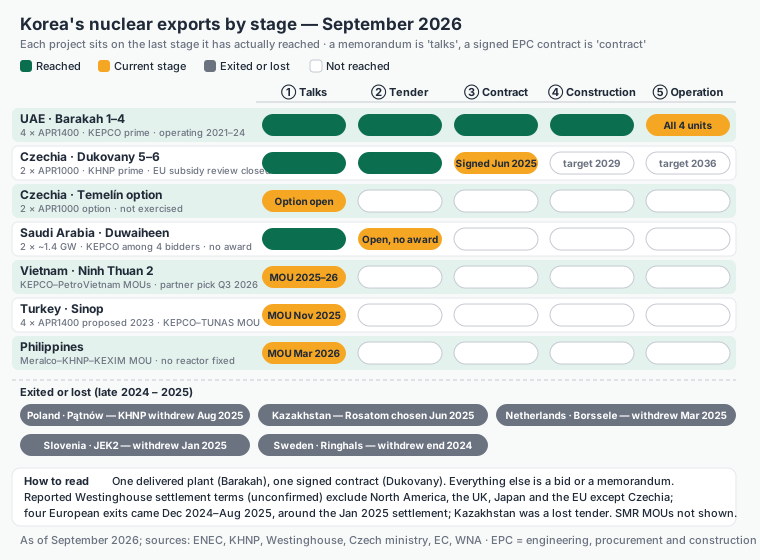
5. The pipeline in September 2026: stage by stage
The table applies one ruler to every country: talks (memoranda, feasibility studies), tender (a formal bid submitted), contract (a signed engineering, procurement and construction contract), construction and operation. A memorandum of understanding is a statement of intent and appears as “talks.” Status is as of September 5, 2026.
| Country, project | Reactor | Stage | Latest confirmed step |
|---|---|---|---|
| UAE, Barakah 1–4 | 4 × APR1400 | Operation | Unit 4 commercial operation, September 5, 2024 |
| Czechia, Dukovany 5–6 | 2 × APR1000 | Contract | Foreign-subsidies review closed June 5, 2026; construction 2029 |
| Czechia, Temelín | 2 × APR1000 (option) | Option, not exercised | “Being considered” per Czech ministry, 2026 |
| Saudi Arabia, Duwaiheen | 2 × about 1.4 GW | Tender | KEPCO one of four vendors approved to bid (with CNNC, EDF, Rosatom); bid deadline last set July 2024; no award announced |
| Vietnam, Ninh Thuan 2 | Not fixed | Talks | KEPCO–PetroVietnam MOUs (Aug. 2025, Apr. 2026); partner choice announced for Q3 2026 |
| Turkey, Sinop | 4 × APR1400 proposed | Talks | KEPCO–TUNAS (Turkey’s state nuclear company) MOU, November 24, 2025 |
| Philippines | Not fixed | Talks | Meralco (the Philippines’ largest power distributor)–KHNP–Korea Eximbank (KEXIM) MOU, March 4, 2026 |
The projects that have ended matter as much for reading the pipeline (outcomes as of September 2026).
| Country, project | Reactor | Outcome | Date |
|---|---|---|---|
| Poland, Pątnów | 2 × APR1400 | KHNP withdrew; PGE moved to buy out ZE PAK’s half | Aug. and Oct. 2025 |
| Kazakhstan, first plant | APR1000/1400 offered | Rosatom selected, CNNC for a second plant; KHNP tied third | June 2025 |
| Netherlands, Borssele | 2 units | KHNP withdrew after a 2023 feasibility study | March 17, 2025 |
| Slovenia, JEK2 | 1 unit | KHNP withdrew | January 2025 |
| Sweden, Ringhals | Large units | KHNP withdrew; Vattenfall chose Rolls-Royce SMR in June 2026 | End of 2024 |
Notes on the live entries:
- Saudi Arabia. The Duwaiheen tender for two reactors of about 1.4 GW each was issued in 2022; the bid deadline slipped from December 2022 to July 2024, and the World Nuclear Association’s profile, updated July 24, 2026, still lists the four vendors as approved to bid with no award, so it is a tender without a public award. The US–Saudi civil nuclear cooperation (“123”) agreement was signed in July 2026 according to the same profile; Korean vendors would need it for US-origin components. Separately, KAERI’s 100 MW SMART reactor is being pursued with Saudi Arabia’s KA-CARE.
- Vietnam. Ninh Thuan 1 went to Russia in March 2026; Japan withdrew from Ninh Thuan 2 in January 2026 citing the schedule. KEPCO signed a workforce memorandum with PetroVietnam in August 2025 and, during President Lee Jae-myung’s April 2026 state visit, an agreement with Korea Eximbank and Korea Trade Insurance to explore Korean financing. In July 2026 Vietnam’s industry ministry said a partner would be chosen in the third quarter; Seoul Economic Daily reported on July 31 that Korea would bid together with the UAE for a four-unit project the paper valued at KRW 12–13 trillion (about $9–10 billion). No selection had been announced in the sources we checked as of September 5.
- Turkey. KEPCO proposed four APR1400 units at Sinop in January 2023 at Turkey’s request. The KEPCO–TUNAS memorandum of November 24, 2025 covers data sharing, site evaluation, financing and training but names no site or reactor; Turkey had not announced a Sinop vendor as of September 2026.
- Philippines. The Meralco–KHNP–KEXIM memorandum covers early-stage development, site selection, training and a review of Korean financing, toward a Philippine goal of first nuclear power by 2032. It specifies no reactor.
- SMR agreements. KHNP has signed SMR study memoranda with Thailand’s EGAT (June 2025) and Singapore’s Energy Market Authority (March 1, 2026), among others. Korea’s i-SMR filed for Standard Design Authorization on February 27, 2026 and has no approved design to sell yet; see our i-SMR status report and the global SMR licensing map.
6. What the record shows
Strengths: one delivered plant, one contract price still standing
By our count, since 2010 Barakah is the only large-reactor export completed in a newcomer country by a vendor from outside China and Russia. It is also one plant, for one customer that financed most of it, built by companies that were constructing the same design at home in parallel. The same team is now contracted in Czechia, where the government says the tender was decided on price and delivery guarantees; the legal and subsidy reviews since then have left the contract price in place, but they tested its legality, not whether a first-of-a-kind APR1000 can be built for it.
Open issues: terms, money, rules and home policy
- Westinghouse terms. If the reported terms are accurate, the addressable market is a named list of countries and each exported unit carries a fixed payment to Westinghouse. The government’s review has not been made public, and any arrangement that would reopen the US market remained unconfirmed as of early September. As of October 1, 2026, a non-binding US-Korea framework contemplates a waiver that would allow up to two APR1400s in the US, financed through Korea’s investment fund, and a Korean minority stake in Westinghouse reported at 5 to 10 percent; no site, owner or contract has been confirmed (see our report on the package).
- Financing. Barakah was financed mainly by the Abu Dhabi government, with a Korea Eximbank loan alongside; Dukovany is financed by a Czech state loan to EDU II. The next buyers are asking vendors to bring money: Vietnam’s stated criteria include concessional credit below 3 percent interest and 30 to 60 percent local content, and the one reported answer so far is to pair with UAE capital (Seoul Economic Daily, July 31, 2026).
- EU rules. The foreign-subsidies review passed at the preliminary stage, but the state-aid decision for Dukovany 6 is expected in early 2027, and any future EU bid would face both regimes from the start.
- First-of-a-kind design. No APR1000 has been built anywhere; Dukovany 5 will be the first, under a fixed price, so Barakah’s repeat-build record applies to the team, not to the unit.
- Domestic policy. Korea’s own program is two large units and one SMR under the 11th Basic Plan, with sites chosen in June 2026, and a public deliberation this autumn on whether to add more; see our report on the September 2026 deliberation.
How to read the next headline
Three checks sort most export news.
- Which reactor. APR1400 (UAE, the Turkey proposal), APR1000 (Czechia; APR1000/1400 were offered to Kazakhstan) or an SMR with no approved design yet.
- Who is prime contractor. KEPCO, KHNP or, from May 2026, both under a joint contract.
- What stage. A memorandum is talks, a bid is a tender, and only a signed construction contract with financing behind it counts as a project.
Where this goes next
Three dates decide the rest of 2026: Vietnam’s partner choice for Ninh Thuan 2, announced for the third quarter; the Nuclear Export Promotion Act and any KEPCO–Westinghouse arrangement, which together set who bids and where; and the Czech state-aid decision on Dukovany 6, expected in early 2027. Saudi Arabia’s tender has slipped repeatedly since 2022; treat headlines about it with caution until a contract is signed.
My own filter for this pipeline is the three-question test above: which reactor, who is prime contractor, what stage. Everything else is a press release.
Industry note
Team Korea includes KEPCO (KRX: 015760), prime contractor at Barakah and lead negotiator under the May 2026 arrangement; KEPCO E&C (KRX: 052690) for design; Doosan Enerbility (KRX: 034020) for main components; KEPCO KPS (KRX: 051600) for commissioning and maintenance; and Daewoo E&C (KRX: 047040) and Hyundai E&C (KRX: 000720) as builders at Dukovany and Barakah respectively. KHNP itself is unlisted.
This section is provided to help understand the industry and is not a recommendation to buy or sell any security. Investment decisions and their consequences are the reader’s own.
Sources: Westinghouse Electric Company, settlement announcement (Jan. 16, 2025); World Nuclear News on the Czech preferred-bidder decision (July 17, 2024), the Dukovany contract signing and court rulings (June 4 and 25, 2025), the Czech–Korean ministerial committee (Feb. 18, 2026), the EU foreign-subsidies decision (June 8, 2026), the Czech ministry’s first-year progress report (July 8, 2026), KHNP’s Dutch withdrawal (Mar. 19, 2025), Kazakhstan’s vendor selection (June 16, 2025), the KEPCO–TUNAS memorandum (Nov. 26, 2025), KEPCO–ENEC memoranda (Nov. 21, 2025), the KHNP–EGAT (June 2025) and KHNP–EMA (Mar. 2026) memoranda, and EUR certification of the APR1400 (Oct. 2017) and APR1000 (Mar. 2023); US NRC, APR1400 design certification, Federal Register (May 22, 2019); ENEC and Abu Dhabi Media Office on Barakah unit 4 (Sept. 2024) and the 2019 Nawah–KHNP–KPS maintenance agreement; World Nuclear Association country profiles for the UAE (July 16, 2026), Czech Republic (July 28, 2026), Saudi Arabia (July 24, 2026), Vietnam (Aug. 12, 2026) and Poland (July 6, 2026); Czech Ministry of Industry and Trade releases (2024–2026); MEED on the Duwaiheen tender (June 2024, Apr. 2025); The Korea Herald (Aug. 19 and 21, 2025) and The Korea Times (Aug. 19, 2025; Mar. 4, 2026) on the Westinghouse terms, the government review, joint-venture talks and the Meralco memorandum; Notes from Poland on the Pątnów withdrawal (Aug. 21, 2025); Business Korea on the European withdrawals (Mar. 2025); Seoul Economic Daily on the export leadership decision (May 14, 2026) and the Korea–UAE bid for Vietnam (July 31, 2026); Korea Economic Daily on the Westinghouse equity proposal (Aug. 24, 2026); Daily Sabah on KEPCO’s Sinop proposal (Feb. 2023); Brookfield and Cameco releases and World Nuclear News on the US-Korea nuclear framework (Sept. 30 to Oct. 1, 2026)