i-SMR licensing tracker, October 2026: where Korea's standard design approval stands
Korea's i-SMR is seven months into design approval review. Key deadlines, what changed since mid-September, and what to watch next.
Data as of October 2, 2026 — statistics, prices, schedules and regulatory status in this article were checked on this date. Where a different date is given in the text, that date takes precedence.
Seven months. That is how long Korea’s first small modular reactor design has been in front of its regulator, and the next two dated deadlines both belong to the developer, not the regulator.
This is a dated status check, not an explainer. The background on the i-SMR, the institutions and the program’s wider setting is in our baseline post on Korea’s SMR program. Everything below is as of October 2, 2026, and where I could not confirm something, I say so.
1. Where the application stands
Filing and document check
The i-SMR Technology Development Project Group, led by KHNP (Korea Hydro & Nuclear Power, the state utility) and KAERI (Korea Atomic Energy Research Institute), filed for Standard Design Approval (SDA) with NSSC (Nuclear Safety and Security Commission, Korea’s regulator) on February 27, 2026, according to World Nuclear News. An SDA is a site-independent approval of a repeatable design. It does not allow construction anywhere.
Korea has no step literally called docketing. The nearest equivalent is a document suitability review by KINS (Korea Institute of Nuclear Safety, the regulator’s technical body). Korean daily coverage of NSSC’s March 4 announcement noted that parts of the design’s safety analysis report were still waiting on testing and verification at filing.
On August 27, 2026, NSSC heard KINS’s review plan at its 13th meeting of the year. KINS found 13 items that need supplements but judged the application good enough to begin the safety review. Korean outlets such as Asia Economy called that the start of the main review.
What the main review is waiting for
The statutory review period is 24 months. NSSC said the real finish line is “fluid” because the applicant plans to hand in supplemented documents by June 2027 and major verification test results by June 2028.
My arithmetic, not NSSC’s: if the last test data arrives in June 2028, KINS has about six months to finish inside 2028. That is the whole margin. Asia Economy added that, to keep the 2035 first-unit goal, the construction permit application would have to be filed by 2029.
2. What changed since mid-September
- The SMR Special Act is in force. The Act passed the National Assembly on February 12 and, per the Ministry of Science and ICT (MSIT), took effect on September 11, 2026 together with its enforcement decree. MSIT must write a five-year SMR System Development Basic Plan, and a promotion committee chaired by the science minister is to launch within 2026 with at least 10 private experts. It is a promotion law and does not change how KINS reviews the i-SMR. MSIT says promulgation was in March; I could not confirm the exact day.
- No i-SMR item at NSSC that I can find. Coverage of the September 11 meeting (No. 2026-14) centered on accident-management plans for older reactors. The September 30 meeting (No. 2026-15) again took up the accident-management plans for Kori 3 and 4 and Hanbit 1 and 2 and again deferred them; coverage of that session mentions no SMR item. The SMR-specific rules stay on the February roadmap: SMR technical standards in 2027 and Nuclear Safety Act amendments in 2028.
- The 12th Basic Plan draft slipped to December. On September 22 the Ministry of Climate, Energy and Environment told the Cabinet it will run a public deliberation of about three months, with a committee of up to 11 members, including its chair, and recommendations around December. The government draft of the 12th Basic Plan for Long-term Electricity Supply and Demand, once aimed at September to October, is now a year-end item. SMRs are in scope, but the counts and sizes will be set later by the plan process.
- The site is unchanged. KHNP’s committee picked Gijang in Busan on June 17, 2026, scoring 87.11 against 84.56 for Gyeongju, for the SMR slot in the 11th Basic Plan. Remaining steps in Korean coverage include a project-zone designation, environmental impact assessment, implementation plan approval and the NSSC construction permit. I found no new Gijang news in September.
- Industry moves are mostly adjacent. On October 1, MSIT met SMR buyers and suppliers and plans a public-private council kickoff in October. The talk was heat demand, offshore SMRs and industrial complexes, not the i-SMR specifically. Doosan Enerbility’s Changwon SMR plant (KRW 806.8 billion, about $600 million, March 2026 to June 2031) serves foreign developers such as X-Energy and TerraPower. I found no KHNP supply contract for the i-SMR announced in September.
3. The milestone table
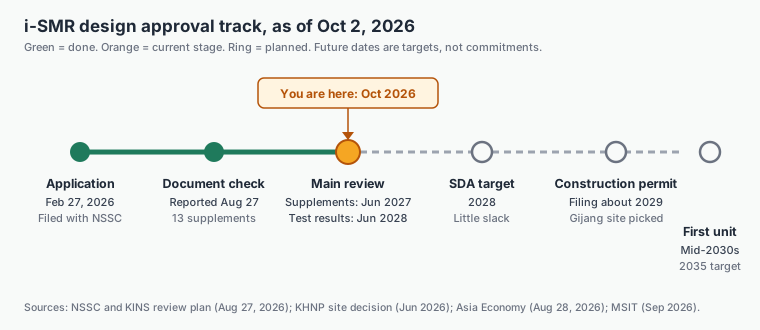
Status as of October 2, 2026:
| Milestone | Planned | Status | Source |
|---|---|---|---|
| Application | Feb 27, 2026 | Filed | NSSC, WNN |
| Document check | Feb to Aug 2026 | Done; 13 supplements requested | NSSC, KINS |
| Supplements due | June 2027 | Pending, applicant’s task | NSSC |
| Test results due | June 2028 | Pending, applicant’s task | NSSC |
| SDA target | 2028 | Target unchanged; little slack | KHNP, NSSC |
| Site | June 2026 | Gijang chosen; permits pending | KHNP |
| Construction permit | Filing about 2029 | Not filed | Asia Economy |
| First unit | 2035 | Target | KHNP, MSIT |
The sources do not agree on when construction starts. Seoul Economic Daily (March 2026) gives 2029 for groundbreaking of the first unit, Asia Economy’s June 18 report on the site pick and Fn News say 2030, and Asia Economy’s August 28 report says the early 2030s.
4. What to watch in the next 30 to 60 days
- The deliberation committee. Its line-up and first sessions will show how much weight SMRs get before the December recommendations.
- MSIT’s October council and committee. Watch whether the promotion committee gets its private members by year-end.
- The IAEA’s International Ministerial Conference on Nuclear Power in Incheon, October 27 to 29. Korea hosts through MSIT. Expect SMR announcements, and treat them as policy signals, not licensing steps.
- NSSC agendas. An SMR rule-making item would matter more than any headline. I know of no scheduled public milestone for the design review itself before June 2027.
- Site follow-up. A zone designation or environmental assessment notice at Gijang would be the first concrete sign that the site track has moved.
5. How the clock compares abroad
NuScale filed its 77 MWe design in January 2023 and the US NRC approved the SDA in May 2025, about 28 months later. At Darlington in Canada, regulator CNSC issued OPG a construction licence for the first BWRX-300 on April 4, 2025. Construction started in May 2025 with grid connection targeted for the end of 2030, according to World Nuclear News.
The comparison is rough, because Canada licenses a specific site directly and Korea’s SDA has no exact twin there. If KINS finishes in 2028, Korea would be about three years behind NuScale on this one step. Other projects are mapped in our global SMR status post.
My read: a tracker like this will be dull for months, and that is the point. Quiet months usually mean test work is under way.
Where this goes next. The next hard date is December, when the deliberation recommendations and the 12th Basic Plan draft are due. After that the calendar goes quiet until June 2027.
Industry note. Listed companies in the October 1 supplier group include Doosan Enerbility (KRX: 034020), Hyundai E&C (KRX: 000720), Samsung C&T (KRX: 028260) and Daewoo E&C (KRX: 047040). Their i-SMR orders depend on a construction permit that is not expected to be filed before about 2029.
This section is provided to help understand the industry and is not a recommendation to buy or sell any security. Investment decisions and their consequences are the reader’s own.
Sources: Nuclear Safety and Security Commission (NSSC), i-SMR review plan (August 27, 2026) and SMR Regulatory Framework Roadmap (February 2026); Ministry of Science and ICT, SMR Special Act and enforcement decree notice (September 11, 2026) and SMR industry meeting (October 1, 2026); Ministry of Climate, Energy and Environment, nuclear public deliberation plan (September 22, 2026) as reported by Korea Daily and Bizhankook; NSSC meetings No. 2026-14 (September 11) and No. 2026-15 (September 30) as reported by Asia Economy and Segye Ilbo; NSSC announcement of March 4, 2026 as reported by Newsseoul; Fn News on the Gijang schedule (June 2026); IAEA, International Ministerial Conference on Nuclear Power (Incheon, October 2026); Korea Hydro & Nuclear Power, site selection result (June 2026); World Nuclear News, i-SMR application and OPG Darlington; Asia Economy and Seoul Economic Daily; US NRC and NuScale, 77 MWe SDA (May 2025); Canadian Nuclear Safety Commission, Darlington construction licence (April 2025); Doosan Enerbility Changwon plant coverage (2026).