Why four Korean reactors are idle: expired licenses, a twice-deferred accident plan, and Wolsong 2 on November 1
Four Korean reactors (3,800 MW) are off line after their licenses expired, and the NSSC has twice deferred their accident plan. Wolsong 2 is next on Nov. 1.
Data as of October 5, 2026 — statistics, prices, schedules and regulatory status in this article were checked on this date. Where a different date is given in the text, that date takes precedence.
KRW 1,891.9 billion, about $1.4 billion. That is the value of the electricity four Korean reactors could not sell between their license expiry dates and September 22, 2026, according to the office of Rep. Hwang Jung-a, working from data supplied by Korea Hydro & Nuclear Power (KHNP), the state utility that operates every Korean reactor, and it counts foregone sales, not cash that left anyone’s account.
The four units are not broken. Their 40-year operating licenses ran out, and Korean law says a reactor must then stop until the regulator approves continued operation. The regulator, the Nuclear Safety and Security Commission (NSSC), has twice put off a related file, an accident-management plan, at meetings on September 11 and 30.
As of October 5, 2026, no new date had been reported. How the review works, and how it compares with the US, Japan and France, is covered in our process explainer. This post is only about why the units are still standing still.
Key takeaways
- Four 950 MW units, Kori 3 and 4 and Hanbit 1 and 2 (3,800 MW in total), are off line after license expiry. If Wolsong 2 (700 MW) also stops on November 1, Seoul Economic Daily reported, idle capacity reaches 4.5 GW.
- The NSSC deferred the accident-management plan approvals for all four on September 11 and September 30. No re-listing date had been reported as of October 5. Some commissioners questioned the plan’s drafting standards.
- Cost estimates differ by who is counting. Hwang’s office put foregone sales at about $1.4 billion; Korea Economic Daily put extra LNG fuel for Hanbit 2 at about $326 million. Environmental groups call the batch review rushed.
1. Why a Korean reactor stops at expiry
Korean reactors carry a design-life date in their license, 40 years for pressurized water reactors. When it arrives the unit must stop. Keeping it running needs a license amendment from the NSSC, supported by a technical review from KINS (Korea Institute of Nuclear Safety, the NSSC’s review body).
The United States works differently on paper: a 40-year license is renewed in 20-year steps, and the NRC’s September 2026 count was 25 units at 13 plants licensed to 80 years. Korea grants 10 years at a time, stops the unit at expiry, and starts the clock at the expiry date, so months spent waiting for approval are lost. That is why a slow review shows up as idle capacity.
2. The four units, as of October 5, 2026
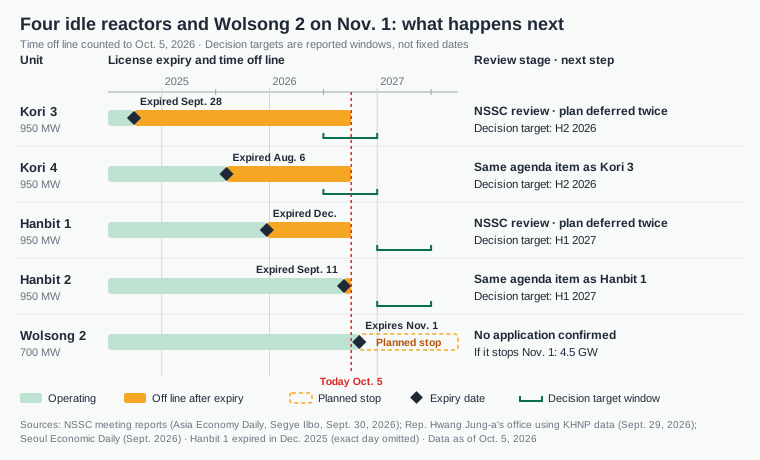
They stopped in order: Kori 3 in September 2024, Kori 4 in August 2025, Hanbit 1 in December 2025 and Hanbit 2 on September 11, 2026. All four are Westinghouse-lineage 950 MW pressurized water reactors, together 3,800 MW. The table is as of October 5, 2026.
| Unit | License expired | Stage | Decision target |
|---|---|---|---|
| Kori 3 | Sept. 28, 2024 | NSSC review; plan deferred twice | H2 2026 |
| Kori 4 | Aug. 6, 2025 | Same agenda item as Kori 3 | H2 2026 |
| Hanbit 1 | Dec. 2025 | NSSC review; plan deferred twice | H1 2027 |
| Hanbit 2 | Sept. 11, 2026 | Same agenda item as Hanbit 1 | H1 2027 |
The decision targets are windows the NSSC reportedly gave earlier, not fixed schedules (Segye Ilbo, September 30, 2026). Even the fleet map still lists these four among 26 “operating” units, which hides the fact that they are not generating.
The precedent is Kori 2. Its license ended in April 2023 and approval came on November 13, 2025. KHNP’s position is that reviews normally take three to four years, so it does not count this as a delay (Maeil Shinmun, September 29, 2026).
3. The bottleneck: an accident-management plan
What is on the table
An accident-management plan is the comprehensive manual for limiting damage in a severe accident. It covers the scope of management, equipment, strategies and training (Asia Economy Daily, September 30, 2026). A license amendment to install related equipment was listed alongside it (Special Economy, September 12, 2026).
KHNP filed plans for its whole operating fleet in June 2019. For these four units, an expert committee did six rounds of preliminary review (Energy Safety News, September 11, 2026).
Why it matters for restart
Legally, the plan is a separate item from the continued-operation license (Supple, September 11, 2026). Korean media still call it the gateway because of sequence.
For Kori 2, the plan was approved on October 23, 2025 and continued operation three weeks later, on November 13 (Segye Ilbo). If the four units follow the same order, this item has to clear before the main decision can move.
Two deferrals
- September 11 (meeting 2026-14): the four units’ plans were listed for the first time. The commission discussed them and carried them over to September 30.
- September 30 (meeting 2026-15): some commissioners questioned the plan’s drafting standards and the debate ran long. According to Asia Economy Daily, the commission tried to vote, some members objected, and the item was sent for re-listing. It is not confirmed whether they objected to the vote or to the plan itself.
- Next listing: no date has been set. The commission judged the item important enough to need more deliberation (Energy Safety News, September 30, 2026).
A split between the technical review and the commissioners
KINS, after site inspections and question rounds, confirmed that the units’ accident-management ability meets the standard (Special Economy), and the expert committee judged the review results appropriate (Asia Economy Daily). So the technical review did not stall; the disagreement is inside the commission, over how to read the standard.
Which commissioners objected, and to which items, has not been reported. Deferral is not new: Saeul 3’s operating license was first discussed on December 19, 2025 and approved on December 30 after more discussion (Newsis), one step in the seven-stage licensing path.
4. November 1: Wolsong 2
Wolsong 2’s license expires on November 1, 2026. Seoul Economic Daily reported that if its review is not finished by then, idle capacity grows to 4.5 GW (September 2026).
Wolsong is Korea’s only CANDU site, a heavy-water design. Unlike the light-water units, it needs major equipment work such as pressure-tube replacement, and the trade paper Electric Times said even with approval the actual extended run would be only six to seven years.
Its review lags the four. Of the ten reactors in the continued-operation program (the nine now in the queue plus Kori 2, already approved), only Wolsong 2, 3 and 4 had not finished an economic evaluation, which delayed the license application and major equipment orders (Energy Safety News and others, April 2026). A March article called the filing date “uncertain.”
As of October 5, I could not confirm that an application had been submitted. Searches of Korean and English coverage for October 4 and 5 turned up nothing new.
5. The cost argument: two figures and the other side
- Rep. Hwang Jung-a’s office: using KHNP data, it put the output the four units could have produced through September 22 at about 23.95 million MWh. Multiplied by the 2025 average nuclear sales price of KRW 79 per kWh (about 6 US cents), that gives KRW 1,891.9 billion in foregone sales. By unit: Kori 3, KRW 988.6 billion (about $732 million); Kori 4, KRW 535.6 billion (about $397 million); Hanbit 1, KRW 355.1 billion (about $263 million); Hanbit 2, KRW 12.5 billion (about $9 million) (September 29, 2026).
- Korea Economic Daily: if Hanbit 2’s output were replaced entirely by LNG during a 10-month stop, the extra cost would be about KRW 440 billion (about $326 million). That assumes a fuel price gap and an 80 percent capacity factor (September 11, 2026).
The two answer different questions. One counts sales not made; the other counts the added fuel bill, so they cannot be added or set against each other. In 2025 the KPX settlement price was about KRW 79 per kWh for nuclear and KRW 158 for LNG (how the bill splits by fuel), and Hwang’s KRW 79 is the nuclear side.
I found no reporting that calculates the effect on customers’ bills, so I will not guess.
The other side deserves equal space.
- Environmental groups: at a September 10 press conference, Busan-area anti-nuclear groups and the 2026 Climate Justice Action Group said reviewing four units as one batch was rushed. They argued that procedural and technical flaws surfaced in the Kori 2 review, yet its plan was approved anyway (NoCut News).
- Some commissioners: they questioned the plan’s drafting standards. What those standards specifically are has not been reported.
- Supporters of faster review do not dismiss deliberation: Hwang said safety must be upheld but that reviewing identical reactor types in parallel could shorten the gap.
I studied nuclear engineering and radiation science, and my reading is simple. A deferral is not a safety verdict, and a call for speed is not a call to cut corners. The trouble is that what is missing cannot be seen from outside, so it is hard to say which side is right.
6. What to watch
Two parliamentary audits are reported: the science and ICT committee examines the NSSC on October 13, and the Climate, Energy, Environment and Labor Committee examines Korea Electric Power Corp. (KEPCO), KHNP and the five KEPCO generation subsidiaries on October 19 (Bloter; Energy Shinmun). Dates can change.
Three signals matter.
- A re-listing date: none exists yet. Whether one is set, and whether the commission reaches a vote, is the first sign.
- November 1: whether Wolsong 2’s application is filed before then.
- The decision targets: whether Kori 3 and 4 get decided in H2 2026 and Hanbit 1 and 2 in H1 2027. Unlike the debate over new reactors, this concerns plants already built, so results show up quickly in the numbers.
Industry note
The areas touching this bottleneck are maintenance and upgrades, accident-management equipment design, and replacement power. KEPCO (KRX: 015760) buys and sells the power; KHNP is unlisted.
KEPCO KPS (KRX: 051600) does plant maintenance, KEPCO E&C (KRX: 052690) design, Doosan Enerbility (KRX: 034020) main components, and KOGAS (KRX: 036460) LNG imports. Abroad, Westinghouse is unlisted, owned by Brookfield Renewable (NYSE: BEP) with institutional partners at 51 percent and Cameco (NYSE: CCJ) at 49 percent.
This section is provided to help understand the industry and is not a recommendation to buy or sell any security. Investment decisions and their consequences are the reader’s own.
Where this goes next
The next facts will arrive in a short window. Parliament questions the NSSC on October 13, Wolsong 2 reaches expiry on November 1, and the Kori 3 and 4 decision is reportedly aimed for the second half of the year. Nothing is scheduled for the accident-management plan yet.
If the plan returns and passes in a single sitting, Kori 3 and 4 could move toward a vote this year. If it keeps being deferred, Kori 3 and 4 slip into 2027, with Wolsong 2 queued behind them.
Sources: NSSC meeting results as reported by Asia Economy Daily (Sept. 11 and 30, 2026); Segye Ilbo on the NSSC re-deliberation (Sept. 30, 2026); Energy Safety News on the Sept. 11 and 30 meetings (Sept. 11 and 30, 2026) and on delays at Wolsong 2–4 (Apr. 3, 2026); Special Economy on the accident-management review (Sept. 12, 2026); Supple (Sept. 11, 2026); Newsis on NSSC meeting 223 (Oct. 23, 2025) and the Saeul 3 operating license review (Dec. 19, 2025); Maeil Shinmun and Kukinews on Rep. Hwang Jung-a’s data (Sept. 29, 2026); Korea Economic Daily on Hanbit 2 (Sept. 11, 2026); Seoul Economic Daily on Hanbit 2 and 4.5 GW (Sept. 2026); NoCut News on the Busan-area press conference (Sept. 10, 2026); Bloter and Energy Shinmun on audit schedules (Sept. 2026); Electric Times on Wolsong continued operation; US NRC subsequent license renewal status (Sept. 8, 2026)