IAEA ministerial conference in Incheon, October 27 to 29: what Korea wants to show, and what the meeting will not decide
The IAEA's sixth International Ministerial Conference on Nuclear Power opens in Incheon on October 27. How it compares with Paris, Beijing and Washington, why the outcome is a president's statement rather than a treaty, and five things to watch.
Data as of October 16, 2026 — statistics, prices, schedules and regulatory status in this article were checked on this date. Where a different date is given in the text, that date takes precedence.
Eleven days from now, on October 27, nuclear ministers from IAEA member states will sit down at Songdo ConvensiA, a convention center on reclaimed land west of Seoul. It is the sixth International Ministerial Conference on Nuclear Power, a series that began in Paris in 2005 and has since moved through Beijing, St. Petersburg, Abu Dhabi and Washington. This is the first time it comes to Korea, and the first East Asian venue since Beijing 17 years ago.
The timing inside Korea is awkward in a way foreign delegates may not notice. The National Assembly’s annual audit of the government ends on October 30, the day after the conference closes. Two days later, on November 1, the operating license of the Wolsong 2 reactor expires. Inside the hall Korea will present itself as an exporter and an SMR developer. Outside it, four reactors sit idle and lawmakers are asking what the export contracts actually cost.
This is a preview, written as of October 16, 2026, of what the meeting is, what it is not, and what to watch.
Key takeaways
- The conference runs October 27 to 29 at Songdo ConvensiA in Incheon. The IAEA organizes it in cooperation with the OECD Nuclear Energy Agency; the Korean government hosts it through the Ministry of Science and ICT (MSIT), the ministry that funds nuclear R&D and the i-SMR program. Source: IAEA conference announcement CN-348.
- The output is a Conference President’s Statement read at the closing plenary. It is not a negotiated declaration, there is no vote, and nothing in it binds a licensing body, a utility or a budget.
- What will carry information: the wording of Korea’s national statement, the headcount versus Washington 2022, bilateral side meetings, and the domestic calendar that overlaps the conference.
1. What the conference is
The IAEA holds this meeting every four to five years. It is a policy forum, not a technical one. Ministers deliver short national statements on their energy strategy and the place of nuclear power in it, and panels of senior officials and executives discuss cross-cutting themes.
The IAEA announcement describes three parts.
- Plenary of ministerial statements. Ministers speak in an order set by a ballot held at IAEA headquarters in Vienna. Statements are delivered in the speaker’s own language.
- Panels and In-Focus sessions. Five panel themes are listed: new builds and embarking countries; regulation, including harmonization and non-proliferation; advanced reactors, SMRs and fusion; workforce and supply chains; and nuclear for maritime, offshore and remote sites. In-Focus sessions cover financing, stakeholder engagement and AI.
- Closing plenary. The conference president reads a statement.
One small change is in the name. The five earlier meetings all carried “21st Century” in their titles. The 2026 announcement drops it. I read that as a sign the question has shifted from whether nuclear belongs in this century to how fast it can be built.
Korea’s hosting was announced from the podium of the 69th IAEA General Conference in September 2025 by Koo Hyuk-chae, MSIT’s first vice minister, who asked all member states to attend (MSIT press release, September 17, 2025). At the 70th General Conference on September 15, 2026, he repeated the invitation at a high level and linked it to Korea’s SMR agenda, according to Korean business daily Financial News. As of October 16 the IAEA has not published a participant count. The registration deadline for delegations is October 19.
2. The five conferences before this one
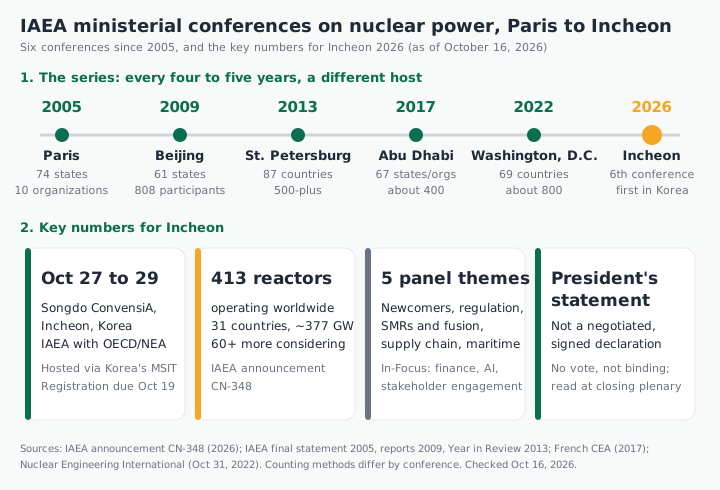
Participation figures below come from the IAEA’s final statements and annual reports, the French CEA and Nuclear Engineering International. Counting methods differ from meeting to meeting, so treat them as rough.
| Conference | Participation | Backdrop |
|---|---|---|
| Paris 2005 | 74 states, 10 organizations | Early talk of a nuclear revival |
| Beijing 2009 | 61 states, 808 participants | Financial crisis, China’s build-out |
| St. Petersburg 2013 | 87 countries, 7 organizations, 500-plus | Two years after Fukushima |
| Abu Dhabi 2017 | 67 states and organizations, about 400 | Barakah under construction |
| Washington 2022 | 69 countries, 9 organizations, about 800 | Energy crisis; Russia excluded |
All five ended the same way, with a concluding statement by the conference president rather than a signed text. In 2013 the IAEA summarized the outcome as nuclear power remaining an important option for many countries. In 2022 it was that nuclear “can make a significant contribution to achieving net zero emissions by 2050”. No delegation voted on either.
The backdrop always followed the host. Abu Dhabi met while Barakah was still being built, and the message was that a newcomer could do this. Washington met eight months into the war in Ukraine, and Russia was excluded from the proceedings (Nuclear Engineering International, October 31, 2022). Incheon’s backdrop is SMRs and exports, and Korea has both to talk about.
3. What Korea wants to show
Korea’s message at IAEA venues has been consistent for a year. Three items stand out.
- The i-SMR. The i-SMR Technology Development Project Group, led by KHNP (Korea Hydro & Nuclear Power, the state utility that runs all Korean reactors), filed for Standard Design Approval on February 27, 2026. NSSC (Nuclear Safety and Security Commission, the regulator) opened the main safety review on August 27. The 2028 approval target and the slack in it are tracked in our October licensing tracker, with the background in our baseline post on Korea’s SMR program.
- Nuclear at sea. At the September General Conference, Vice Minister Koo described SMR-powered ships that combine nuclear and shipbuilding know-how as part of a national “K-Moonshot” program. It is no accident that maritime, offshore and remote applications have their own panel in Incheon.
- Export record. Four APR1400 units operating at Barakah in the UAE, two APR1000 units under contract at Dukovany in the Czech Republic, and the US-Korea nuclear package announced on September 30: six AP1000 units and up to two APR1400 units, up to $120 billion, non-binding. The project-by-project position is in our export tracker and the package explainer.
There is also what Korea would rather not discuss in front of visiting ministers. Four reactors, Kori 3 and 4 and Hanbit 1 and 2, are idle on expired licenses, and Wolsong 2 joins them on November 1 unless something changes. During the audit on October 12, the head of KEPCO (Korea Electric Power Corporation, the state power company and parent of KHNP) confirmed that the Westinghouse technology fee on the two Dukovany units is $350 million, after first saying it was far less. KHNP has booked a KRW 1.2 trillion (about $890 million) loss provision on its Egyptian El Dabaa work. The same week Korea tells the world it is an exporter, its parliament is asking what the exports cost.
4. What gets decided, and what does not
What gets decided. The sentences in the president’s statement. Which theme gets a paragraph of its own, and how SMR licensing, private finance or maritime nuclear are worded, becomes the reference point for IAEA programs and for every national press release that follows. Every previous conference was presided over by a figure from the host country, so by custom Korea will have a say in how the draft reads.
What does not. Almost everything else. There is no treaty, no vote and no budget line. The i-SMR review runs on the clock of NSSC and KINS (Korea Institute of Nuclear Safety, the regulator’s technical arm), not on the conference calendar. The site and the operator for the eight reactors in the US package will be settled in commercial talks that have nothing to do with Incheon. Memoranda signed during the week are bilateral documents agreed in side rooms; they are not part of the conference outcome and most of them are not binding either.
The practical consequence is that a headline reading “nations agree at IAEA conference” should be checked against the text. Agreement at these meetings means nobody objected to the president’s summary.
5. Five things to watch during the week
- Who reads Korea’s national statement, and what numbers it uses. A minister, or someone above a minister, is itself a signal. If the figures on the i-SMR or on exports differ from what has already been published, that difference is the story.
- The headcount. Whether the number of countries and ministers exceeds Washington 2022 (69 countries, about 800 participants), and whether Russian and Chinese delegations attend, will show what an Asian venue adds.
- New wording in the president’s statement. Watch for first appearances of SMR regulatory harmonization, private and multilateral-bank financing, maritime nuclear and AI. The 2026 announcement names all four, so their absence from the statement would be the surprise.
- Bilateral meetings and memoranda. The United States on follow-up to the September 30 package; the Czech Republic ahead of the Dukovany auxiliary-equipment tender planned for November; the UAE; and Vietnam. For each, look for the counterpart’s name and whether the document binds anyone.
- The calendar outside the hall. The audit closes on October 30 and Wolsong 2’s license lapses on November 1. One more Korean reactor going dark three days after the conference ends is a picture foreign coverage may well pick up.
My own reading, having studied this field, is that these meetings produce sentences, and sentences rarely change what gets built. But a host country’s unfinished homework tends to show through its own statement. I will read Korea’s one page more carefully than the president’s.
Where this goes next. The president’s statement should be posted on the IAEA conference page on or soon after October 29. The next dated items in Korea are the Wolsong 2 license expiry on November 1 and, in December, the public deliberation recommendations and the draft 12th Basic Plan for electricity supply, which will set how many SMRs and large reactors the country actually plans to build.
Sources: IAEA, announcement for the International Ministerial Conference on Nuclear Power, CN-348/EVT2502033 (2026, copy posted by the Czech State Office for Nuclear Safety) and conference web page; Ministry of Science and ICT, press release on the 69th IAEA General Conference (September 17, 2025, reposted by the Korea Nuclear International Cooperation Foundation); Financial News (September 16, 2026); Munhwa Ilbo and Digital Times (September 17, 2025); SBS (October 1, 2026); IAEA final statement of the Paris 2005 conference (CN-122), Beijing 2009 conference reports, 2013 Year in Review and Division of Nuclear Power newsletter (September 2013); French CEA report on the Abu Dhabi conference (November 2017); Nuclear Engineering International (October 31, 2022); NSSC, i-SMR review plan (August 27, 2026); World Nuclear News on the US Department of Commerce fact sheet (October 1, 2026); Korean coverage of the National Assembly audit (October 12, 2026).