Thirty years to a repository: how Korea sited, fought over and finally built Gyeongju
Korea spent 30 years and a 2005 referendum to build its Gyeongju low-level waste site. What got built, what it left unsolved, and what critics still argue.
Data as of September 26, 2026 — statistics, prices, schedules and regulatory status in this article were checked on this date. Where a different date is given in the text, that date takes precedence.
On May 13, 2026, officials in white hard hats cut a ribbon at a coastal site in Gyeongju, marking the finish of a second disposal facility for low-level radioactive waste. It was a quiet event for a project that began in 1986. Getting from the first attempt to a working repository took Korea 30 years of failed sitings, one violent standoff, a nationwide referendum and a very large incentive package.
Key takeaways
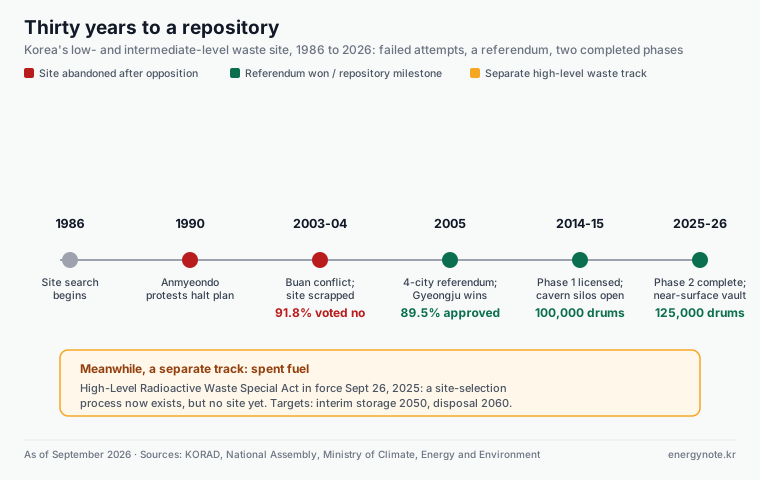
- Korea’s first four attempts to site a radioactive waste repository collapsed between 1986 and 2004, most visibly at Buan in 2003 to 2004, before a 2005 referendum among four volunteer cities picked Gyeongju with 89.5 percent approval.
- Gyeongju’s repository now runs in two completed phases: an underground silo facility (100,000 drums, operating since 2015) and a near-surface vault (125,000 drums, completed in 2026), with a third phase and 800,000 drums of eventual capacity still to come.
- The site solves none of Korea’s spent-fuel problem. A 2025 special act finally created a legal process for a separate high-level waste repository, targeting 2050 for interim storage and 2060 for disposal, decades behind where Gyeongju already stands.
1. Fourteen years of no
South Korea started looking for a site for its radioactive waste in 1986, while it was still building the reactor fleet that would produce it. For most of the next two decades, the government’s approach was to pick a site and announce it, and residents’ approach was to stop the trucks.
The clearest early failure was Anmyeondo, a coastal township in Taean County, Chungcheongnam Province. In 1990, protests severe enough to draw national attention forced the government to drop it. A second attempt on Gulup Island, off the west coast, collapsed the same way in 1994 and 1995. Both plans died at the announcement stage, before construction of any kind began.
The worst of the failures came at Buan, a fishing county on the southwest coast. In July 2003, its county chief applied, on his own initiative, to host the facility on Wido, a small island in the county. The industry ministry confirmed the site after roughly a month of geological review, far too short for many residents to accept as real due diligence.
What followed was close to a year of unrest. Protesters wearing yellow, the movement’s color, held rallies that at times drew tens of thousands of participants; the government sent thousands of riot police into the county. Hundreds of people were reported injured in the clashes. When Buan held its own referendum on February 14, 2004, 91.8 percent voted against the plan. The industry ministry abandoned the site-selection process that September, and the Wido plan was formally scrapped that November.
Buan is still cited in Korean policy circles as the case that forced a rethink. A government designating a site and then explaining it to residents afterward had failed four times in a row. The next attempt would have to start from consent, not announcement.
2. A different method: bidding, incentives and a referendum
For the next try, the government flipped the process. Instead of naming a site, it invited municipalities to apply voluntarily, with a fixed incentive package attached, and it agreed in advance to hold a binding local referendum before any site was finalized.
Four cities volunteered: Gyeongju, Gunsan, Yeongdeok and Pohang. All four held referendums on the same day, November 2, 2005. The approval margins were:
- Gyeongju: 89.5 percent, on a 70.8 percent turnout of the city’s roughly 209,000 eligible voters
- Gunsan: 84.4 percent
- Yeongdeok: 79.3 percent
- Pohang: 67.5 percent
Gyeongju’s margin was the largest, and the government named it the winning site the next day, choosing a location called Bongil-ri on the coast next to the existing Wolsong nuclear plant.
The incentive package that came with hosting was substantial: a KRW 300 billion special support fund (about $222 million) paid directly to Gyeongju city, relocation of KHNP (Korea Hydro & Nuclear Power, the state utility that operates Korea’s reactor fleet) headquarters to the city, and a national proton accelerator research center built there with government funding. KHNP’s headquarters was completed in Gyeongju at the end of 2015; the accelerator center, delayed for years by budget disputes, finally held its completion ceremony in April 2018. Government and public agencies later committed a further KRW 3.2 trillion (roughly $2.4 billion) to broader local support projects tied to the agreement, on top of ongoing per-drum fees paid to the city.
Whether that price tag reflects fair compensation or simply what it took to overcome the memory of Buan is still debated by Korean researchers who study the case. What is not disputed is that it worked, where four prior attempts at persuasion by decree had not.
3. What actually got built
Ground was broken in July 2007, five years after the referendum, and construction proper began that November. The facility took its official name, the Wolseong Low- and Intermediate-Level Radioactive Waste Disposal Center, in January 2008.
Phase 1 is a cavern-type facility: six underground silos, reached through a tunnel more than a kilometer long, disposing of waste in bedrock roughly 80 to 130 meters below sea level. Construction finished in June 2014. Korea’s nuclear regulator, the NSSC (Nuclear Safety and Security Commission), approved operation on December 11, 2014, and the first drums went into a silo on July 13, 2015, with a formal completion ceremony that August 28.
Phase 2 is a different design: a near-surface facility of 20 concrete disposal vaults, described by its builders as a five-layer barrier system rated to withstand a magnitude-7.0 earthquake, for waste with lower radioactivity than Phase 1 handles. The project traces back to 2012, but construction under its NSSC permit ran from 2022 and finished in December 2025, at a reported cost of about KRW 314.1 billion (roughly $233 million). The NSSC gave final operating approval on March 16, 2026, and the completion ceremony was held on May 13, 2026, with full-scale operation due to begin in the second half of the year.
Capacity and status, as of September 2026:
| Phase | Method | Capacity | License / operation |
|---|---|---|---|
| Phase 1 | Underground silo (cavern) | 100,000 drums | NSSC approval Dec 2014; first waste emplaced July 2015 |
| Phase 2 | Near-surface concrete vault | 125,000 drums | Construction complete Dec 2025; NSSC approval Mar 2026; ceremony May 2026 |
| Phase 3 (planned) | Landfill-type, very low-level | about 160,000 drums | Targeted 2031 |
| Full site (design capacity) | All methods combined | 800,000 drums | No fixed date; long-term design target |
KORAD (Korea Radioactive Waste Agency), the state agency that builds and runs the site, describes Gyeongju as the world’s first single complex to combine cavern and near-surface disposal. With Phase 2 barely open, that combination is now real, even if most of the design capacity still sits unbuilt.
4. How much is actually buried, and where the rest is waiting
Progress inside the repository has been steady but slow relative to the site’s ultimate size. As of reporting in mid-2026, Phase 1 held about 37,700 drums, roughly 38 percent of its 100,000-drum capacity, after 11 years of operation. Phase 2 had barely started taking waste.
Outside the fence, the picture is more crowded. Korea’s reactor sites and research facilities keep generating low- and intermediate-level waste faster than Gyeongju can absorb it, and most of it still sits where it was produced. According to Korea’s Radioactive Waste Safety Management Integrated Information System, cited by the Korean outlet Supple in September 2026, Kori, Korea’s oldest nuclear plant, holds the country’s largest stockpile: about 40,087 drums of low- and intermediate-level waste in on-site storage. The second-largest stockpile, about 29,587 drums, is not at a plant at all but at two facilities in Daejeon: KAERI (Korea Atomic Energy Research Institute) and KEPCO Nuclear Fuel, both inside a metropolitan area of 1.4 million people.
KAERI has been shipping its own backlog to Gyeongju at roughly 800 drums a year, a rate that would clear its current inventory by around 2035. That pace illustrates the underlying math of the whole program: production and shipping capacity have generally run behind the pace at which reactors and research facilities generate waste, which is exactly why a second, larger phase became necessary barely a decade after the first opened.
5. What Gyeongju never touched: spent fuel
Gyeongju disposes of low- and intermediate-level waste: contaminated tools, filters, resins and reactor components, not the used nuclear fuel itself. Spent fuel is classified as high-level waste, and Korea still has no site, and no operating facility, for it at all.
That gap finally has a legal process behind it. The Special Act on High-Level Radioactive Waste Management passed South Korea’s National Assembly on February 27, 2025, was promulgated on March 25, and took effect on September 26, 2025. It created a High-Level Radioactive Waste Management Commission to run site selection, made KORAD the only body allowed to build such a facility, and set targets of an interim storage facility by 2050 and a permanent disposal facility by 2060.
The commission spent 2026 drawing up criteria to exclude geologically unsuitable areas and plans to open a call for volunteer municipalities in 2027, following broadly the same voluntary, incentive-based model that worked at Gyeongju. Whether that model transfers to a facility that must isolate far more dangerous material, for far longer, is the open question behind the 2050 and 2060 dates. How the rest of the world’s high-level programs are doing, and how Korea’s targets compare, is set out in our survey of the world’s deep repositories; the fuel itself, and how full the pools already are at each Korean reactor site, is covered in our inventory of Korea’s spent fuel.
6. Lessons, and the argument that didn’t go away
The comparison researchers draw most often is Buan against Gyeongju: a site chosen by decree against one chosen by a bid, incentives and a binding vote. The usual lesson is that compensation alone did not win Gyeongju; the referendum did, because it let one community claim the decision as its own rather than have it handed down.
That framing has its limits. Critics, including Korean environmental groups, have argued for years that the 89.5 percent vote settled a political question without fully settling a geological one. The clearest example surfaced in 2016, when Hankook Ilbo reporting revealed that chloride levels in the site’s drainage pumps had reached roughly 753 milligrams per liter as of March 2016, well above the 20 milligrams per liter assumed at the design stage, evidence that seawater was finding its way into a facility built partly below sea level. The pumps, installed in 2014, had already corroded and were replaced with corrosion-resistant stainless models in September 2015; KINS judged the amounts involved too small to affect public health. A separate 2014 dispute inside the safety authority over possible long-term radionuclide migration into groundwater had already delayed Phase 1’s operating license to December 2014. The debate delayed licensing by months and left a lasting seam of distrust that resurfaces whenever the site makes news.
Seismic risk is the other recurring objection. The magnitude-5.8 earthquake that struck Gyeongju itself in September 2016, Korea’s strongest since modern recordkeeping began, sat only a few dozen kilometers from the repository and from the Wolsong nuclear plant next door. Anti-nuclear groups renewed calls at the time for tighter scrutiny of aging reactors and waste sites in the region. KORAD’s response was engineering rather than relocation: it added redundant drainage and backup power systems at the site afterward, and Phase 2’s vaults were built to the magnitude-7.0 standard partly in answer to that episode.
Neither dispute has stopped the facility from running. Both keep showing up whenever KORAD, the ministry or the operator explains why a milestone took longer than scheduled. Reading through three decades of these fights for this piece, the incentive package that finally worked in 2005 reads less like generosity and more like the price of everything four earlier, cheaper attempts had already burned through.
Where this goes next
Phase 2’s ramp-up through the rest of 2026 is the near-term marker. If it disposes waste at anything close to Phase 1’s eventual rate, the backlog at sites such as Kori and Daejeon should start shrinking rather than merely growing more slowly. Phase 3, targeted for 2031, is the next construction milestone.
The bigger question sits one level up. Korea now has a working template, incentives plus a local vote, for low-level waste, and a legal process built on the same template for high-level waste. Whether a town will actually volunteer for the far heavier commitment a spent-fuel site demands, on anything like the 2050 and 2060 schedule, is the test the Gyeongju story has not yet answered.
Industry note. Companies with roles in Korea’s waste-disposal construction include KEPCO E&C (KRX: 052690), which has worked on design and safety assessment for KORAD’s facilities, and Doosan Enerbility (KRX: 034020), a supplier of nuclear equipment across Korea’s back-end industry; the broader decommissioning and waste value chain is mapped in our Korean guide to decommissioning stocks (in Korean).
This section is provided to help understand the industry and is not a recommendation to buy or sell any security. Investment decisions and their consequences are the reader’s own.
Sources: KORAD (Korea Radioactive Waste Agency), official history and phase overview of the Gyeongju LILW repository; World Nuclear Association, “Nuclear Power in South Korea” country profile; Hankook Ilbo, referendum and site-selection reporting (February 2004 and November 2005); Digital Buan Culture Encyclopedia (Grand Culture), account of the Buan anti-waste-site movement; WISE International, Nuclear Monitor #600, “Buan victorious as waste dump proposal retracted”; Kyunghyang Shinmun, comparison of Gyeongju and Buan outcomes (April 2011); Edaily, coverage of the Gyeongju low- and intermediate-level repository’s completion 30 years after the site search began (August 2015); Newsis, report on Phase 2 nearing completion (January 2025); Seoul Economic Daily, “Korea Completes Surface Disposal Facility for Low-Level Radioactive Waste” (May 13, 2026); The Asia Business Daily, “Safe Storage of Low-Level Radioactive Waste with Five-Layer Barriers” (May 13, 2026); World Nuclear News, “Expansion of South Korean waste repository begins” (August 2022); Nate News, report on Phase 1 disposal progress (May 2026); Hankook Ilbo, reporting on seawater infiltration and pump replacement at the repository (May 2016) and on licensing delays (November 2014); Maeil Shinmun, editorials on repository safety and post-earthquake upgrades (June 2014 and June 2021); Seoul Shinmun, environmental groups’ response to the 2016 Gyeongju earthquake (September 2016); Supple, National Assembly-linked reporting on nationwide low- and intermediate-level waste storage by site (September 12, 2026); Edaily and other reports on KAERI’s annual waste shipments to Gyeongju; Korea Law Information Center, Special Act on the Management of High-Level Radioactive Waste (Act No. 20843, promulgated March 25, 2025, effective September 26, 2025); World Nuclear News, “South Korea enacts legislation on high-level waste” (February 2025).