Three years of Fukushima treated-water discharge: the numbers, and how South Korea watches from next door
Batch 23 is underway. Cumulative volume, tritium, tank levels, IAEA checks, Korea's own sea and seafood monitoring — and what is still unsettled.
Data as of September 22, 2026 — statistics, prices, schedules and regulatory status in this article were checked on this date. Where a different date is given in the text, that date takes precedence.
172,729 metric tons. That is how much water left the Fukushima Daiichi plant for the Pacific in 22 batches between August 24, 2023 and August 17, 2026. The 23rd batch — the fifth of Japan’s fiscal 2026 — began on August 31 and finished on September 18, adding 7,863 tons.
Three years after the first release made headlines and emptied salt shelves in Korean supermarkets, this is a look at where the numbers stand, including what South Korea, the closest neighbor with its own monitoring program, has measured.
One note on terms. The water is “ALPS-treated water” in Japan’s usage (after the Advanced Liquid Processing System that filters it) and “contaminated water” in Korean usage, including in the Korean edition of this article. This article uses “treated water,” the IAEA’s term, from here on, without taking a side.
Key takeaways
- 172,729 tons discharged through batch 22; batch 23 (Aug 31–Sept 18) finished at 7,863 t. Tritium at the outlet in batch 23 was 149–223 Bq/L, against Japan’s own target of below 1,500 and the WHO drinking-water guideline of 10,000.
- Tanks have gone from about 1.34 million tons to 1.24 million — a 7.6% drop in three years — and discharge is planned to run until 2051.
- The IAEA’s sixth review mission and South Korea’s own sea and seafood monitoring both report nothing out of range, but non-tritium nuclides, organically bound tritium and trust over a 30-year horizon remain open questions.
1. Three years of discharge, in numbers
Tokyo Electric Power Company (TEPCO) plans the releases by Japanese fiscal year (April to March) in batches of roughly 7,800 tons. It completed 4 batches in FY2023, 7 in FY2024 and 7 in FY2025, and plans 8 batches totaling about 62,400 tons in FY2026 (as of September 2026).
| Item | Figure (as of September 2026) |
|---|---|
| Cumulative volume | About 172,729 t through batch 22 (August 17, 2026) |
| Tritium per batch | Batch 22 about 1.3 trillion Bq; batch 23 about 1.3 trillion Bq (finished Sept 18) |
| Annual plan | FY2026 about 11 trillion Bq, roughly half the 22 trillion Bq cap |
| Outlet concentration | Batch 22: 167–245 Bq/L; batch 23: 149–223 Bq/L after dilution (target: below 1,500 Bq/L) |
| Tank inventory | About 1.34 million t before discharge → about 1.24 million t (August 2026, −7.6%) |
The 22 trillion Bq annual cap is the plant’s pre-accident release-control target. TEPCO’s own tally puts cumulative tritium at about 39 trillion Bq through batch 22 (as reported by Japan’s Jiji Press on August 24, 2026) — averaged over three years, roughly 60% of the annual cap each year.
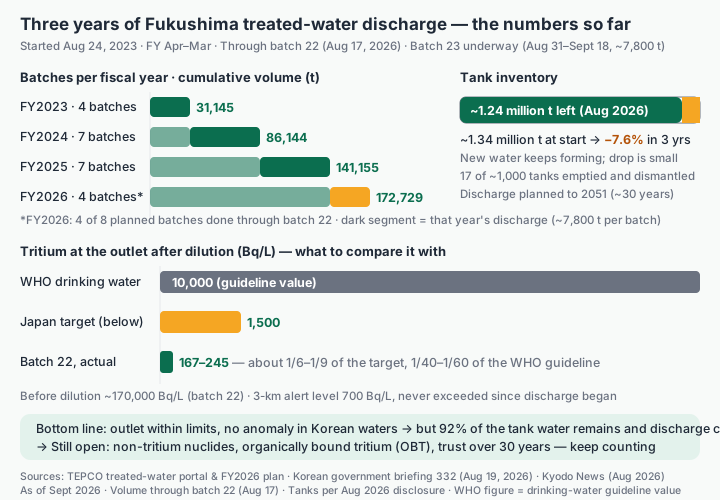
The tank numbers matter more than they look. More than 170,000 tons went out, yet the inventory fell only 7.6%, because groundwater and rain keep seeping into the reactor buildings and generating new contaminated water that must in turn be treated.
Of roughly 1,000 tanks, 17 have been emptied and dismantled, and TEPCO intends to keep discharging until its 2051 decommissioning target. That “about 30 years” is the root of the disputes in section 5.
2. Who is checking the Japanese numbers
The IAEA. On May 11–15, 2026, the International Atomic Energy Agency’s task force completed its sixth on-site review since discharge began. The conclusion was that the operation remains “consistent with international safety standards,” and that nuclide concentrations in seawater near the outlet are far below operational targets and consistent with earlier results. The fifth review (December 2025, report published April 2026) included experts from nine countries, among them South Korea, China and the United States.
Interlaboratory comparisons. Beyond the review missions, the IAEA runs comparisons in which laboratories in several countries measure the same samples — treated water, seawater, fish — independently and then compare results. Two Korean bodies take part:
- KINS (Korea Institute of Nuclear Safety), the technical review body of the NSSC, Korea’s nuclear regulator, has participated in the comparison on the treated water itself.
- KAERI (Korea Atomic Energy Research Institute) is one of the laboratories analyzing the third large marine sampling, collected in September 2025, alongside French and Swiss laboratories and the IAEA’s own labs in Monaco and Vienna. Results are due in the second half of 2026.
Near-shore thresholds. Japan’s own alert levels are 700 Bq/L of tritium within 3 km of the plant and 30 Bq/L within 10 km. Neither has been exceeded since discharge began. Before dilution, the batch 22 water itself contained about 170,000 Bq/L of tritium; seawater dilution of more than 100-fold brings it to the 167–245 Bq/L measured just before the outlet.
3. How South Korea watches from next door
South Korea is the nearest country with a monitoring program independent of Japan’s, and its government has briefed the public on every batch.
Per-batch briefings. The Office for Government Policy Coordination (under the prime minister), the Ministry of Oceans and Fisheries and the NSSC (Nuclear Safety and Security Commission, Korea’s nuclear regulator) hold regular joint briefings — 332 of them as of August 19, 2026, plus one more after batch 23 finished, on September 21, 2026 — that present the Japanese data for each batch alongside Korea’s own measurements.
Korean waters. In the precision surveys of Korean waters, cesium-137 was below 0.069–0.090 Bq/L and tritium below 6.1–6.8 Bq/L — that is, below the detection limits of the methods used, and within the range measured before discharge started. The faster emergency-survey program reports the same: below detection limits, no significant change.
Seafood. Testing at the production stage (953 samples) and the distribution stage (849 samples) found every sample compliant, and tritium monitoring of 32 domestic samples found none detected. Separately, the Seoul Metropolitan Government’s Research Institute of Public Health and Environment ran 13,335 radioactivity tests on seafood from 2023 to 2025 and reached the same conclusion.
“Not detected” is not the same as zero — it means below what the instrument and counting time can distinguish from background. What the term does and does not mean is covered in our Korean piece on detection limits (in Korean).
4. Dinner tables, markets and the import ban
Consumer behavior. Right after the first release, the Korean government’s tally (October 2023) compared the four weeks before and after: seafood restaurant spending fell 8.7%, but retail sales at hypermarkets and at Seoul’s Noryangjin fish market rose, and the government concluded in December 2023 that there was “no sign of consumption contracting.” Three years on, we could not find an official indicator stating that consumption has “recovered to pre-discharge levels.”
The 2026 outlook from the Fisheries Economic Institute of Suhyup, Korea’s federation of fisheries cooperatives, expects seafood consumption to decline to about 4.03 million tons — but attributes that to weak demand among younger consumers and prices relative to meat, not to the discharge.
The import ban. Korea’s ban on seafood from eight Japanese prefectures — Fukushima, Gunma, Tochigi, Chiba, Ibaraki, Miyagi, Iwate and Aomori — has been in place since 2013 and is unchanged. In June 2026 the Japanese government asked Korea to set up a consultative body to discuss lifting it; Seoul has so far withheld an answer.
The cost on the Japanese side is on record too. TEPCO’s compensation for discharge-related losses stood at about 1,100 cases and ¥96.7 billion as of August 2026, according to Kyodo News. The catch value of Fukushima Prefecture’s coastal fishery was about ¥4.4 billion in FY2025, still around half its pre-accident level.
5. The case that is still open
Everything above points the same way: no anomalous signal so far. The counter-arguments, however, also come with numbers, and they deserve to be stated in full.
- Nuclides other than tritium. ALPS cannot remove tritium or carbon-14, and it does not fully remove strontium-90 or cobalt-60. These have long half-lives and a tendency to bind to sediment and organisms. Ken Buesseler of the Woods Hole Oceanographic Institution argued in Science in 2020, before discharge began, that the debate should not be about tritium alone. TEPCO’s answer is procedural: before each batch it re-measures 29 nuclides besides tritium in the tank group, confirms that the sum of their concentration ratios to regulatory limits is below 1, and the IAEA cross-checks the results.
- Organically bound tritium (OBT). Tritium in the form of water leaves the body with a half-life of about ten days; tritium bound into biological tissue stays far longer. A critical paper in Frontiers in Marine Science in March 2026 (Lee et al.) pointed out that TEPCO’s OBT monitoring amounts to 83 samples from three species since 2014. Why tritium is rated a low hazard, and where OBT complicates that picture, is covered in our Korean explainer on alpha radiation and tritium (in Korean).
- Trust. Fukushima’s fishing cooperatives still oppose the discharge, citing the 2015 written promise from the government and TEPCO that no disposal would take place “without the understanding of those concerned.” And three years of good data is a different proposition from 30 years of good data. Because the effects of doses this low are too small to detect in individual studies, there is no basis for calling the monitoring finished.
6. Where this goes next
Every published figure sits within the discharge limits and within the normal range of Korean waters. But those figures only mean something as long as the system that produces them — the IAEA missions, the interlaboratory comparisons, Korea’s per-batch surveys and seafood tests — keeps running for more than two decades to come. The third-anniversary verdict is not “settled”; it is “keep counting.”
Batch 23 finished on September 18 as scheduled. The next checkpoints are the marine-sample comparison results due in the second half of 2026 and Seoul’s answer to Tokyo’s request on the import ban.
Industry note. The listed company at the center of this is TEPCO Holdings (TSE: 9501), which carries both the discharge operation and the compensation liability described above. The Korean monitoring bodies — KINS, KAERI and the Seoul research institute — are public institutions, not listed companies.
This section is provided to help understand the industry and is not a recommendation to buy or sell any security. Investment decisions and their consequences are the reader’s own.
Health note — This article is general information from a radiation-protection perspective and does not replace medical advice.
Sources: Office for Government Policy Coordination, Ministry of Oceans and Fisheries and NSSC, Fukushima discharge briefing no. 332 (Aug 19, 2026) and the batch-23 completion briefing (Sept 21, 2026); IAEA, press release on batch-23 tritium verification (Sept 2026); TEPCO, ALPS-treated water portal and FY2026 discharge plan (Mar 2026); IAEA, press release on the sixth task-force review mission (May 2026) and fifth review report (mission Dec 2025, published Apr 2026); IAEA and Japan’s Nuclear Regulation Authority, press releases on the marine-sample interlaboratory comparison (Aug–Sept 2025); Seoul Metropolitan Government Research Institute of Public Health and Environment, three-year seafood radioactivity testing results (Aug 2026); Ministry of Oceans and Fisheries, seafood consumption briefings (Oct and Dec 2023); Suhyup Fisheries Economic Institute, 2026 Fisheries Economic Outlook; Kyodo News, Jiji Press and Yomiuri Shimbun coverage of the third anniversary (Aug 2026); Lee et al., Frontiers in Marine Science (2026); Buesseler, Science (2020)