How Korea's electricity bill works — and what the nuclear share has to do with it
A Korean household's August 2026 bill, taken apart: the three-tier tariff, the 2025 generation mix, and why nuclear at KRW 79/kWh versus LNG at 158 matters.
Data as of September 3, 2026 — statistics, prices, schedules and regulatory status in this article were checked on this date. Where a different date is given in the text, that date takes precedence.
On August 2, 2026, the city of Yangsan in Korea’s southeast recorded 42.5°C, the highest temperature ever observed in the country. A month later the August bills arrived, and a four-person household that ran its air conditioner ten hours a day is now looking at a number it does not recognize.
That bill is a useful object. Korea has a single national utility, KEPCO (Korea Electric Power Corporation), which buys electricity from every power plant in the country and sells it to nearly every customer at retail tariffs set by the government. So one household bill has two layers: a tiered residential tariff on top, and underneath it the cost of the national generation mix that KEPCO pays for.
This post takes the August 2026 bill apart layer by layer and ends at the question Korea is debating this fall: whether building new reactors would change it.
Key takeaways
- Korea’s residential tariff has three tiers. In July–August the tiers are widened, but past 450 kWh a month the rate jumps to about KRW 307 per kWh (about 23 cents), and past 1,000 kWh to about KRW 736 (about 55 cents).
- Nuclear was Korea’s cheapest source in 2025 at about KRW 79 per kWh (about 5.9 cents) in the wholesale market; LNG was the most expensive at about KRW 158 (about 11.7 cents). The evening summer peak is met with LNG and coal.
- More reactors would lower KEPCO’s average purchase cost in the long run, but not soon: a reactor takes more than ten years to build, and the retail tariff is a policy price, not a cost pass-through.
1. The top layer: the tiered residential tariff
Korea’s residential tariff is progressive: the more a household uses in a month, the higher the rate per kilowatt-hour on the additional use. It has three tiers, and the government widens the tiers every July and August. As it applied to an August 2026 bill:
- Tier 1 covers the first 300 kWh of the month (the summer limit for July and August; it is lower the rest of the year).
- Tier 2 covers use from 300 kWh up to 450 kWh.
- Tier 3 starts the moment the month passes 450 kWh: the energy rate jumps to about KRW 307 per kWh (about 23 cents) and the fixed base charge rises sharply as well.
- Super-user rate: above 1,000 kWh a month, the rate becomes about KRW 736 per kWh (about 55 cents), 2.4 times the ordinary tier 3 rate.
For the household in the opening, this is the first cause of the shock. An air conditioner running ten hours a day through a heat wave pushes a family of four past 450 kWh without much difficulty, and everything past that line is billed at the tier 3 rate. Energy-saving tips are easy to find elsewhere; this post goes to the layer beneath.
2. The bottom layer: where the electricity came from
In 2025, Korea’s electricity came from roughly 31 percent nuclear, 29 percent coal, 27 percent LNG (natural gas) and 11 percent renewables (KEPCO statistics). KEPCO buys the output of all of these plants and resells it. What it pays differs sharply by source.
The price it pays is the settlement price, the per-kWh amount paid to generators through the Korea Power Exchange (KPX), which runs the national wholesale market. Settlement prices by fuel, from KPX’s 2025 Power Market Statistics (annual figures):
| Source | 2025 settlement price | In US cents |
|---|---|---|
| Nuclear | about KRW 79 per kWh | about 5.9 |
| Renewables | about KRW 125 per kWh | about 9.3 |
| Coal | about KRW 138 per kWh | about 10.2 |
| LNG | about KRW 158 per kWh | about 11.7 |
The figures move with fuel prices each year. In 2024 nuclear was KRW 66 and LNG KRW 175 (about 4.9 and 13 cents), a wider gap than in 2025, but the order has stayed roughly the same.
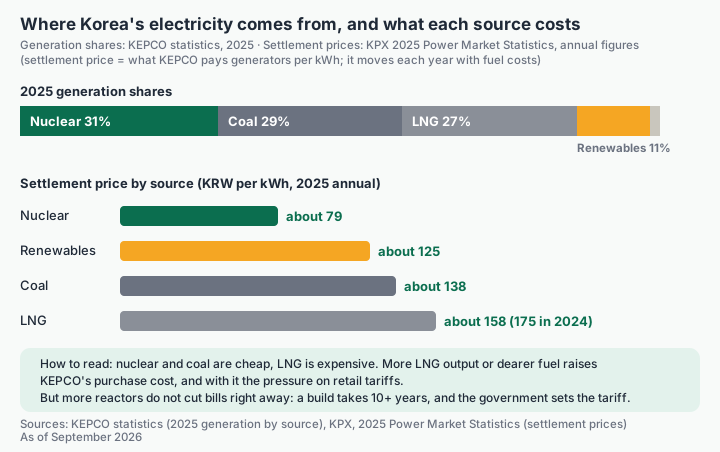
Nuclear is cheap for two reasons: uranium is a small share of the cost of a nuclear kilowatt-hour, and many of Korea’s reactors paid off their construction costs long ago. LNG is expensive because the fuel itself is expensive and its price follows the international market directly.
One honest caveat belongs here. The nuclear settlement price above is for existing reactors whose construction costs have already been recovered. A new reactor carries its construction cost into its generating cost, so its electricity would be more expensive than KRW 79, and forecasts of how much more diverge widely.
What happens at the evening peak
On a heat-wave day the mix changes by the hour. During daylight, solar covers about a quarter of demand. But at the evening peak this year, 7 p.m. on August 7, when demand reached 95.3 GW, renewable output had fallen into the 3 GW range, and LNG and coal plants were ramped up to fill the gap.
Nuclear plants run at a nearly constant output all year, so they have no spare capacity to squeeze out at the peak. For KEPCO, summer is the season when it buys more of its most expensive electricity, and that is the root of the pressure to raise tariffs.
3. So would more nuclear lower the bill?
The honest answer is that it would reduce the pressure in the long run, but not now.
- Why not now: a reactor takes more than ten years to build. A decision made today is a late-2030s story. And Korea’s retail tariff does not track cost directly; it is a policy price the government decides. The clearest example is KEPCO’s accumulated deficit from selling below cost in 2021–2023, about KRW 36 trillion (about $27 billion) on a standalone basis, which is still on the books even after a KRW 13.5 trillion (about $10 billion) profit in 2025.
- Why the pressure falls in the long run: if the cheap source (nuclear) grows and the expensive one (LNG) shrinks in the mix, KEPCO’s average purchase cost falls. Run it the other way, replacing nuclear with LNG, and the purchase cost rises.
- The missing variables: renewable costs keep falling. The cost of expanding the transmission grid (see our post on the grid bottleneck) and the costs of spent fuel and reactor decommissioning (see our Kori-1 decommissioning post) also end up in the bill. No source is free.
This is not a hypothetical. The government is due to publish the draft 12th Basic Plan for Electricity Supply and Demand, its rolling 15-year power plan running to 2040 and the successor to the current 11th plan, in September or October 2026. A public deliberation on whether the plan should include new reactors gets under way in the same two months; we covered its setup in our post on the new-reactor debate.
Whether new reactors would make the bill of the late 2030s lower is an open question, and both sides have a real case. The case for: the existing fleet is the cheapest source in the mix, and replacing it with LNG would raise KEPCO’s purchase cost. The case against: a new reactor’s electricity costs more than the paid-off fleet’s, and the cost of renewables and storage is still falling, so the gap that exists today may not exist when a reactor ordered now comes online.
Where this goes next
Two documents will settle the near-term direction: the draft 12th Basic Plan, expected in September or October, and the outcome of the public deliberation on new reactors running alongside it. For anyone startled by an August bill, the plan being written this fall is the one that shapes the bill ten years from now. The mix of sources in that plan, and the assumptions it makes about construction costs and renewable costs, are what to read first.
Industry note
The listed company at the center of the tariff and energy-mix debate is KEPCO itself (KRX: 015760): a tariff increase is KEPCO’s earnings, and a change in the generation mix changes its purchase-cost structure. If the 12th Basic Plan includes new reactors, the construction supply chain mapped in our Korean nuclear industry map, led by Doosan Enerbility (KRX: 034020) and KEPCO E&C (KRX: 052690), is the part of the market affected; an expansion of LNG and renewables instead would bear on gas and power-equipment companies.
This section is provided to help understand the industry and is not a recommendation to buy or sell any security. Investment decisions and their consequences are the reader’s own.
Sources: KEPCO residential tariff table (2026); KEPCO statistics and monthly power statistics bulletin, 2025 generation by source; Korea Power Exchange, 2025 Power Market Statistics, settlement prices by fuel; Korean government announcements on the 12th Basic Plan for Electricity Supply and Demand (2026)