Korea's nuclear decommissioning market — what the 500-trillion-won headline actually means
Korea's first reactor decommissioning, Kori-1, set off '500-trillion-won market' headlines. What the figure means, who does the work, and why the money is slow.
Data as of September 2, 2026 — statistics, prices, schedules and regulatory status in this article were checked on this date. Where a different date is given in the text, that date takes precedence.
In June 2025, Korea’s nuclear regulator approved the dismantling of a commercial power reactor for the first time. The reactor is Kori-1, near Busan, Korea’s first commercial nuclear plant: it made electricity from 1978 for close to 40 years and was permanently shut down in 2017. Within days, Korean headlines were announcing that “a 500-trillion-won decommissioning market has opened.”
Five hundred trillion won is roughly $370 billion. The number is not invented, but it does not mean what the headlines imply, and the companies that will actually earn from decommissioning are a shorter list than the ones whose shares moved. This post explains what decommissioning is as a job, where the 500-trillion figure comes from and what it leaves out, and who does the work in Korea.
Key takeaways
- Decommissioning is radiation management, not demolition: fuel out, decontaminate, cut and dismantle, sort the waste and restore the site. Kori-1’s version costs about KRW 1,071.3 billion ($790 million) and runs to 2037.
- The “500 trillion won” is a cumulative forecast for the world market over several decades, paid from utilities’ decommissioning reserves, which come from electricity bills. It is not an annual market and it is not Korea’s.
- Korea’s domestic market is one approved project so far, Kori-1, with Wolsong-1 next in line, and no Korean company has completed a commercial reactor decommissioning. Kori-1 is the track record the industry needs before anyone abroad will hire it.
1. Decommissioning is radiation management, not demolition
Taking a reactor apart is closer to a radiation-protection operation than to a construction job run in reverse. The order of work is what makes the difference, and it is the order Kori-1 will follow.
- Fuel removal. Taking the spent fuel out of the plant removes most of the facility’s radioactivity. What remains is the activated material inside structures and components that sat next to the core for decades.
- Decontamination. Surface contamination is stripped with chemicals, high-pressure water or dry-ice blasting.
- Cutting and dismantling. Large components, the reactor vessel and steam generators above all, are cut up with remote equipment and robots, because some areas are not safe for people to work in for long.
- Waste handling and site restoration. The cut-up material is sorted by radioactivity level and disposed of accordingly, and the site is returned to a condition in which it can be reused.
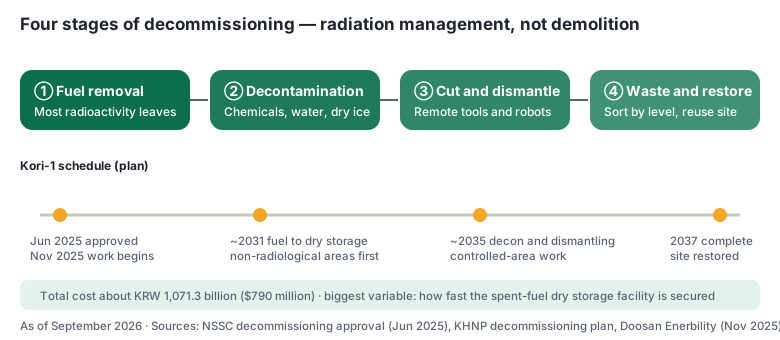
For Kori-1 the program is costed at about KRW 1,071.3 billion, roughly $790 million, on the estimate of its owner KHNP, with completion targeted for 2037. Building a reactor costs trillions of won; taking one down costs on the order of a trillion. That is the first thing the market headline gets right: the sum per plant is real.
2. Kori-1: the only reference project Korea has
Every Korean decommissioning claim will be tested against Kori-1, so it helps to know the schedule. Progress in detail is in our Kori-1 tracker; the short version follows.
- Owner. KHNP (Korea Hydro & Nuclear Power) is the state utility that operates all of Korea’s reactors and a subsidiary of the national utility KEPCO. It owns Kori-1, pays for the work and awards the contracts.
- Approval. The Nuclear Safety and Security Commission (NSSC), Korea’s nuclear regulator, approved the final decommissioning plan in June 2025.
- Work under way. In November 2025 a consortium led by Doosan Enerbility, Korea’s manufacturer of reactor vessels and steam generators, with KEPCO KPS among its members, began dismantling in the non-controlled area, the part of the plant where radiation never exceeded regulatory limits.
- The plan after that. Spent fuel to on-site dry storage by around 2031, decontamination and dismantling of the radiological area by around 2035, and site restoration by 2037.
The item to watch is the dry storage facility for the spent fuel. Until the fuel leaves the pool the reactor building cannot be taken apart, and how quickly that facility is secured is the single biggest variable in the 2037 date.
3. What “500 trillion won” means
The headline figure comes from forecasts of the global decommissioning market that the industry and Korean media cite: several hundred trillion won, about KRW 500 trillion ($370 billion). Three things about it are usually left out.
It is cumulative, over decades. More than 200 reactors worldwide are already permanently shut down, and many operating ones are old, so the pipeline is real. But the forecast adds up spending over several decades, not a market that exists this year, and dividing it among the listed “decommissioning stocks” tells you nothing about anyone’s revenue.
It is paid from reserves, which come from electricity bills. Utilities set money aside for decommissioning while a plant is operating, and KHNP’s Kori-1 budget comes from exactly such a reserve. A growing decommissioning market therefore means consumers’ past contributions being spent, not new money appearing.
Very few countries have done it. The countries with real decommissioning experience are a short list, the United States and Germany among them. Until Korean companies have finished Kori-1 they have no track record to show. That track record is the entry ticket to the overseas market the 500-trillion figure describes.
The same market in one table, as of September 2026:
| Question | Answer |
|---|---|
| How big? | On the order of KRW 500 trillion (about $370 billion), worldwide |
| Over what period? | Several decades, cumulative |
| Who pays? | Utilities’ decommissioning reserves, funded from electricity bills |
| Korea’s share today? | One approved project, Kori-1, about KRW 1,071.3 billion ($790 million) |
4. Why the domestic market is small and slow
Seen from inside the industry, three features of decommissioning work explain why the headline and the reality are so far apart.
Long cycles. One decommissioning takes more than ten years, and a contractor’s revenue is recognized across that period. The distance between “500 trillion” and any company’s annual results is very large.
First-project risk. No Korean company has taken a commercial reactor all the way to a released site. The practical checkpoints are the ones Kori-1 produces: which firms win each contract, and whether the schedule slips.
Headline-driven swings. Whenever decommissioning is in the news, small Korean shares tagged with the theme rise and fall sharply, and the pattern repeats. The useful question is always what a company actually does in the decommissioning chain, which is what the industry note below sets out.
None of this means the market is imaginary. Korea operates 26 reactors and will eventually decommission all of them, and the world has more than 200 shut-down units waiting. It means the market is real, slow and paid in installments, and that the first Korean project is the only evidence available so far.
Where this goes next
The dated events that will move the Korean chapter of this market are all on the Kori-1 site: the contracts that follow the current non-controlled-area work, the licensing of the on-site dry storage that gates the 2031 fuel removal, and whether the 2035 and 2037 milestones hold. For the waste side of the story see our tour of the world’s repositories and reprocessing versus disposal; for where decommissioning sits in the wider Korean industry, see Korea’s nuclear industry map.
Industry note
Companies in Korea’s decommissioning chain, with roles as described in public documents and press reports, as of September 2026. KOSPI is Korea’s main stock market board and KOSDAQ its second board; the codes are for identification only.
| Role | Company | What it does |
|---|---|---|
| Owner | KHNP (unlisted) | KEPCO’s generation subsidiary; owns Kori-1, commissions and manages the decommissioning |
| Main components | Doosan Enerbility (KOSPI: 034020) | Maker of reactor vessels and steam generators; since November 2025, lead contractor for Kori-1 non-controlled-area dismantling in a consortium with KEPCO KPS and others |
| Maintenance crews | KEPCO KPS (KOSPI: 051600) | KEPCO group’s plant maintenance company; its reactor maintenance workforce can be deployed to decommissioning sites |
| Design, licensing | KEPCO E&C (KOSPI: 052690) | KEPCO group’s nuclear plant design firm; decommissioning design and safety assessment |
| Instrumentation | Woojin (KOSPI: 105840) | Major supplier of nuclear plant instrumentation |
| I&C maintenance | Woojin NTec (KOSDAQ: 457550) | Woojin affiliate; maintenance of instrumentation and control equipment, participant in decommissioning demonstration work |
| Radiation services | Orbitech (KOSDAQ: 046120) | Radiation management services and waste clearance, the release of material from regulatory control |
In the United States, BWX Technologies (NYSE: BWXT), long the builder of reactors for the US Navy’s ships, also manages and operates US Department of Energy nuclear sites and carries out environmental cleanup. Much of the large US decommissioning and cleanup work is done by unlisted specialists such as EnergySolutions in consortia with large engineering firms, so pure-play listed decommissioning companies are rarer than the theme suggests.
This section is provided to help understand the industry and is not a recommendation to buy or sell any security. Investment decisions and their consequences are the reader’s own.
Sources: Nuclear Safety and Security Commission (NSSC), decision approving the Kori-1 final decommissioning plan (June 2025); Korea Hydro & Nuclear Power (KHNP), Kori-1 decommissioning plan materials; IAEA and World Nuclear Association data on permanently shut-down reactors and decommissioning; Doosan Enerbility, announcement of the Kori-1 non-controlled-area decommissioning contract (November 2025); Korean press reports (2026).