Barakah at five years: the UAE's Korean-built reactors, by the numbers
Five years after Unit 1 went commercial, Barakah's output, safety record, cost overruns and Korea's export pipeline, checked against primary sources.
Data as of September 22, 2026 — statistics, prices, schedules and regulatory status in this article were checked on this date. Where a different date is given in the text, that date takes precedence.
Drive 53 km west of Ruwais on the UAE’s Gulf coast and four reactor domes rise out of the desert together. All four have been generating power since September 2024. The first of them, Unit 1, passed its fifth anniversary of commercial operation in April 2026, which is the anchor date for this scorecard. What follows checks the plant’s own numbers, and its critics’ numbers, against primary sources.
Key takeaways
- Barakah’s four APR1400 units, contracted in 2009 for $20.4 billion, all reached commercial operation between April 2021 and September 2024. Operator ENEC says the plant now supplies about a quarter of UAE electricity, generating roughly 40 TWh a year.
- Regulator FANR licensed the plant unit by unit after finding more than 400 issues in its 2018 readiness review; construction-era concrete voids in the containment structures, found in 2017–18, were repaired and reviewed by outside experts before any unit loaded fuel.
- The delay pushed completion three to four years past the original 2017–2020 target and inflated the contract by roughly $4 billion; a $1.1 billion cost dispute between Korean state companies KEPCO and KHNP over who absorbs the overrun is now in domestic arbitration.
1. Timeline: from contract to full fleet
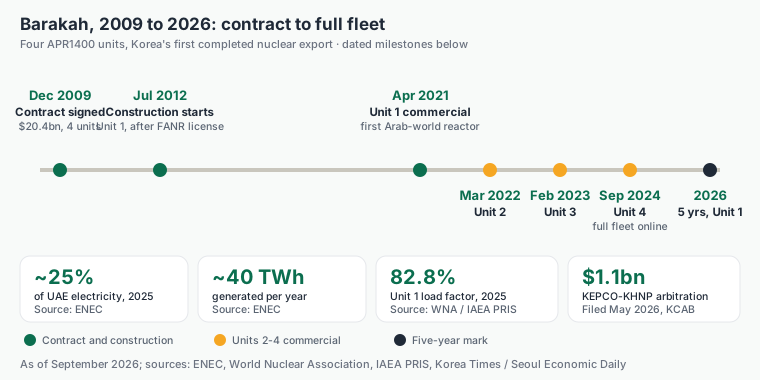
The Emirates Nuclear Energy Corporation (ENEC), the UAE’s state nuclear developer, awarded the Barakah contract on December 27, 2009 to a consortium led by Korea Electric Power Corporation (KEPCO), the South Korean state utility, beating bids from a French Areva-led group and GE-Hitachi. The World Nuclear Association and an OECD Nuclear Energy Agency presentation on the project both put the original contract value at $20.4 billion, covering design, construction and initial fuel loads for four APR1400 reactors, a 1,400 MW-class Korean pressurized-water design.
Construction of Unit 1 began on July 18, 2012, one day after regulator FANR issued a combined construction license for Units 1 and 2. Units 3 and 4 followed under a second license issued in 2014. Grid connection and commercial operation then arrived unit by unit:
| Unit | Construction start | Commercial operation | Net capacity |
|---|---|---|---|
| Unit 1 | July 2012 | April 2021 | 1,337 MW |
| Unit 2 | April 2013 | March 2022 | 1,337 MW |
| Unit 3 | September 2014 | February 2023 | 1,337 MW |
| Unit 4 | July 2015 | September 5, 2024 | 1,337 MW |
Sources: World Nuclear Association reactor database; ENEC/Abu Dhabi Media Office announcements.
“Five years” in this article’s headline refers to Unit 1, which crossed its fifth year of commercial operation in April 2026. The other three units are younger: Unit 4 had generated for barely two years as of this writing. The original schedule, set out around financial close in 2011, had targeted first power for 2017 and full-fleet operation by 2020, so every unit arrived three to four years late.
2. Performance: a quarter of the grid
ENEC said in 2025 that Barakah’s four units together meet about 25 percent of the UAE’s electricity demand and avoid more than 22 million tonnes of carbon dioxide a year, a figure the company has repeated in its one-year full-fleet update and that outside coverage has not contested. Combined output is around 40 TWh annually, and ENEC says the plant had generated more than 120 TWh cumulatively since Unit 1 started, roughly the annual electricity use of New York City by ENEC’s own comparison.
Individual-unit performance data, drawn from the World Nuclear Association’s reactor database (itself sourced from the IAEA’s Power Reactor Information System), shows a ramp typical of a new fleet rather than a flat line. Unit 1’s annual load factor was 85.5 percent in 2021, fell to 70.0 percent in 2022, recovered to 89.6 percent in 2023, peaked at 96.2 percent in 2024, and eased to 82.8 percent in 2025. The 2022 dip lines up with a scheduled refueling and maintenance outage; Nawah, the operating company (82 percent ENEC, 18 percent KEPCO), has not published a detailed outage log in English.
Unit 4, still building an operating history, posted an 83.7 percent load factor for its partial 2024 and 85.5 percent for 2025. A trade-press interview with ENEC in October 2025 cited a 40 percent gain in “efficiencies across timeline, manpower and costs” between Units 1 and 4, without a fuller methodology.
3. Safety and regulation
FANR, the UAE’s Federal Authority for Nuclear Regulation, licenses Barakah unit by unit rather than as a single plant. It issued Unit 1’s operating license in February 2020, nearly eight years after construction began, following an operational-readiness review that FANR itself has said raised more than 400 adverse findings on technical, organizational and management issues — a large number for a first-of-a-kind program, and one reason startup slipped by at least 18 months.
Construction had its own findings. ENEC’s quality process turned up hairline cracks in reactor containment structures in 2017, later confirmed across multiple units, and then concrete voids in Unit 3 (with a minor case in Unit 2) in 2018. ENEC says KEPCO’s teams first flagged the voids and it then notified FANR as license holder; FANR reviewed the repair plan, and an independent concrete expert under contract to ENEC verified the fix, completed by the end of 2018, before Unit 3 loaded fuel.
Areva’s then chief executive, a rival bidder for the original contract and so not a neutral voice, compared the reactor’s safety margins to “a car without airbags and seatbelts.” His complaint pointed to the APR1400’s lack of a core catcher, a device some newer Western designs use to contain molten fuel after a severe accident. The US Nuclear Regulatory Commission’s design review nonetheless found the APR1400 meets US safety requirements, and it has held an NRC design certification since 2019.
Since startup, the IAEA has run Operational Safety Review Team (OSART) missions: a pre-operational review in 2017 and a follow-up mission to Unit 1 in September 2022, which the agency said found operational safety had been strengthened and the 2017 findings addressed, while encouraging the plant to keep using IAEA review services and to carry the lessons into Unit 4, then still under construction. ENEC separately says the plant has hosted more than 42 IAEA and World Association of Nuclear Operators (WANO) peer reviews across its construction and operating life, a figure that comes from the company rather than the IAEA.
Regionally, the plant has drawn a formal objection. In March 2019, Qatar wrote to the IAEA arguing Barakah’s location and design posed risks to Gulf water supplies and regional stability, citing desalination dependency and travel time for any radioactive plume; the UAE’s IAEA representative called the claims false and pointed to its adherence to IAEA safety and non-proliferation standards. The complaint came amid the wider Gulf rift in which the UAE, Saudi Arabia, Egypt and Bahrain had cut ties with Qatar since 2017, and no IAEA finding has since substantiated Doha’s specific safety claims.
4. Economics: delay, overrun and an internal dispute
The contract that was $20.4 billion in 2009 had grown to roughly $24 billion by completion, an increase of close to $4 billion that analysts attribute mainly to the multi-year schedule slip rather than to a single failure. The $24.4 billion financing package, formally closed in October 2016, split into $4.7 billion of equity (82 percent ENEC, 18 percent KEPCO) and $19.6 billion of debt: a $16.2 billion sovereign-guaranteed loan from Abu Dhabi’s Department of Finance, a $2.5 billion export-credit loan from the Export-Import Bank of Korea, and a $250 million commercial tranche. Barakah One, the project company, refinanced part of the Korean debt through First Abu Dhabi Bank and Abu Dhabi Commercial Bank in July 2023.
The delay has since become a dispute inside the Korean camp rather than with the Emirati customer. KHNP, the KEPCO subsidiary that supplied operating staff and support services under an $880 million contract running through 2030, filed a roughly $1 billion arbitration claim against its own parent, KEPCO, at the London Court of International Arbitration in May 2025, arguing it bore extra costs from schedule delays and change orders that KEPCO has not reimbursed. Seoul’s trade ministry then pushed both companies to move the case to the Korea Commercial Arbitration Board instead, citing cost and the risk of exposing reactor technology abroad in a foreign venue. KHNP filed there in May 2026, seeking about $1.1 billion.
KEPCO’s position, reported by Korean outlets, is that any internal settlement should wait until it has recovered costs from the UAE side. It had set aside about 170 billion won (roughly $126 million), around a tenth of the disputed amount, as of mid-2025, and KEPCO’s own Barakah-related returns had turned slightly negative by that point after several profitable years. Nothing in the public record points to a parallel claim by KEPCO or KHNP against ENEC itself.
Operationally, Nawah runs the plant with a workforce Korea helped build from scratch: KHNP has supplied qualified staff through 2030 under that support agreement, and ENEC says more than 2,000 UAE nationals have worked on the program since 2009 as part of a longer Emiratization push, though neither company has published a current breakdown of Korean versus Emirati headcount.
ENEC also argues the economics look better from the demand side: it credits Barakah with more than $9 billion in avoided LNG-import costs and a multi-year low in Abu Dhabi’s gas burn for power. Critics take a different view of the same tradeoff. An OilPrice.com analysis argued the UAE’s abundant solar and wind resources could have delivered similar decarbonization at lower capital risk, a view Gulf-based commentators have echoed given the region’s low utility-scale solar costs.
5. What Barakah bought Korea
Barakah remains Korea’s only completed nuclear export, and its record shaped how the next one was sold. Dukovany, the Czech contract KHNP signed in 2025 for two APR1000 units, is priced and scheduled differently, with construction not due to start until around 2029, partly a reaction to Barakah’s own slip. Whether that caution holds through Dukovany’s build, and what Barakah’s cost and safety record mean for pending bids in Saudi Arabia and elsewhere, is covered in more detail in our project-by-project map of Korea’s nuclear exports.
Where this goes next
The KEPCO-KHNP arbitration is the number to watch this year: its outcome will show, in dollar terms, who inside Team Korea absorbs the cost of a first-of-a-kind delay, and how the two companies price risk on Dukovany and future bids. A second question is quieter but longer-running, whether Nawah’s load factors keep climbing toward a mature four-unit average as the plant banks more years of operating history. Reading the regulatory record for this piece, what stands out to me is how ordinary Barakah’s construction defects were by industry standards; the unusual part was building the plant’s first-of-a-kind program and its safety culture from zero, in a country with no prior reactor, at the same time.
Industry note. Companies named in this article include Korea Electric Power Corporation (KRX: 015760), whose subsidiary KHNP operates Korea’s reactor fleet and, through KHNP, is a party to the Barakah cost arbitration.
This section is provided to help understand the industry and is not a recommendation to buy or sell any security. Investment decisions and their consequences are the reader’s own.
Sources: Emirates Nuclear Energy Corporation (ENEC) and Abu Dhabi Media Office announcements (2024–2025); World Nuclear Association, “Nuclear Power in the United Arab Emirates” and reactor database (Barakah 1–4); OECD Nuclear Energy Agency, Barakah project presentation; Federal Authority for Nuclear Regulation (FANR) license announcements; International Atomic Energy Agency, OSART mission statement (September 2022); Korea Times and Seoul Economic Daily reporting on the KEPCO-KHNP arbitration (2025–2026); Aju Business Daily (Aju Press), August 2025; Power Technology, “Divided opinion: inside the UAE’s Barakah nuclear plant”; OilPrice.com, “UAE’s Nuclear Power Pivot Comes At A High Cost”; Al Jazeera and Gulf News reporting on Qatar’s March 2019 IAEA complaint.