What is the APR1400? Korea's export reactor explained — design, safety systems, track record and cost
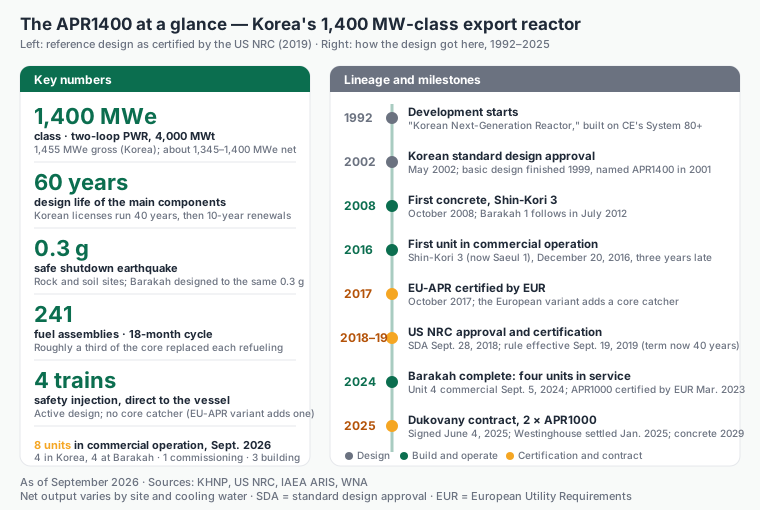
The APR1400 in one page: System 80+ lineage, four-train active safety, NRC and EUR certification, eight units running, and what its cost figures compare with.
Data as of October 2, 2026 — statistics, prices, schedules and regulatory status in this article were checked on this date. Where a different date is given in the text, that date takes precedence.
Eight APR1400 reactors are selling electricity as of September 2026, four in South Korea and four at Barakah in the United Arab Emirates. A ninth, Saeul 3, is in commissioning, three more are under construction in Korea, and two units of its 1,000 MW-class derivative are under contract in Czechia. By our count it is the only large reactor since 2010 exported to a newcomer country and completed by a vendor outside China and Russia, and also a design whose first units took roughly twice as long to build as planned.
This article explains the APR1400 in the order an engineer would ask: origin, key numbers, safety systems and how they differ from the AP1000 and EPR, certifications, build record and cost. The units are listed in our Korean reactor fleet map, the export projects in our export tracker.
Key takeaways
- The APR1400 is a 1,400 MW-class, two-loop pressurized water reactor developed in Korea from 1992 to 2002 out of Combustion Engineering’s System 80+ and Korea’s own OPR1000. Its safety systems are mostly active, in four trains, with a few passive devices; the base design has no core catcher, which only the European EU-APR variant adds.
- It holds a US NRC design certification (effective September 19, 2019, now valid for 40 years under a 2025 rule) and European Utility Requirements certification for the EU-APR (2017) and the APR1000 (2023). None is a license to build on a site.
- Eight units are in commercial operation. From first concrete to commercial operation they took 8 to 11 years against plans of about 5. Published costs, from $20.4 billion for Barakah (2009) to KRW 11.68 trillion for Shin-Hanul 3 and 4, are not on the same basis as Vogtle or Hinkley Point C.
1. Where the design came from
The family tree runs through one American company. In 1987 Korea chose Combustion Engineering’s two-loop System 80 as the basis of its standard plant, which became the OPR1000 (Optimized Power Reactor, 1,000 MW). Combustion Engineering’s next design, the System 80+, received a US NRC certification in June 1997 that expired unused in 2012; Westinghouse, which absorbed the business, licensed it to Korea and, as the NRC’s safety evaluation records, “provided design support to KHNP throughout the design review.”
Korea’s own program began in 1992 as the “Korean Next-Generation Reactor,” a government-led project. The basic design was finished in 1999, the reactor was named APR1400 in February 2001, and the Korean government granted standard design approval in May 2002 (the World Nuclear Association’s profile says May 2003). The first two units, Shin-Kori 3 and 4, now Saeul 1 and 2, were licensed for construction in 2008.
Four variants have followed, none yet built:
- APR+ variant: a 1,500 MW-class stretch with a passive auxiliary feedwater system, Korean standard design approval August 2014.
- EU-APR: the European version with double containment, a core catcher and extra safety-train redundancy, certified against the European Utility Requirements in October 2017.
- US-APR1400: the NRC-certified version, adapted to US rules such as aircraft-impact assessment, in a single-unit layout with a cooling tower.
- APR1000: a 1,000 MW-class design combining the OPR1000’s output with APR1400, APR+ and EU-APR safety features, certified by EUR in March 2023 and chosen for Dukovany 5 and 6.
2. The numbers
The reference design as described in the NRC’s final safety evaluation (2018), the OECD Nuclear Energy Agency’s Multinational Design Evaluation Programme report and the IAEA’s Advanced Reactors Information System:
| Item | APR1400 | Note |
|---|---|---|
| Thermal power | 4,000 MWt | Core output 3,983 MWt plus pump heat |
| Electrical output | 1,400 MW class | 1,455 MWe gross in Korean conditions, about 1,400 MWe gross at Barakah; Barakah units 1,345 MWe net (IAEA PRIS) |
| Primary circuit | 2 loops | 2 steam generators, 4 coolant pumps, 1 pressurizer |
| Fuel | 241 assemblies | Uranium dioxide below 5 percent enrichment |
| Refueling cycle | 18 months or longer | Roughly a third of the core replaced per cycle |
| Design life | 60 years | Vessel, steam generators, pumps, main piping |
| Seismic design | 0.3 g | Safe shutdown earthquake, rock and soil sites; Barakah uses the same 0.3 g on a low-hazard site |
| Containment | Prestressed concrete, steel-lined | Cylinder and dome on a common basemat with the auxiliary building |
| Risk targets | KHNP design goals: core damage below 10⁻⁵ per reactor-year | Large release below 10⁻⁶; the US review’s internal-events figure was 1.1 × 10⁻⁶ for core damage at power |
Two numbers cause most confusion. “1,400” is a class name: gross output is about 1,455 MWe in Korea and about 1,400 MWe at Barakah, and net output after the plant’s own consumption is roughly 1,345–1,400 MWe depending on site. And “60 years” is the design life of major components; Korean operating licenses run 40 years with 10-year extensions.
3. How the safety systems work
The APR1400 is an active-safety design: pumps driven by safety-grade electricity inject water, and diesel generators supply that electricity if the grid is lost. What changed from the System 80+ is the arrangement, plus passive devices where they matter most.
- Four trains of safety injection with direct vessel injection. Four independent pumps, each in its own physically separated division, inject borated water straight into the reactor vessel through four nozzles rather than into the cold-leg piping. Each has 50 percent capacity for the largest pipe break and 100 percent for other design-basis accidents.
- Safety injection tanks with a fluidic device. Four nitrogen-pressurized tanks discharge without power when pressure falls. A passive vortex device in each delivers a high flow while the vessel refills, then a low flow as the tank empties, which let the designers delete the low-pressure injection pumps of earlier plants.
- In-containment refueling water storage tank (IRWST). The emergency water supply sits inside containment, so pumps draw from it continuously with no switchover to the sump; it also condenses steam vented from the pressurizer.
- Severe-accident features. If the core melts through the vessel, valves route IRWST water into the reactor cavity, whose large floor spreads the debris for cooling; the same flooding can cool the vessel from outside. Thirty passive autocatalytic recombiners and ten igniters (eight in the US design) control hydrogen.
What it does not have. The base design has no core catcher, the dedicated structure under the vessel that the EPR uses to collect molten core, and no passive containment cooling of the AP1000 type; the EU-APR adds a core catcher and double containment but has not been built. After Fukushima, Korea spent about KRW 1.1 trillion (about $815 million; KHNP figure via S&P Global Platts) from 2011 to 2017 on fleet-wide measures such as passive hydrogen recombiners, watertight doors on diesel buildings and mobile generators, and the regulator’s review of those recombiners became one cause of the Shin-Hanul 1 delay (section 5).
Compared with the AP1000 and the EPR
Figures are from the World Nuclear Association and the IAEA; “first unit” is the first commercial operation anywhere.
| Feature | APR1400 (Korea) | AP1000 (Westinghouse) | EPR (Framatome) |
|---|---|---|---|
| Output | 1,400 MW class, 2 loops | 1,110–1,170 MWe net, 2 loops | 1,630–1,660 MWe net, 4 loops |
| Safety philosophy | Active, four trains, some passive devices | Passive: gravity and natural circulation, no safety-related pumps, 72 hours without operator action | Active, four separate trains, plus passive elements |
| Molten-core strategy | Cavity flooding and external vessel cooling | In-vessel retention by flooding the vessel exterior | Core catcher below the vessel |
| Containment | Single prestressed concrete, steel-lined | Steel vessel inside a passively cooled shield building | Double containment |
| First unit | Shin-Kori 3, Dec. 2016 | Sanmen 1, China, Sept. 2018 | Taishan 1, China, Dec. 2018 |
None of the three has had a core-damage accident, so this compares analyses, not records; what it shows is a design choice, with the APR1400 keeping the proven active architecture and adding redundancy where the AP1000 removed pumps and the EPR added a catcher.
4. Certifications: what each one means
A design certification says a regulator or utility group has reviewed the standard design; it never authorizes a specific plant. Dates as of September 2026.
| Date | Body | What was granted |
|---|---|---|
| May 2002 | Korean government | Standard design approval |
| Oct. 2017 | EUR organization | EU-APR certified against the European Utility Requirements |
| Sept. 28, 2018 | US NRC | Final safety evaluation and standard design approval |
| Sept. 19, 2019 | US NRC | Design certification rule (10 CFR Part 52, Appendix F) in effect |
| Mar. 2, 2023 | EUR organization | APR1000 certified (applied Nov. 2019) |
| Sept. 15, 2025 | US NRC | Term of all design certifications raised from 15 to 40 years |
KEPCO and KHNP applied to the NRC on December 23, 2014; the NRC docketed the application in March 2015 and finished the review 42 months later. The rule was written to run 15 years, but the NRC’s 2025 rule extended every certification in force to 40 years, so the APR1400’s can be referenced until 2059; a US utility would still need a combined license for a site, and none has applied. The European Utility Requirements are a utility specification, about 4,000 requirements long, not a regulatory approval, and the Czech regulator’s licensing of Dukovany has not begun.
5. Track record: ten units, and how long each took
Every APR1400 so far was built by the same team: KEPCO E&C for design, Doosan Enerbility for the reactor vessel, steam generators and turbine, KEPCO Nuclear Fuel for fuel and Korean builders for civil works, with KHNP as operator in Korea and technical partner in the UAE (see who does what in Korea’s nuclear industry). Construction start is first structural concrete per the IAEA’s PRIS database (ENEC’s timeline dates units 2 and 4 a month or two later).
| Unit | First concrete | Commercial operation | Years |
|---|---|---|---|
| Saeul 1 (Shin-Kori 3) | Oct. 2008 | Dec. 20, 2016 | 8.2 |
| Saeul 2 (Shin-Kori 4) | Aug. 2009 | Aug. 29, 2019 | 10.0 |
| Shin-Hanul 1 | July 2012 | Dec. 7, 2022 | 10.4 |
| Shin-Hanul 2 | June 2013 | Apr. 5, 2024 | 10.8 |
| Saeul 3 | Apr. 2017 | Target Oct. 2026 | 9.5 if met |
| Saeul 4 | Sept. 2018 | Target 2027 | About 9 if met |
| Shin-Hanul 3 | May 2025 | Target 2032 | Plan: 7 |
| Shin-Hanul 4 | May 2026 | Target 2033 | Plan: 7 |
| Unit | First concrete | Commercial operation | Years |
|---|---|---|---|
| Barakah 1 | July 2012 | Apr. 2021 | 8.7 |
| Barakah 2 | Apr. 2013 | Mar. 2022 | 8.9 |
| Barakah 3 | Sept. 2014 | Feb. 2023 | 8.4 |
| Barakah 4 | July 2015 | Sept. 5, 2024 | 9.2 |
The plan for each first unit was about five years: Shin-Kori 3 was due at the end of 2013, Shin-Hanul 1 in April 2017 and Barakah 1 in 2017. The causes, as publicly reported:
- Shin-Kori 3 and 4: falsified cable certificates. In May 2013 the NSSC found that safety-related control cables sold with forged test certificates had been installed at four reactors (Shin-Kori 1 and 2, Shin-Wolsong 1 and 2) and that the same cables, which had failed a retest, were in Shin-Kori 3 and 4; replacing them pushed completion to 2015 and beyond. Unit 4 was then held for seismic reassessment after the Gyeongju (2016) and Pohang (2017) earthquakes.
- Shin-Hanul 1 and 2: post-Fukushima reviews. Fuel loading planned for June 2019 was held while the NSSC (Nuclear Safety and Security Commission, Korea’s regulator) reviewed the passive hydrogen recombiners and asked for measures against aircraft threats; unit 1 was licensed on July 9, 2021.
- Saeul 3 and 4: a political pause and a long review. Construction stopped for three months in 2017 while a citizens’ jury voted on continuing (59.5 percent said yes), and the operating-license review, filed in August 2020, ran more than five years (POWER magazine, September 2026).
- Barakah 1: licensing the operator. Construction was declared complete in March 2018, but the operator Nawah moved start-up to late 2019 or early 2020 to finish operator training and regulatory approvals; the operating license came in February 2020. The concrete voids reported in 2018 were in units 3 and 2, not unit 1, according to ENEC.
In both countries most of the lost years fell between construction completion and the operating license, not in civil construction. Barakah’s four units then arrived about a year apart, the “repeat build” rhythm Korean bidders cite.
6. Cost: what has been published, and what it compares with
Every APR1400 cost figure in circulation comes from a different year, currency, scope and financing structure. As of September 2026:
| Project | Published figure | Basis |
|---|---|---|
| Barakah 1–4 (5.6 GW gross) | About $20.4 billion | 2009 contract value per ENEC and WNA; no final cost published |
| Saeul 3 and 4 (2 × 1,400 MW) | KRW 8.63 trillion (about $6.4 billion) | Expected cost at the 2016 construction permit, per WNA |
| Shin-Hanul 3 and 4 (2 × 1,400 MW) | KRW 11.68 trillion (about $8.7 billion) | Total project cost per Nuclear Engineering International (2024) |
| Dukovany 5 and 6 (2 × about 1,050 MW APR1000) | CZK 407 billion (about $18.6 billion) | Fixed-price contract, June 2025; about CZK 200 billion per unit |
| Vogtle 3 and 4 (2 × about 1,117 MW AP1000) | About $36 billion | Final cost including financing, per POWER (April 2025) |
| Hinkley Point C (2 × about 1,630 MW EPR) | £31–34 billion in 2015 money | EDF’s January 2024 estimate; first unit 2029–2031 |
Read as cost per kilowatt, the Korean budgets work out to roughly $2,300 to $3,100 per kW (each divided by 2,800 MW at about 1,350 won to the dollar; WNA’s 2016-rate conversion gives $2,700 for Saeul 3 and 4). Barakah’s contract value is about $3,600 per kW gross and Dukovany’s about $8,900; Vogtle’s total, which includes years of interest, is about $16,000 per kW, and Hinkley’s midpoint about £10,000 at 2015 prices.
Three caveats stop this from becoming a league table. The Korean figures are owner’s estimates in a system where the utility and designer belong to the same state group, the builders have worked as one repeat team, and labor and financing costs differ from the US and UK; Barakah’s is a 2009 contract price, not an outturn; Vogtle’s is an audited total after a first-of-a-kind build, while Hinkley’s is a forecast. That the APR1400 has cost less per kilowatt in Korea and the UAE than the AP1000 in Georgia or the EPR in Somerset is well supported; a single ratio is not.
7. Open questions
- Westinghouse’s terms. The System 80+ heritage was the basis of Westinghouse’s 2022 lawsuit against KEPCO and KHNP. The settlement of January 16, 2025 dismissed all claims, but its terms are confidential; reported market limits and per-unit payments have not been confirmed by either company. A September 30, 2026 US-Korea framework contemplates a waiver for up to two US APR1400s, reportedly with about $2 billion of value per unit to Westinghouse (Cameco); it names no site, owner or licence application yet (see our report on the package).
- One supplier for the main components. Every APR1400 vessel and steam generator has come from Doosan Enerbility, also contracted for Dukovany and Shin-Hanul 3 and 4 while supplying US SMR developers.
- The APR1000 is unbuilt. Dukovany 5 will be the first anywhere, under a fixed price, so the repeat-build record belongs to the team and the 1,400 MW design, not the unit Czechia bought.
- European regulation. The Czech regulator has yet to license the design, and the European Commission’s state-aid review of the second unit is expected to conclude in early 2027.
- The 60-year claim. No APR1400 is ten years old; Korean licenses run 40 years, and Barakah’s 60-year licenses are the only ones written to the full design life.
Where this goes next
Two dates will test the record within a year: Saeul 3’s commercial operation, targeted for October 2026, and Saeul 4’s operating license, targeted for January 2027, which would bring ten units into service. Beyond Korea, watch whether Czechia’s regulator opens its licensing of the APR1000 in time for a 2029 construction start, and whether any US utility references a certification that now runs to 2059; the history so far says the reactor gets built, and the license is where the years go. For the older units this design will replace, see our Kori 1 decommissioning tracker; for the small reactors competing for the next orders, the 2026 SMR licensing map.
Industry note
The APR1400 supply chain is concentrated in three listed Korean companies: KEPCO (KRX: 015760), prime contractor at Barakah; KEPCO E&C (KRX: 052690), which designed it; and Doosan Enerbility (KRX: 034020), sole supplier to date of the reactor vessel, steam generators and turbine. KHNP is unlisted.
This section is provided to help understand the industry and is not a recommendation to buy or sell any security. Investment decisions and their consequences are the reader’s own.
Sources: US NRC, APR1400 Final Safety Evaluation Report, Chapter 1 (Sept. 2018) and design-certification page; Federal Register, APR1400 Design Certification direct final rule (May 22, 2019) and Revising the Duration of Design Certifications (July 2, 2025, effective Sept. 15, 2025); OECD Nuclear Energy Agency, MDEP Technical Report TR-APR1400-01; IAEA, Advanced Large Water Cooled Reactors, ARIS booklet (2020); World Nuclear Association, Nuclear Power in South Korea, Nuclear Power in the United Arab Emirates and Advanced Nuclear Power Reactors (accessed Sept. 2026); World Nuclear News on the EU-APR EUR certification (Oct. 9, 2017), the APR1000 EUR certification (Mar. 2, 2023), the Shin-Hanul 1 operating permit (July 2021), the Barakah 1 schedule revision (May 29, 2018), the Shin-Hanul 3 and 4 construction contract (Dec. 1, 2023) and Shin-Hanul 3 first concrete (May 28, 2025); Nuclear Engineering International on Shin-Hanul 3 and 4 (2024) and Shin-Kori 4 (2019); POWER magazine, Bringing the APR1400 Reactor to Market (July 2019), Saeul 3’s Nine-Year Nuclear Odyssey (Sept. 1, 2026) and What Was Learned from Building New Nuclear Reactors (Apr. 1, 2025); EDF, Hinkley Point C update (Jan. 23, 2024); ENEC, Barakah plant FAQ; S&P Global Platts on post-Fukushima spending (Mar. 2016); Westinghouse Electric Company settlement announcement (Jan. 16, 2025); KHNP English site, reactor types; KEPCO E&C news on the APR1000 EUR project (June 2020); Asia Economy on the APR1400 development history (Dec. 27, 2009); Kim and Kim, APR1400 Development Status and Design Features, IAEA INIS (2002); Brookfield and Cameco releases and World Nuclear News on the US-Korea nuclear framework (Sept. 30 to Oct. 1, 2026)