What ALARA is, and why the NRC wants to change it
The US NRC wants to delete ALARA, the 'as low as reasonably achievable' rule, from its regulations. What it does, what replaces it, and how Korea compares.
Data as of October 8, 2026 — statistics, prices, schedules and regulatory status in this article were checked on this date. Where a different date is given in the text, that date takes precedence.
At the dentist, before the X-ray, the assistant drapes a heavy lead apron over your chest and neck. The dose from one dental image is a small fraction of any legal limit. So why the apron?
The answer has a name: ALARA, short for “as low as reasonably achievable.” In July 2026 the US Nuclear Regulatory Commission proposed removing that term from its regulations entirely, and took public comment through August 31. This piece lays out what the principle does, what the NRC wants instead, and whether anything changes for a patient in Seoul or in Ohio. (As of October 2026.)
1. The second of three principles
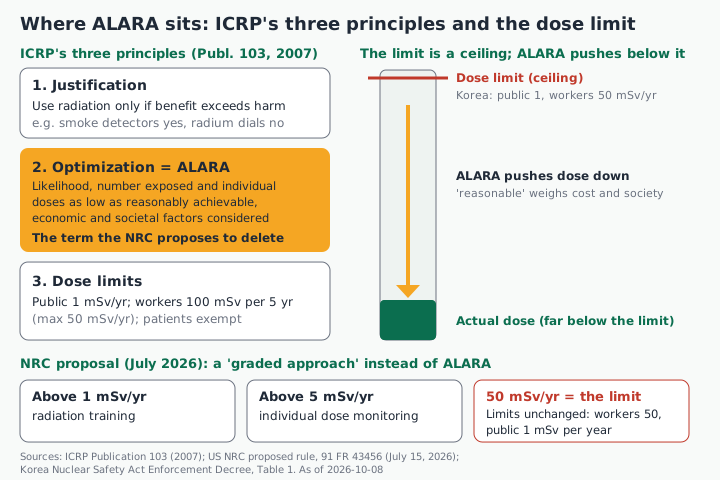
The International Commission on Radiological Protection’s 2007 Recommendations (Publication 103) rest the whole system on three principles.
- Justification: use radiation only when it does more good than harm. Our Korean explainer on smoke detectors (in Korean) is about this one.
- Optimization: the likelihood of exposure, the number of people exposed and the size of their individual doses should all be kept “as low as reasonably achievable, taking into account economic and societal factors.” That sentence is ALARA.
- Dose limits: total dose to an individual from regulated sources must not exceed set values. Patients’ medical exposure is exempt.
A limit is a ceiling. ALARA is the force that works underneath it. The word “reasonably” carries cost and societal factors, so the principle was never “as low as possible,” although its critics argue that in practice it drifted that way.
2. Where ALARA shows up in daily life
Hospitals are the clearest case. Patients have no dose limit, so justification and optimization are the entire system. In Korea, the Korea Disease Control and Prevention Agency (KDCA) reset diagnostic reference levels for 13 CT examination types in May 2022; a reference level sits near the 75th percentile of the patient dose distribution and is a benchmark hospitals check themselves against, not a cap.
For workers the tools are time, distance and shielding. Article 134 of the Enforcement Decree of Korea’s Nuclear Safety Act requires operators to provide radiation shielding and appropriate facility layout, use materials and equipment effective for dose reduction, and secure adequate working space. The shield thicknesses written into a reactor design come from the same principle.
3. What the NRC proposes
The NRC unveiled the rule on July 1, 2026 and published it in the Federal Register on July 15 (91 FR 43456, docket NRC-2025-1140). Comments closed on August 31. The core change is to remove every instance of the term ALARA and replace it with a “graded approach to dose management”: above an expected 100 mrem (1 mSv) per year, workers get radiation training; above 500 mrem (5 mSv), individual dose monitoring; 5 rem (50 mSv) remains the limit.
Two things stay put. The limits themselves, 5 rem a year for workers and 100 mrem (1 mSv) for the public, do not move. And the NRC keeps the linear no-threshold (LNT) model, under which risk falls in proportion to dose all the way to zero, calling it “the most appropriate available consensus model” and noting that “no consensus-supported, regulation-ready alternative model to the LNT model exists at this time.”
The stated problem is subjectivity. The notice says ALARA has “often been applied without a reasonable stopping point,” producing costs “without commensurate public health and safety gains.” Chairman Ho Nieh put it this way: “We’re raising the standard for regulatory clarity, not lowering the standard for safety.” The agency’s analysis estimates industry savings of about $9.53 million a year.
Other provisions ride along. A “planned occupational dose limit extension” would let a worker receive up to 10 rem (100 mSv) in a single year by drawing on unused dose within a five-year, 25 rem (250 mSv) window. The constraint on airborne effluents would rise from 10 to 25 mrem (0.1 to 0.25 mSv) per year; the NRC’s own arithmetic puts the 70-year excess fatal-cancer risk at that constraint at 0.04 and 0.09 cases per 100 people, respectively. Behind all of it sits Executive Order 14300 of May 2025, which told the NRC to reconsider both LNT and ALARA.
4. What critics say, in their own words
The Conference of Radiation Control Program Directors, which represents state regulators, wrote to the Commission on January 23 asking it to weigh the role and value of the ALARA principle, compatibility with state rules, and the consequences for both materials and X-ray programs, and to give state programs a real part in the review.
The Natural Resources Defense Council argued on August 31 that “an unchanged limit is not an unchanged level of protection,” pointing to the notice’s own admission that ALARA “has generally led to low overall radiation doses.” Edwin Lyman of the Union of Concerned Scientists said the change would “allow nuclear facility workers and the general public to be exposed to higher levels of cancer-causing radiation.”
Scientists are split rather than opposed. Nicole Martinez of Clemson University, an ICRP member, sees ALARA as “that sweet spot that’s supposed to be able to account for prevailing circumstances,” while acknowledging a tension between trusting workers’ own judgment and having regulatory mechanisms that guarantee their protection. Kathryn Higley, president of the National Council on Radiation Protection and Measurements, pointed to a side effect of ALARA, workers slowed by protective gear and exposed to heat stress, but said that if ALARA goes, the United States may need to align its unchanged 5 rem worker limit with the international community (ICRP recommends 2 rem a year on average).
Supporters are equally direct. Emily Caffrey, a health physicist at the University of Alabama at Birmingham, told NPR that “‘reasonable’ is too loosey-goosey” and that a number is better. Doug True of the Nuclear Energy Institute said, “It’s not like we’re just going to throw open the doors and let everything run up to the limits.”
5. How Korea compares
Korea’s regulator is the Nuclear Safety and Security Commission (NSSC). Article 91 of the Nuclear Safety Act requires every operator to take “measures necessary to keep the discharge of radioactive materials and radiation exposure dose as low as reasonably achievable.” In other words, ALARA is written into the statute itself, not into a rule beneath it.
The limits sit in Table 1 of the Act’s Enforcement Decree: workers may receive 100 mSv over any five years with no more than 50 mSv in a single year; members of the public, 1 mSv a year. The worker limit is tighter than the American one, which allows 50 mSv every year. I found no sign of a comparable rulemaking in Korea.
6. What changes for you
Nothing, at the CT scanner. Patient exposure is managed everywhere by justification and optimization rather than limits, and an American rule does not reach a hospital in Busan or Berlin. Our Korean post on the dose from one CT (in Korean) still reads the same.
The dispute is about the cost of “how low.” Risk at these doses is too small to detect in individual studies, a point we explored in the radon spa and hormesis piece, so whether another dollar of shielding is worth spending is not a question science alone can settle. Having studied radiation protection, what strikes me is that both camps start from the same fact. Actual doses have sat far below the limits for decades, and nobody disputes that ALARA is what put them there. The open question is whether that outcome survives without the words.
Where this goes next
The NRC must respond to significant comments before issuing a final rule; NPR reported in late August that it could take effect early next year, that is, in 2027. Watch for three things in the final text: whether the 500 mrem monitoring trigger moves, whether the effluent constraint stays at 25 mrem, and whether Agreement States that want to keep ALARA are allowed to.
Health note — This article is general information from a radiation-protection perspective and does not replace medical advice.
Sources: US NRC press release No. 26-070 (July 1, 2026); Federal Register, “Reforming and Modernizing the NRC’s Radiation Protection Framework,” 91 FR 43456 (July 15, 2026), docket NRC-2025-1140; ANS Nuclear Newswire (July 13, 2026); NPR and Michigan Public (Aug. 27, 2026); Associated Press (July 26, 2026); CRCPD letter to the Commission (Jan. 23, 2026, as summarized in the FRMAC Partner Update of Jan. 28, 2026); NRDC comments (Aug. 31, 2026); Union of Concerned Scientists statement (July 2, 2026); ICRP Publication 103 (2007); Korea Nuclear Safety Act Article 91 and Enforcement Decree Articles 2 and 134 and Table 1 (Korea Law Information Center); KDCA CT diagnostic reference levels (Digital Daily, May 24, 2022) and DRL definition (Medical Times, Sept. 20, 2019).